Meyer Travis A, Quinto Christopher A, Bao Gang
Wallace H Coulter Department of Biomedical Engineering, Georgia Institute of Technology and Emory University, Atlanta, GA 30322, USA.
Department of Bioengineering, Rice University, Houston, TX 77030, USA.
IEEE Magn Lett. 2016;7. doi: 10.1109/lmag.2015.2508006. Epub 2015 Dec 11.
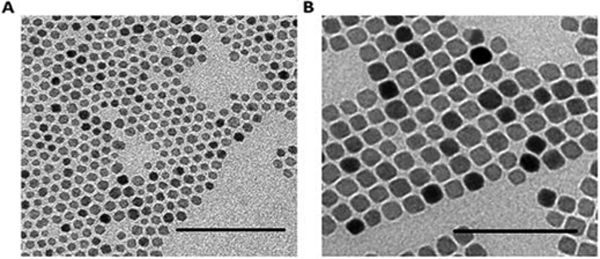
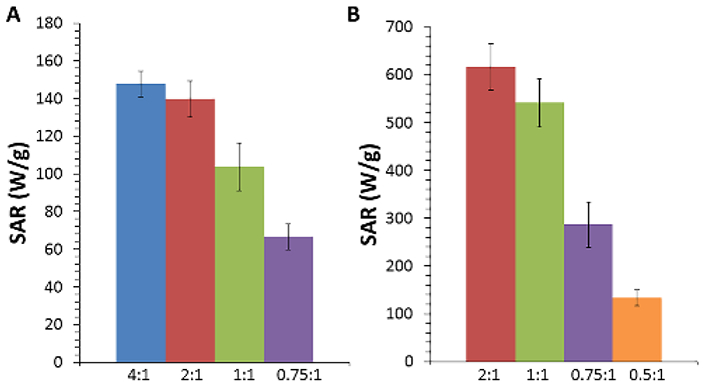
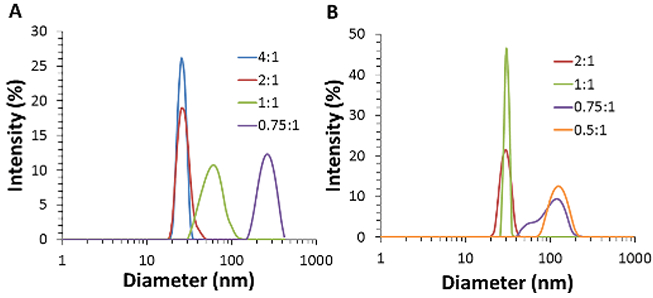
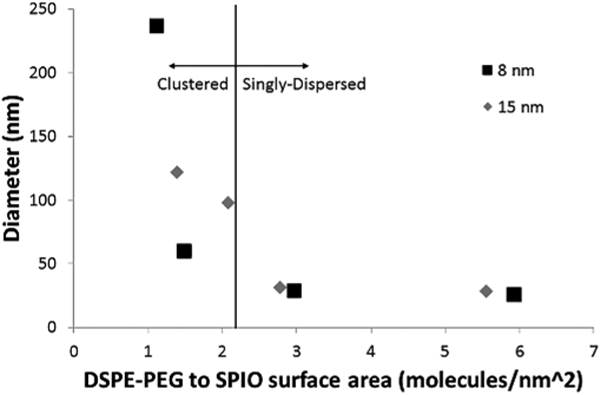
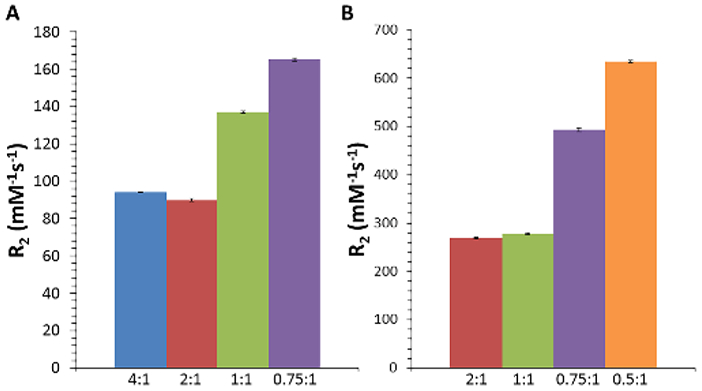
Superparamagnetic iron oxide nanoparticles (SPIOs) have considerable promise for magnetic resonance imaging, drug/gene delivery, and hyperthermia applications. It has been shown recently that self-assembly of SPIOs into large superstructures can have a significant impact on their magnetic properties and functionality. In this work, we developed a novel method for controlling the clustering of SPIOs with two different core sizes (8 nm and 15 nm) by varying the amount of amphiphilic coating molecules used during the dual solvent exchange coating process. We show that hydrodynamic size and T relaxivity can be increased using this approach, while the specific absorption rate is decreased. These results demonstrate a new, simple method for triggering the self-assembly of SPIO clusters using commercially available and biocompatible phospholipid-poly(ethylene glycol) conjugates.
超顺磁性氧化铁纳米颗粒(SPIOs)在磁共振成像、药物/基因递送和热疗应用方面具有巨大潜力。最近的研究表明,SPIOs自组装成大型超结构会对其磁性能和功能产生重大影响。在这项工作中,我们开发了一种新方法,通过改变双溶剂交换涂层过程中使用的两亲性涂层分子的量,来控制两种不同核心尺寸(8纳米和15纳米)的SPIOs的聚集。我们表明,使用这种方法可以增加流体动力学尺寸和T弛豫率,同时降低比吸收率。这些结果证明了一种新的、简单的方法,可利用市售且具有生物相容性的磷脂 - 聚(乙二醇)共轭物触发SPIO簇的自组装。