Choi Yoo Jin, Yoon Woongchang, Lee Areum, Han Youngmin, Byun Yoonhyeong, Kang Jae Seung, Kim Hongbeom, Kwon Wooil, Suh Young-Ah, Kim Yongkang, Lee Seungyeoun, Namkung Junghyun, Han Sangjo, Choi Yonghwan, Heo Jin Seok, Park Joon Oh, Park Joo Kyung, Kim Song Cheol, Kang Chang Moo, Lee Woo Jin, Park Taesung, Jang Jin-Young
Department of Surgery and Cancer Research Institute, Seoul National University College of Medicine, Seoul, Korea.
Bio-MAX/N-Bio Institute, Seoul National University, Seoul, Korea.
Ann Surg Treat Res. 2021 Mar;100(3):144-153. doi: 10.4174/astr.2021.100.3.144. Epub 2021 Feb 26.
Diagnostic biomarkers of pancreatic ductal adenocarcinoma (PDAC) have been used for early detection to reduce its dismal survival rate. However, clinically feasible biomarkers are still rare. Therefore, in this study, we developed an automated multi-marker enzyme-linked immunosorbent assay (ELISA) kit using 3 biomarkers (leucine-rich alpha-2-glycoprotein [LRG1], transthyretin [TTR], and CA 19-9) that were previously discovered and proposed a diagnostic model for PDAC based on this kit for clinical usage.
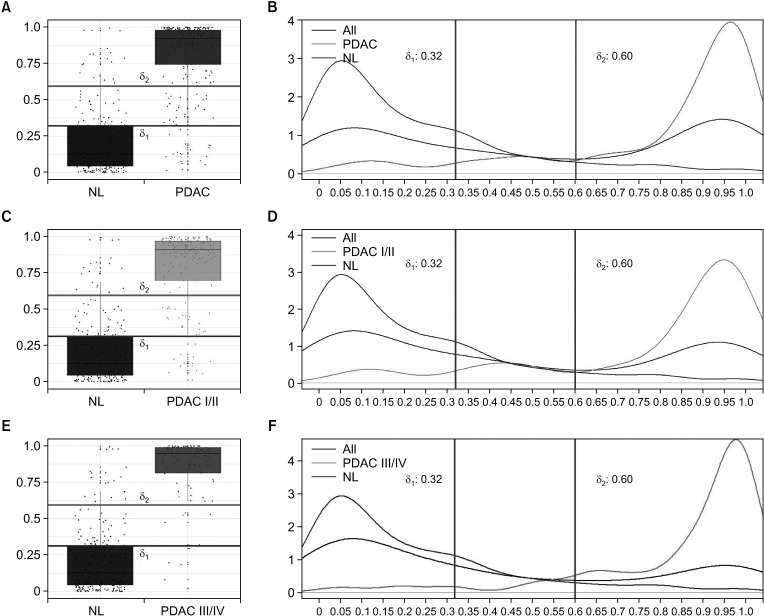
Individual LRG1, TTR, and CA 19-9 panels were combined into a single automated ELISA panel and tested on 728 plasma samples, including PDAC (n = 381) and normal samples (n = 347). The consistency between individual panels of 3 biomarkers and the automated multi-panel ELISA kit were accessed by correlation. The diagnostic model was developed using logistic regression according to the automated ELISA kit to predict the risk of pancreatic cancer (high-, intermediate-, and low-risk groups).
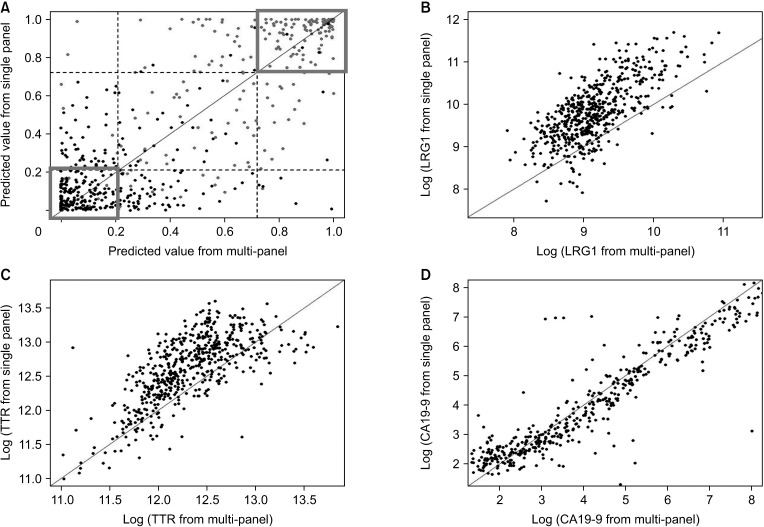
The Pearson correlation coefficient of predicted values between the triple-marker automated ELISA panel and the former individual ELISA was 0.865. The proposed model provided reliable prediction results with a positive predictive value of 92.05%, negative predictive value of 90.69%, specificity of 90.69%, and sensitivity of 92.05%, which all simultaneously exceed 90% cutoff value.
This diagnostic model based on the triple ELISA kit showed better diagnostic performance than previous markers for PDAC. In the future, it needs external validation to be used in the clinic.
胰腺导管腺癌(PDAC)的诊断生物标志物已被用于早期检测,以降低其令人沮丧的生存率。然而,临床上可行的生物标志物仍然很少。因此,在本研究中,我们使用先前发现的3种生物标志物(富含亮氨酸的α-2-糖蛋白[LRG1]、转甲状腺素蛋白[TTR]和CA 19-9)开发了一种自动化多标志物酶联免疫吸附测定(ELISA)试剂盒,并基于该试剂盒提出了一种用于临床的PDAC诊断模型。
将单个LRG1、TTR和CA 19-9检测板组合成一个自动化ELISA检测板,并在728份血浆样本上进行测试,包括PDAC样本(n = 381)和正常样本(n = 347)。通过相关性评估3种生物标志物的单个检测板与自动化多检测板ELISA试剂盒之间的一致性。根据自动化ELISA试剂盒,使用逻辑回归开发诊断模型,以预测胰腺癌的风险(高风险、中风险和低风险组)。
三联标志物自动化ELISA检测板与之前的单个ELISA检测板预测值的Pearson相关系数为0.865。所提出的模型提供了可靠的预测结果,阳性预测值为92.05%,阴性预测值为90.69%,特异性为90.69%,敏感性为92.05%,所有这些均同时超过90%的临界值。
基于三联ELISA试剂盒的这种诊断模型显示出比先前的PDAC标志物更好的诊断性能。未来,它需要进行外部验证才能用于临床。