Department of Ophthalmology, Taipei Tzu-chi Hospital, New Taipei City 231, Taiwan.
Department of Ophthalmology, Tzu-chi University, Huanlien County 907, Taiwan.
Int J Environ Res Public Health. 2020 Mar 17;17(6):1967. doi: 10.3390/ijerph17061967.
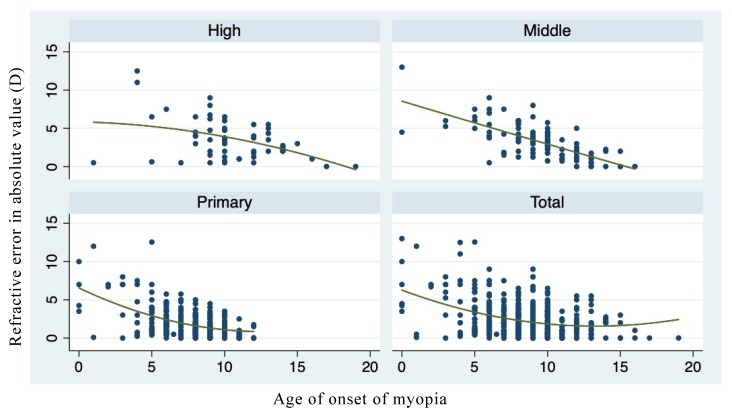
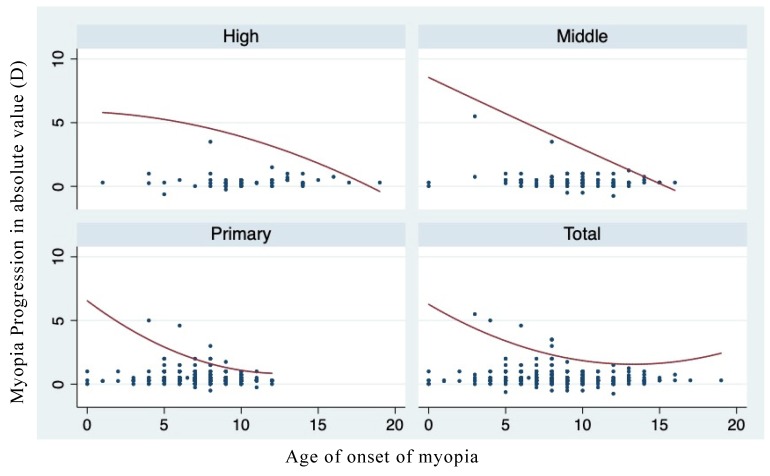
Because of the high prevalence of myopia in Taiwan, understanding the risk factors for its development and progression is important to public health. This study investigated the risk factors for myopia and their influence on the progression of myopia in schoolchildren in Taiwan. Patients' clinical records were obtained retrospectively from ophthalmologists. Questionnaires were given to collect demographic information, family background, hours spent on daily activities, myopia progression, and treatment methods. From a regional medical hospital in northern Taiwan, 522 schoolchildren with myopia participated in the study. Written informed consent was obtained from participants of legal age or the parents or legal guardians of younger children. Multivariable regression analyses were performed. Myopia measured in cycloplegic spherical equivalent (SE) was analysed, controlling for patients' family and demographic information as well as their daily activity behaviours. Children with high myopic parents were more myopic. Earlier onset age of myopia was associated with a higher level of myopia and greater annual myopic progression. Children reporting longer time usage of electronic devices had greater progression of myopia. Boys tended to be more myopic than girls. Lower levels of myopia were associated with more outdoor activities, and better vision care knowledge in children and parents. In addition to genetics, education and environment can influence the development of myopia. Health policies for schoolchildren should promote protective activities and vision care knowledge at a young age, to protect the eyesight of schoolchildren.
由于台湾地区近视的高发率,了解近视发展和进展的风险因素对公共卫生非常重要。本研究调查了近视的风险因素及其对台湾地区学童近视进展的影响。通过回顾性收集眼科医生的临床记录,获取患者的临床记录。此外,还通过问卷调查收集了人口统计学信息、家族背景、日常活动时间、近视进展情况和治疗方法等信息。本研究共纳入了来自台湾北部一家地区医疗中心的 522 名近视患儿。对于法定年龄的参与者或未成年的父母或法定监护人,我们获得了书面知情同意。然后,我们进行了多变量回归分析。在控制了患者的家庭和人口统计学信息以及日常活动行为后,我们对睫状肌麻痹等效球镜(SE)进行了分析。有高度近视父母的孩子更近视。近视发病年龄越早,近视程度越高,年近视进展越大。报告电子设备使用时间较长的儿童近视进展更快。男孩比女孩更近视。户外活动时间多、儿童和家长的视力保健知识水平高,近视程度较低。除了遗传因素外,教育和环境也会影响近视的发展。针对学童的健康政策应在年轻时就提倡开展保护活动和视力保健知识,以保护学童的视力。