Universidade Municipal de São Caetano do Sul, São Caetano do Sul, Brazil.
ABC Center for Mental Health Studies, Santo André, Brazil.
Front Public Health. 2021 Mar 4;9:634396. doi: 10.3389/fpubh.2021.634396. eCollection 2021.
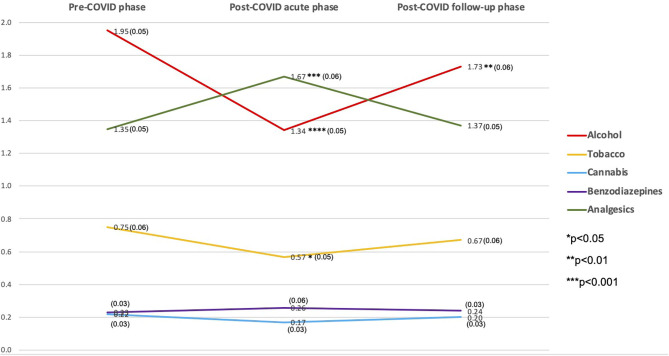
There is a need for prospective studies investigating substance use variations in mild COVID-19 patients. These individuals represent the majority of patients affected by the disease and are routinely treated at home, facing periods of quarantine. This was a retrospective cohort study. All people who tested positive for COVID-19 and classified as mild cases (i.e., no alarm sign/symptom, no need for in-person consultation) during the treatment in the public health system of a Brazilian city with around 160,000 inhabitants were monitored by phone for all the COVID-19 symptoms listed by the Centers for Disease Control and Prevention (CDC) during the active phase of the disease (i.e., no longer experiencing symptoms, up to 14 days in mild cases). After this phase (median = 108 days after intake, IQR = 76-137), we asked these patients who were classified as experiencing mild COVID-19 ( = 993) about last-month substance use in three time-points: pre-COVID, just after COVID-19 acute phase (post-COVID acute phase) and in the period before survey (post-COVID follow-up phase). The number of COVID-19 symptoms was not associated with pre- or post-infection substance use. Pre-COVID alcohol and non-medical benzodiazepine use were associated with specific COVID-19 symptoms. However, sensitivity analyses showed that such associations could be explained by previous psychiatric and medical profiles. Alcohol and tobacco use decreased and non-medical analgesics increased in the post-COVID acute phase. However, just alcohol use remained lower in the post-COVID follow-up period. Higher pre-COVID levels of tobacco and alcohol were associated with post-COVID follow-up cannabis and non-medical analgesic use, respectively. Non-medical benzodiazepine use had positive and negative bi-directional associations with cannabis and non-medical analgesic use, respectively. We were not able to find specific associations between substance use and COVID-19 symptomatology in the present study. Patients with mild COVID-19 should be monitored for substance use in the post-COVID-19 period, and preventive interventions for non-medical analgesic use should be implemented. Focused preventive interventions increasing the perceived risks of cannabis and non-medical benzodiazepine and analgesic use among people experiencing mild COVID-19 that reported previous substance use could be useful.
需要前瞻性研究来调查轻度 COVID-19 患者的物质使用变化。这些人代表了受疾病影响的大多数患者,他们通常在家中接受治疗,面临隔离期。这是一项回顾性队列研究。在巴西一个拥有约 16 万居民的城市的公共卫生系统中,对所有 COVID-19 检测呈阳性并被归类为轻症病例(即无警报症状/体征,无需亲自就诊)的人进行了电话监测,以监测疾病活跃期(即不再有症状,轻症病例持续 14 天)列出的所有 COVID-19 症状。在这一阶段之后(中位数=摄入后 108 天,IQR=76-137),我们询问了这些被归类为经历轻度 COVID-19 的患者(=993 人)在三个时间点的上月物质使用情况:COVID-19 之前、COVID-19 急性期之后(COVID-19 急性后)和调查前(COVID-19 随访期)。COVID-19 症状的数量与感染前或感染后的物质使用无关。COVID-19 前酒精和非医疗用苯二氮䓬类药物的使用与特定的 COVID-19 症状有关。然而,敏感性分析表明,这些关联可能可以通过以前的精神和医疗概况来解释。COVID-19 急性后,酒精和烟草的使用减少,非医疗性镇痛药的使用增加。然而,在 COVID-19 随访期间,酒精的使用仍然较低。COVID-19 前较高的烟草和酒精水平分别与 COVID-19 随访期间大麻和非医疗性镇痛药的使用有关。非医疗用苯二氮䓬类药物的使用与大麻和非医疗性镇痛药的使用呈正双向关联。在本研究中,我们未能发现物质使用与 COVID-19 症状之间的特定关联。轻度 COVID-19 患者应在 COVID-19 后期间监测物质使用情况,并应实施非医疗性镇痛药使用的预防干预措施。在报告以前有物质使用史的经历轻度 COVID-19 的人群中,实施重点预防干预措施,增加对大麻和非医疗用苯二氮䓬类药物和镇痛药使用的感知风险,可能会有所帮助。