Human Nature Lab, Department of Sociology, Yale University, New Haven, CT, USA.
Yale College, New Haven, CT, USA.
Addict Behav. 2022 Apr;127:107213. doi: 10.1016/j.addbeh.2021.107213. Epub 2021 Dec 18.
We conducted a scoping review focused on various forms of substance use amid the pandemic, looking at both the impact of substance use on COVID-19 infection, severity, and vaccine uptake, as well as the impact that COVID-19 has had on substance use treatment and rates.
A scoping review, compiling both peer-reviewed and grey literature, focusing on substance use and COVID-19 was conducted on September 15, 2020 and again in April 15, 2021 to capture any new studies. Three bibliographic databases (Web of Science Core Collection, Embase, PubMed) and several preprint servers (EuropePMC, bioRxiv, medRxiv, F1000, PeerJ Preprints, PsyArXiv, Research Square) were searched. We included English language original studies only.
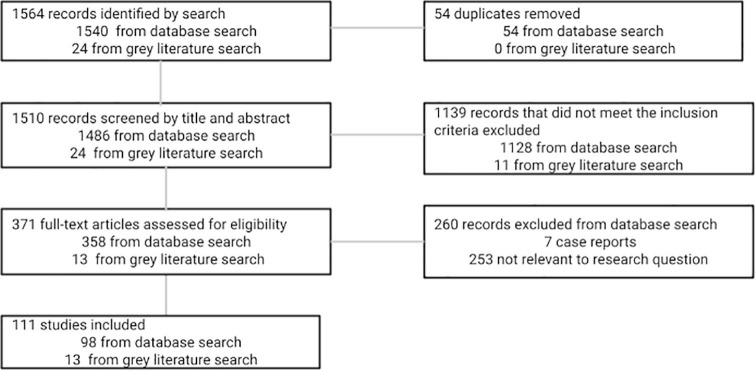
Of 1564 articles screened in the abstract and title screening phase, we included 111 research studies (peer-reviewed: 98, grey literature: 13) that met inclusion criteria. There was limited research on substance use other than those involving tobacco or alcohol. We noted that individuals engaging in substance use had increased risk for COVID-19 severity, and Black Americans with COVID-19 and who engaged in substance use had worse outcomes than white Americans. There were issues with treatment provision earlier in the pandemic, but increased use of telehealth as the pandemic progressed. COVID-19 anxiety was associated with increased substance use.
Our scoping review of studies to date during COVID-19 uncovered notable research gaps namely the need for research efforts on vaccines, COVID-19 concerns such as anxiety and worry, and low- to middle-income countries (LMICs) and under-researched topics within substance use, and to explore the use of qualitative techniques and interventions where appropriate. We also noted that clinicians can screen and treat individuals exhibiting substance use to mitigate effects of the pandemic.
Study was funded by the Institution for Social and Policy Studies, Yale University and The Horowitz Foundation for Social Policy. DH was funded by a NIDA grant (R01DA048860). The funding body had no role in the design, analysis, or interpretation of the data in the study.
我们进行了一项范围综述,重点关注大流行期间各种形式的物质使用,既关注物质使用对 COVID-19 感染、严重程度和疫苗接种的影响,也关注 COVID-19 对物质使用治疗和率的影响。
2020 年 9 月 15 日和 2021 年 4 月 15 日,我们进行了一项范围综述,综合了同行评议和灰色文献,重点关注物质使用和 COVID-19,以捕捉任何新的研究。我们检索了三个书目数据库(Web of Science 核心合集、Embase、PubMed)和几个预印本服务器(EuropePMC、bioRxiv、medRxiv、F1000、PeerJ 预印本、PsyArXiv、Research Square)。我们只纳入了英语原始研究。
在摘要和标题筛选阶段,我们筛选了 1564 篇文章,纳入了 111 项符合纳入标准的研究(同行评议:98 项,灰色文献:13 项)。除了涉及烟草或酒精的物质使用外,关于其他物质使用的研究有限。我们注意到,从事物质使用的人感染 COVID-19 的严重程度增加,患有 COVID-19 且从事物质使用的美国黑人比美国白人的结局更差。大流行早期在治疗方面存在问题,但随着大流行的发展,远程医疗的使用增加。COVID-19 焦虑与物质使用增加有关。
我们对 COVID-19 期间迄今为止的研究进行了范围综述,发现了显著的研究差距,即需要在疫苗方面开展研究工作,关注 COVID-19 相关问题,如焦虑和担忧,以及中低收入国家(LMICs)和物质使用中研究不足的主题,并探索在适当情况下使用定性技术和干预措施。我们还注意到,临床医生可以对表现出物质使用的个体进行筛查和治疗,以减轻大流行的影响。
该研究由耶鲁大学社会与政策研究所和霍洛威茨社会政策基金会资助。DH 由 NIDA 资助(R01DA048860)。资助机构在研究中没有参与数据的设计、分析或解释。