van Gijtenbeek Lieke A, Eckhardt Thomas H, Herrera-Domínguez Lucía, Brockmann Elke, Jensen Kristian, Geppel Asger, Nielsen Kristian Fog, Vindeloev Jannik, Neves Ana Rute, Oregaard Gunnar
R&D, Chr. Hansen A/S, Hørsholm, Denmark.
Front Bioeng Biotechnol. 2021 Mar 3;9:622835. doi: 10.3389/fbioe.2021.622835. eCollection 2021.
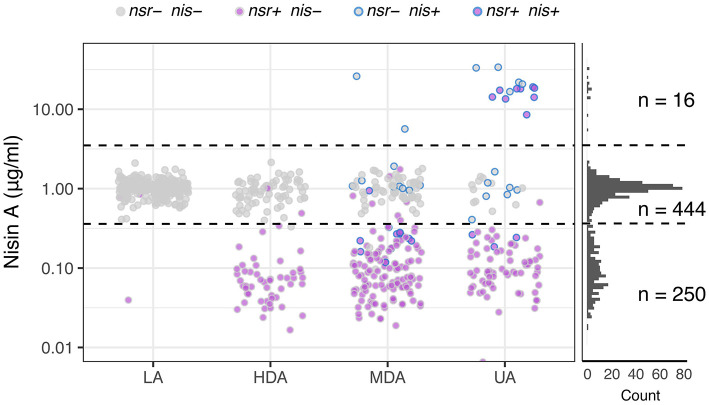
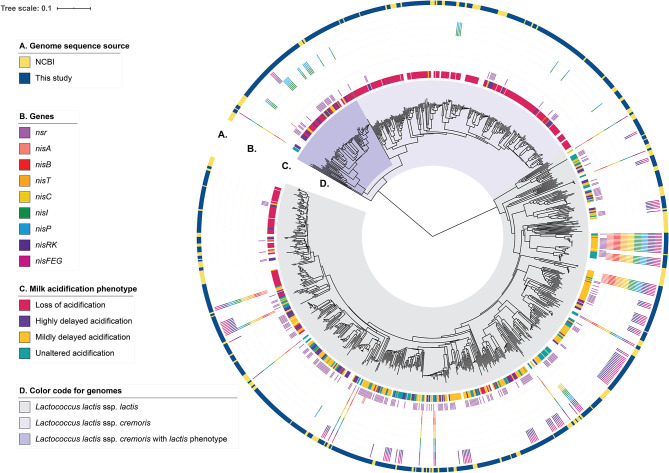
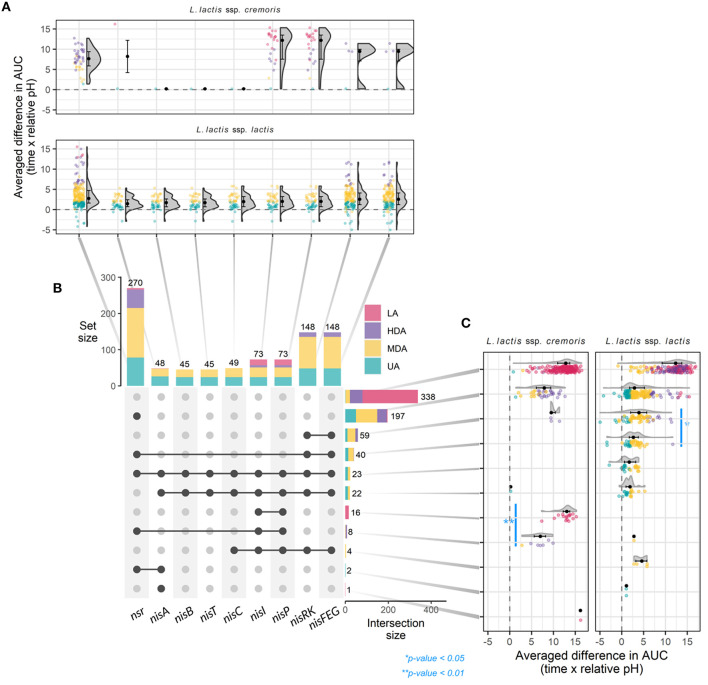
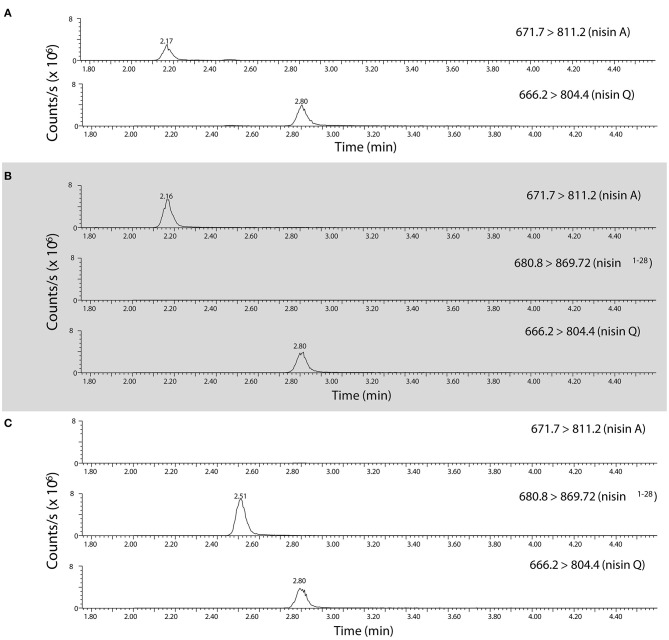
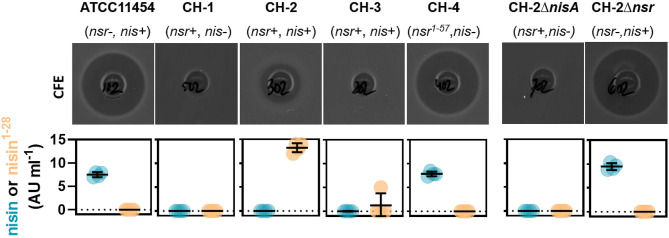
cheese starter cultures typically contain a mix of many strains and may include variants that produce and/or tolerate the antimicrobial bacteriocin nisin. Nisin is well-established as an effective agent against several undesirable Gram-positive bacteria in cheese and various other foods. In the current study, we have examined the effect of nisin on 710 individual strains during milk fermentations. Changes in milk acidification profiles with and without nisin exposure, ranging from unaltered acidification to loss of acidification, could be largely explained by the type(s) and variants of nisin immunity and nisin degradation genes present, but surprisingly, also by genotypic lineage ( ssp. vs. ssp. ). Importantly, we identify that nisin degradation by NSR is frequent among and therefore likely the main mechanism by which dairy-associated strains tolerate nisin. Insights from this study on the strain-specific effect of nisin tolerance and degradation during milk acidification is expected to aid in the design of nisin-compatible cheese starter cultures.
奶酪发酵剂通常包含多种菌株的混合物,可能包括产生和/或耐受抗菌细菌素乳酸链球菌素的变体。乳酸链球菌素是一种公认的有效剂,可对抗奶酪和其他各种食品中的几种不良革兰氏阳性菌。在本研究中,我们研究了乳酸链球菌素在牛奶发酵过程中对710个单独菌株的影响。有无乳酸链球菌素暴露时牛奶酸化曲线的变化,从未改变的酸化到酸化丧失,在很大程度上可以由存在的乳酸链球菌素免疫和乳酸链球菌素降解基因的类型和变体来解释,但令人惊讶的是,也可以由基因型谱系(亚种与亚种)来解释。重要的是,我们发现NSR对乳酸链球菌素的降解在……中很常见,因此可能是与乳制品相关的……菌株耐受乳酸链球菌素的主要机制。这项关于牛奶酸化过程中乳酸链球菌素耐受性和降解的菌株特异性效应的研究结果,有望有助于设计与乳酸链球菌素兼容的奶酪发酵剂。