Girard Dorothée, Torossian Frédéric, Oberlin Estelle, Alexander Kylie A, Gueguen Jules, Tseng Hsu-Wen, Genêt François, Lataillade Jean-Jacques, Salga Marjorie, Levesque Jean-Pierre, Le Bousse-Kerdilès Marie-Caroline, Banzet Sébastien
INSERM UMRS-MD 1197, Institut de Recherche Biomédicale des Armées (IRBA), Clamart, France.
INSERM UMRS-MD 1197, Université Paris-Saclay, Hôpital Paul Brousse, Villejuif, France.
Front Cell Dev Biol. 2021 Mar 5;9:611842. doi: 10.3389/fcell.2021.611842. eCollection 2021.
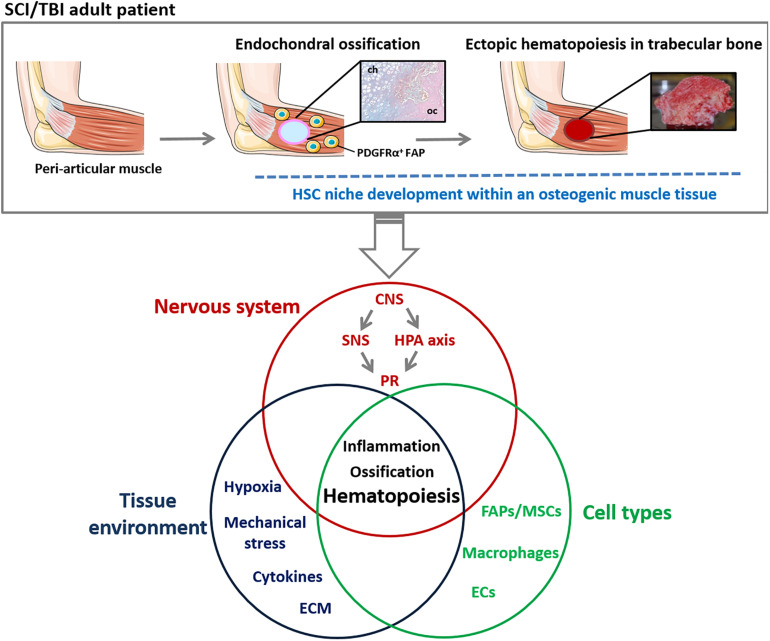
Hematopoiesis and bone interact in various developmental and pathological processes. Neurogenic heterotopic ossifications (NHO) are the formation of ectopic hematopoietic bones in peri-articular muscles that develop following severe lesions of the central nervous system such as traumatic cerebral or spinal injuries or strokes. This review will focus on the hematopoietic facet of NHO. The characterization of NHO demonstrates the presence of hematopoietic marrow in which quiescent hematopoietic stem cells (HSC) are maintained by a functional stromal microenvironment, thus documenting that NHOs are neo-formed ectopic HSC niches. Similarly to adult bone marrow, the NHO permissive environment supports HSC maintenance, proliferation and differentiation through bidirectional signaling with mesenchymal stromal cells and endothelial cells, involving cell adhesion molecules, membrane-bound growth factors, hormones, and secreted matrix proteins. The participation of the nervous system, macrophages and inflammatory cytokines including oncostatin M and transforming growth factor (TGF)-β in this process, reveals how neural circuitry fine-tunes the inflammatory response to generate hematopoietic bones in injured muscles. The localization of NHOs in the peri-articular muscle environment also suggests a role of muscle mesenchymal cells and bone metabolism in development of hematopoiesis in adults. Little is known about the establishment of bone marrow niches and the regulation of HSC cycling during fetal development. Similarities between NHO and development of fetal bones make NHOs an interesting model to study the establishment of bone marrow hematopoiesis during development. Conversely, identification of stage-specific factors that specify HSC developmental state during fetal bone development will give more mechanistic insights into NHO.
造血与骨骼在各种发育和病理过程中相互作用。神经源性异位骨化(NHO)是在中枢神经系统严重损伤(如创伤性脑损伤或脊髓损伤或中风)后,在关节周围肌肉中形成异位造血骨。本综述将聚焦于NHO的造血方面。NHO的特征表明存在造血骨髓,其中静止的造血干细胞(HSC)由功能性基质微环境维持,从而证明NHO是新形成的异位HSC龛。与成年骨髓类似,NHO的允许环境通过与间充质基质细胞和内皮细胞的双向信号传导来支持HSC的维持、增殖和分化,涉及细胞粘附分子、膜结合生长因子、激素和分泌的基质蛋白。神经系统、巨噬细胞和炎性细胞因子(包括制瘤素M和转化生长因子(TGF)-β)参与这一过程,揭示了神经回路如何微调炎症反应以在受伤肌肉中生成造血骨。NHO在关节周围肌肉环境中的定位也表明肌肉间充质细胞和骨代谢在成人造血发育中的作用。关于胎儿发育过程中骨髓龛的建立和HSC循环的调节知之甚少。NHO与胎儿骨骼发育的相似性使NHO成为研究发育过程中骨髓造血建立的有趣模型。相反,鉴定在胎儿骨骼发育过程中指定HSC发育状态的阶段特异性因子将为NHO提供更多的机制性见解。