Tissue Engineering, Department of Biomedicine, University Hospital Basel, University of Basel, Basel, Switzerland.
Wellcome Trust-Medical Research Council Cambridge Stem Cell Institute, Cambridge, United Kingdom.
Front Immunol. 2020 May 20;11:956. doi: 10.3389/fimmu.2020.00956. eCollection 2020.
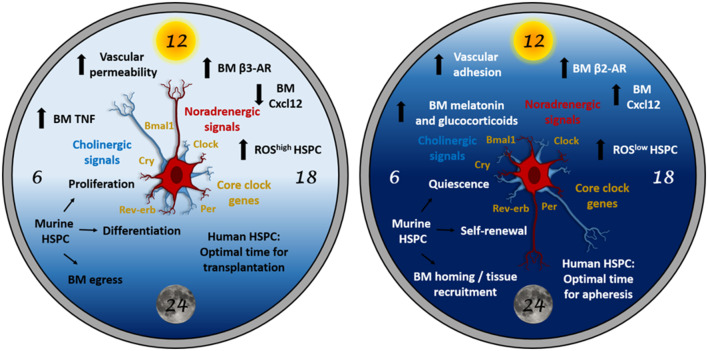
As for many other adult stem cells, the behavior of hematopoietic stem and progenitor cells (HSPCs) is subjected to circadian regulatory patterns. Multiple HSPC functions, such as proliferation, differentiation or trafficking exhibit time-dependent patterns that require a tight coordination to ensure daily blood cell production. The autonomic nervous system, together with circulating hormones, relay circadian signals from the central clock-the suprachiasmatic nucleus in the brain-to synchronize HSC niche physiology according to light/darkness cycles. Research over the last 20 years has revealed how specific neural signals modulate certain aspects of circadian HSC biology. However, only recently some studies have started to decipher the cellular and molecular mechanisms that orchestrate this complex regulation in a time-dependent fashion. Here we firstly review some of the recent key findings illustrating how different neural signals (catecholaminergic or cholinergic) regulate circadian HSC egress, homing, maintenance, proliferation, and differentiation. In particular, we highlight the critical role of different neurotransmitter receptors in the bone marrow microenvironment to channel these neural signals and regulate antagonistic processes according to circadian cues and organismal demands. Then, we discuss the potential biological meaning of HSC circadian regulation and its possible utility for clinical purposes. Finally, we offer our perspective on emerging concepts in HSC chronobiology.
对于许多其他成人干细胞而言,造血干细胞和祖细胞(HSPC)的行为受到昼夜节律调节模式的影响。多种 HSPC 功能,如增殖、分化或迁移,表现出时间依赖性模式,需要紧密协调以确保每日血细胞生成。自主神经系统与循环激素一起,将来自中枢时钟(大脑中的视交叉上核)的昼夜节律信号传递到 HSC 生态位生理学,根据光/暗循环进行同步。在过去 20 年的研究中,已经揭示了特定的神经信号如何调节昼夜节律 HSPC 生物学的某些方面。然而,直到最近,一些研究才开始解析协调这种复杂调节的细胞和分子机制,以时间依赖的方式进行。在这里,我们首先回顾了一些最近的关键发现,这些发现说明了不同的神经信号(儿茶酚胺能或胆碱能)如何调节昼夜节律 HSPC 迁出、归巢、维持、增殖和分化。特别是,我们强调了不同神经递质受体在骨髓微环境中的关键作用,以根据昼夜节律线索和机体需求传递这些神经信号并调节拮抗过程。然后,我们讨论了 HSC 昼夜节律调节的潜在生物学意义及其在临床中的可能应用。最后,我们对 HSC 生物钟生物学中的新兴概念提出了看法。