In 't Ven Lieke, Roelofs Erik, Cubillos Mesías Macarena, Compter Inge, Klaver Yvonne L B, Smeenk Robert Jan, Janssens Geert O, Kaanders Johannes H A M, Fajardo Raquel Davila, Oldenburger Foppe, de Ruysscher Dirk, Troost Esther G C, Eekers Daniëlle B P
Department of Radiation Oncology (Maastro), GROW School for Oncology, Maastricht University Medical Centre, Maastricht, the Netherlands.
OncoRay - National Center for Radiation Research in Oncology, Dresden, Germany.
Clin Transl Radiat Oncol. 2021 Feb 22;28:32-38. doi: 10.1016/j.ctro.2021.02.006. eCollection 2021 May.
Proton therapy is expected to outperform photon-based treatment regarding organs at risk (OAR) sparing but to date there is no method to practically measure clinical benefit. Here, we introduce the novel ROCOCO Performance Scoring System (RPSS) translating dose differences into clinically relevant endpoints and apply this to a treatment plan comparison of volumetric modulated arc therapy (VMAT) and intensity modulated proton therapy (IMPT) in 20 pilocytic astrocytoma patients.
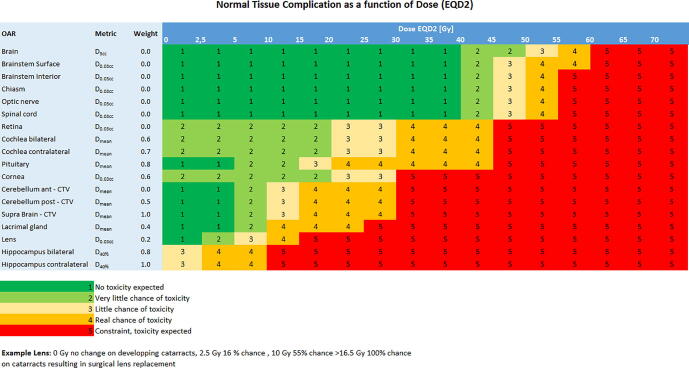
The RPSS was developed on the basis of expert-based weighting factors and toxicity scores per OAR. The imaging datasets of 20 pilocytic astrocytoma patients having undergone radiotherapy were included in this in silico dosimetric comparison trial as proof of principle. For each of these patients, treatment plans to a total dose of 54 Gy (RBE) were generated for VMAT and IMPT and these were compared regarding radiation dose to the clinical target volume (CTV) and OARs. The RPSS was calculated for each treatment plan comparing VMAT and IMPT.
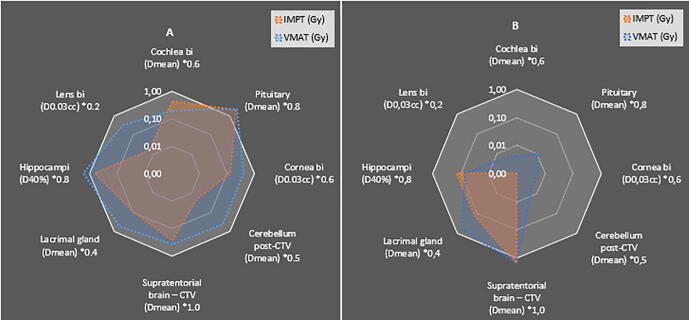
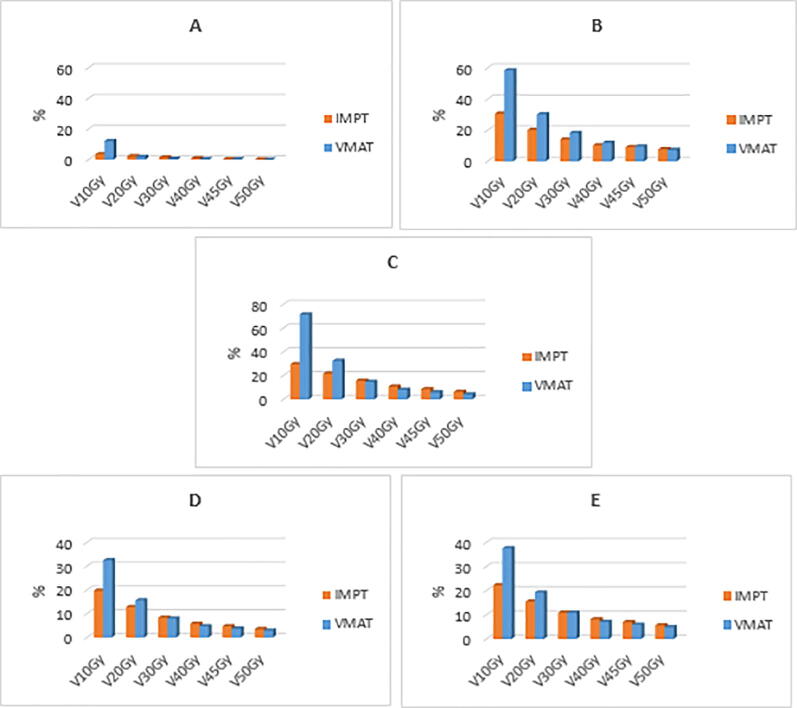
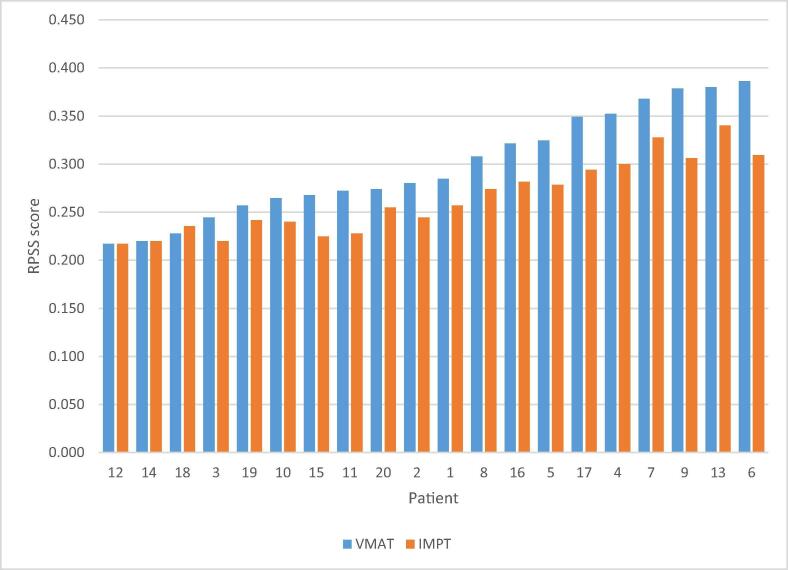
In 40 analysed treatment plans, the average and low dose volumes to various OARs were significantly reduced when using IMPT compared to VMAT ( < 0.05). Using the RPSS, a significant difference between both treatment modalities was found, with 85% of the patients having a lower RPSS in favour of the IMPT plan.
There are dosimetric differences between IMPT and VMAT in pilocytic astrocytoma patients. In absence of clinically validated NTCP models we introduce the RPSS model in order to objectively compare treatment modalities by translating dosimetric differences in potential clinical differences.
质子治疗在保护危及器官(OAR)方面有望优于基于光子的治疗,但迄今为止,尚无实际测量临床获益的方法。在此,我们引入了新颖的ROCOCO性能评分系统(RPSS),将剂量差异转化为临床相关终点,并将其应用于20例毛细胞型星形细胞瘤患者的容积调强弧形治疗(VMAT)和调强质子治疗(IMPT)的治疗计划比较。
RPSS是基于专家给出的权重因子和每个OAR的毒性评分开发的。作为原理验证,本计算机模拟剂量学比较试验纳入了20例接受过放疗的毛细胞型星形细胞瘤患者的影像数据集。对于这些患者中的每一位,均生成了VMAT和IMPT的总剂量为54 Gy(相对生物效应)的治疗计划,并比较了它们对临床靶体积(CTV)和OARs的辐射剂量。计算了比较VMAT和IMPT的每个治疗计划的RPSS。
在40个分析的治疗计划中,与VMAT相比,使用IMPT时,各种OAR的平均和低剂量体积显著降低(<0.05)。使用RPSS发现,两种治疗方式之间存在显著差异,85%的患者的RPSS较低,有利于IMPT计划。
毛细胞型星形细胞瘤患者的IMPT和VMAT之间存在剂量学差异。在缺乏临床验证的正常组织并发症概率(NTCP)模型的情况下,我们引入了RPSS模型,以便通过将剂量学差异转化为潜在的临床差异来客观比较治疗方式。