Liu Peter Y, Irwin Michael R, Krueger James M, Gaddameedhi Shobhan, Van Dongen Hans P A
Division of Endocrinology, The Lundquist Institute at Harbor-UCLA Medical Center, Torrance, CA, 90502, USA.
David Geffen School of Medicine, University of California - Los Angeles, Los Angeles, CA, 90095, USA.
Neurobiol Sleep Circadian Rhythms. 2021 Mar 5;10:100063. doi: 10.1016/j.nbscr.2021.100063. eCollection 2021 May.
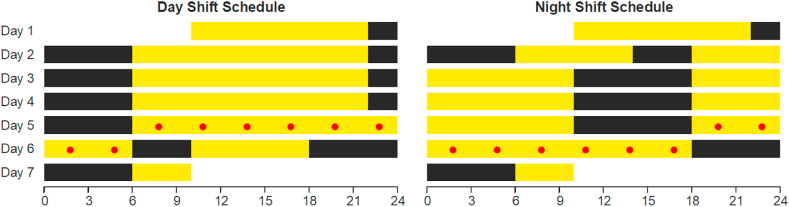
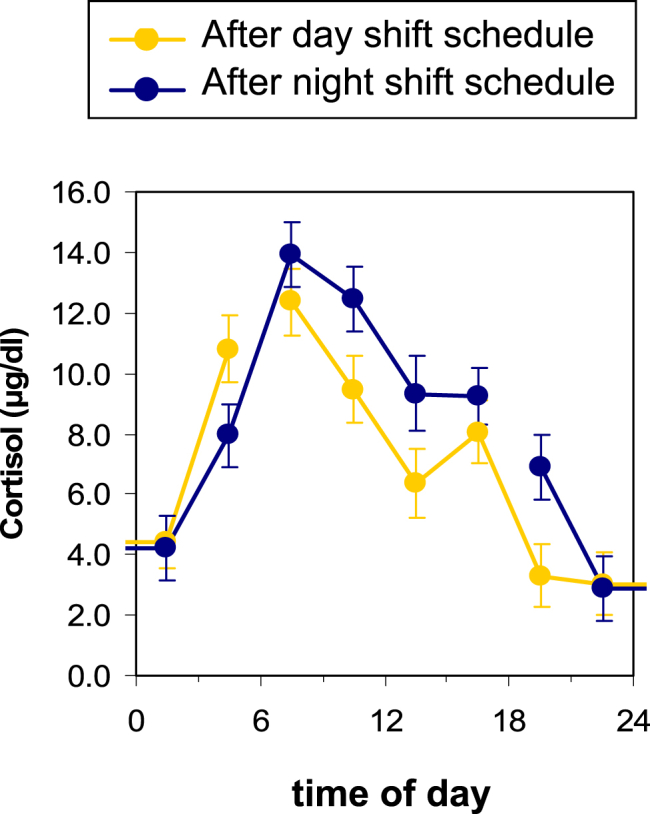
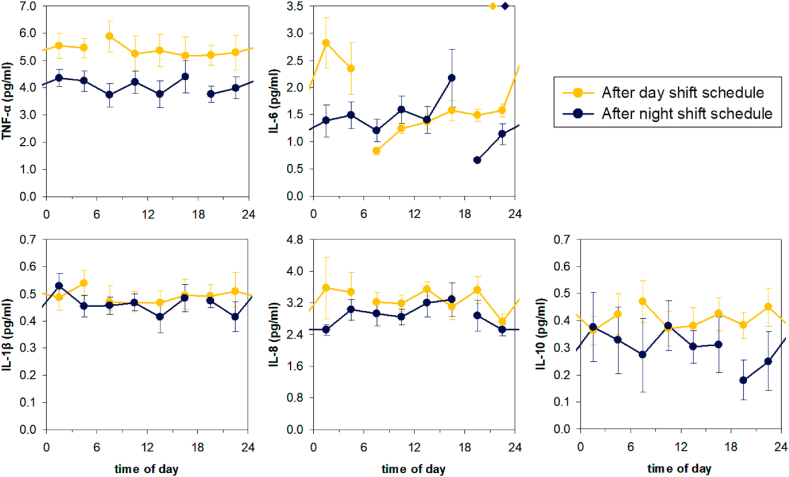
Night shift work is a risk factor for viral infection, suggesting that night shift schedules compromise host defense mechanisms. Prior studies have investigated changes in the temporal profiles of circulating cytokines important for priming and restraining the immune response to infectious challenges from night shift work, but not by way of a 24-h constant routine of continuous wakefulness devoid of behavioral or environmental influences. Hence the true pattern of cytokines, and the combined effect of sleep loss and circadian misalignment on these cytokines remains unknown. Here, 14 healthy young men and women underwent three days of either a simulated night shift or a simulated day shift schedule under dim light in a controlled in-laboratory environment. This was followed by a 24-h constant routine protocol during which venous blood was collected at 3-h intervals. Those who had been in the night shift schedule showed lower mean circulating TNF-α (t = -6.03, p < 0.001), without any significant differences in IL-1β, IL-8 and IL-10, compared with those who had been in the day shift (i.e., control) schedule. Furthermore, circulating IL-6 increased with time awake in both shift work conditions (t = 6.03, p < 0.001), such that temporal changes in IL-6 were markedly shifted relative to circadian clock time in the night shift condition. These results indicate that night shift work compromises host defense by creating cytokine conditions that initially impede anti-viral immunity (lower TNF-α) and may eventually promote autoimmunity (mistimed rise in IL-6).
夜班工作是病毒感染的一个风险因素,这表明夜班排班会损害宿主防御机制。先前的研究调查了循环细胞因子的时间分布变化,这些变化对于启动和抑制针对夜班工作引起的感染性挑战的免疫反应很重要,但不是通过一种没有行为或环境影响的24小时持续清醒的恒定日常安排来进行的。因此,细胞因子的真实模式以及睡眠剥夺和昼夜节律失调对这些细胞因子的综合影响仍然未知。在这里,14名健康的年轻男性和女性在实验室可控环境中的昏暗灯光下,接受了为期三天的模拟夜班或模拟日班排班。随后进行了一个24小时的恒定日常方案,在此期间每隔3小时采集静脉血。与处于日班(即对照)排班的人相比,处于夜班排班的人平均循环肿瘤坏死因子-α水平较低(t = -6.03,p < 0.001),而白细胞介素-1β、白细胞介素-8和白细胞介素-10没有任何显著差异。此外,在两种轮班工作条件下,循环白细胞介素-6水平都随着清醒时间的增加而升高(t = 6.03,p < 0.001),因此在夜班条件下,白细胞介素-6的时间变化相对于昼夜节律时钟时间明显偏移。这些结果表明,夜班工作通过创造细胞因子条件来损害宿主防御,这些条件最初会阻碍抗病毒免疫(较低的肿瘤坏死因子-α),并可能最终促进自身免疫(白细胞介素-6的时间错误升高)。