Moorfields Eye Hospital NHS Foundation Trust, London, UK.
Auckland District Health Board, Auckland, New Zealand.
Mol Genet Genomic Med. 2021 Dec;9(12):e1663. doi: 10.1002/mgg3.1663. Epub 2021 Mar 22.
This case series reports the performance of a next-generation sequencing (NGS) panel of 176 retinal genes (NGS 176) in patients with inherited retinal disease (IRD).
Subjects are patients who underwent genetic testing between 1 August 2016 and 1 January 2018 at Moorfields Eye Hospital, London, UK. Panel-based genetic testing was performed unless a specific gene (e.g., RS1) or small group of genes (e.g., ABCA4, PRPH2) were suspected. If a novel variant was identified, a further comment on their predicted pathogenicity and evolutionary conservation was offered and segregation studies performed. The main outcome measure is the likelihood of obtaining a genetic diagnosis using NGS 176.
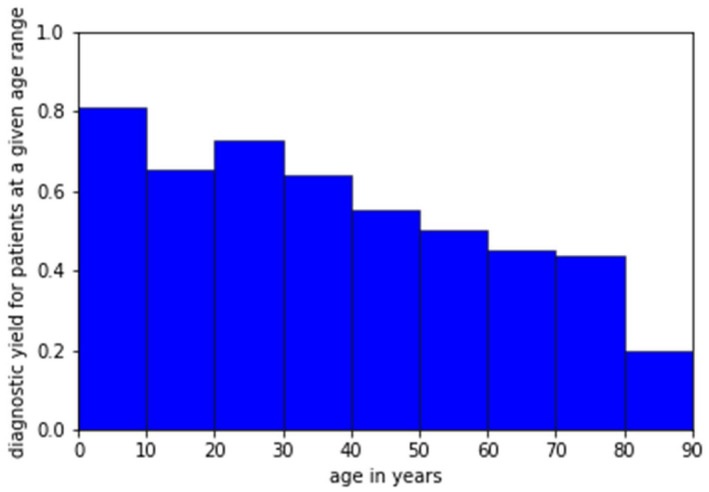
488 patients were included. A molecular diagnosis was obtained for 59.4% of patients. Younger patients were more likely to receive a molecular diagnosis; with 92% of children under the age of 6 years receiving a conclusive result. There was a change in their initially assigned inheritance pattern in 8.4% of patients following genetic testing. Selected IRD diagnoses (e.g., achromatopsia, congenital stationary night blindness) were associated with high diagnostic yields.
This study confirms that NGS 176 is a useful first-tier genetic test for most IRD patients. Age and initial clinical diagnosis were strongly associated with diagnostic yield.
本病例系列报告了用于遗传性视网膜疾病(IRD)患者的下一代测序(NGS)176 个视网膜基因检测 panel(NGS 176)的性能。
本研究的受试者为 2016 年 8 月 1 日至 2018 年 1 月 1 日期间在英国伦敦 Moorfields 眼科医院接受基因检测的患者。除非怀疑特定基因(例如 RS1)或一小部分基因(例如 ABCA4、PRPH2),否则进行基于 panel 的基因检测。如果发现新的变异,则进一步对其预测致病性和进化保守性进行评论,并进行分离研究。主要观察指标是使用 NGS 176 获得遗传诊断的可能性。
共纳入 488 例患者。59.4%的患者获得了分子诊断。年轻患者更有可能获得分子诊断;92%的 6 岁以下儿童获得了明确的结果。在接受基因检测后,8.4%的患者的最初遗传模式发生了改变。一些特定的 IRD 诊断(例如,色盲、先天性静止性夜盲)与高诊断率相关。
本研究证实,NGS 176 是大多数 IRD 患者的有用的一线基因检测方法。年龄和初始临床诊断与诊断率密切相关。