Department of Human Genetics, Sidra Medicine, Doha, Qatar.
Department of Genetic Medicine, Weill Cornell Medical College, Doha, Qatar.
IUBMB Life. 2021 Apr;73(4):670-675. doi: 10.1002/iub.2465. Epub 2021 Mar 22.
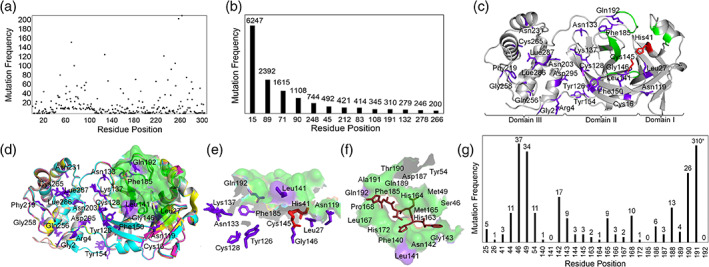
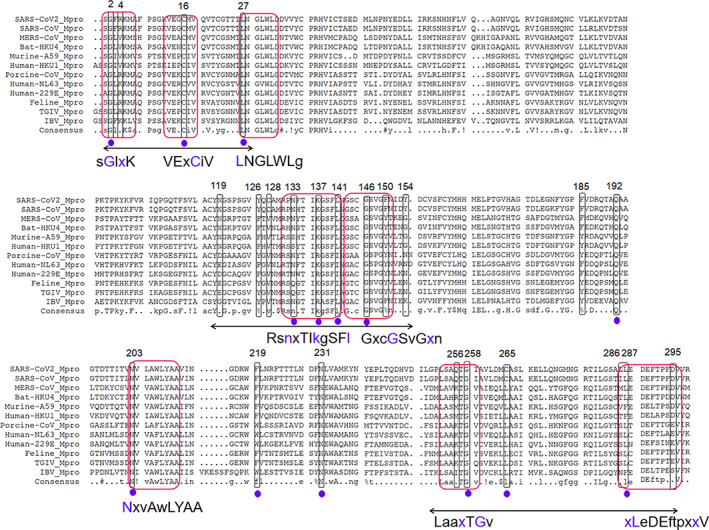
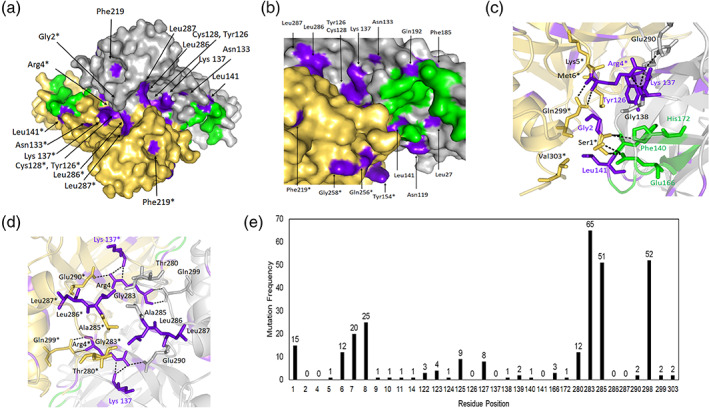
Mutations in the novel coronavirus SARS-CoV2 are the major concern as they might lead to drug/vaccine resistance. In the host cell, the virus largely depends on the main protease (M ) to regulate infection hence it is one of the most attractive targets for inhibitor design. However, >19,000 mutations in the M have already been reported. The mutations encompassing 282 amino acid positions and these "hotspots" might change the M structure, activity and potentially delay therapeutic strategies targeting M . Thus, here we identified 24 mutational "coldspots" where mutations have not been observed. We compared the structure-function relationship of these coldspots with several SARS-CoV2 M X-ray crystal structures. We found that three coldspot residues (Leu141, Phe185, and Gln192) help to form the active site, while seven (Gly2, Arg4, Tyr126, Lys137, Leu141, Leu286, and Leu287) contribute to dimer formation that is required for M activity. The surface of the dimer interface is more resistant to mutations compared to the active site. Interestingly, most of the coldspots are found in three clusters and forms conserved patterns when compared with other coronaviruses. Importantly, several conserved coldspots are available on the surface of the active site and at the dimer interface for targeting. The identification and short list of these coldspots offers a new perspective to target the SARS-CoV2 M while avoiding mutation-based drug resistance.
新型冠状病毒(SARS-CoV2)的突变是主要关注点,因为它们可能导致药物/疫苗耐药性。在宿主细胞中,病毒在很大程度上依赖于主蛋白酶(M)来调节感染,因此它是抑制剂设计最有吸引力的目标之一。然而,已经报道了 M 上超过 19000 个突变。这些“热点”涵盖 282 个氨基酸位置的突变可能会改变 M 的结构、活性,并可能延迟针对 M 的治疗策略。因此,我们在这里确定了 24 个未观察到突变的突变“冷点”。我们比较了这些冷点的结构-功能关系与几种 SARS-CoV2 M X 射线晶体结构。我们发现三个冷点残基(Leu141、Phe185 和 Gln192)有助于形成活性位点,而七个残基(Gly2、Arg4、Tyr126、Lys137、Leu141、Leu286 和 Leu287)有助于形成二聚体形成,这是 M 活性所必需的。与活性位点相比,二聚体界面的表面对突变更具抗性。有趣的是,大多数冷点存在于三个簇中,并与其他冠状病毒相比形成保守模式。重要的是,几个保守的冷点在活性位点和二聚体界面的表面上可用于靶向。这些冷点的鉴定和候选名单为靶向 SARS-CoV2 M 提供了一个新视角,同时避免了基于突变的耐药性。