School of Population and Public Health, The University of British Columbia (UBC), 2206 East Mall, Vancouver, British Columbia, V6T 1Z3, Canada.
Faculty of Forestry, The University of British Columbia, Forest Sciences Centre, 2424 Main Mall, Vancouver, BC, V6T 1Z4, Canada.
Environ Health. 2021 Mar 22;20(1):31. doi: 10.1186/s12940-021-00708-z.
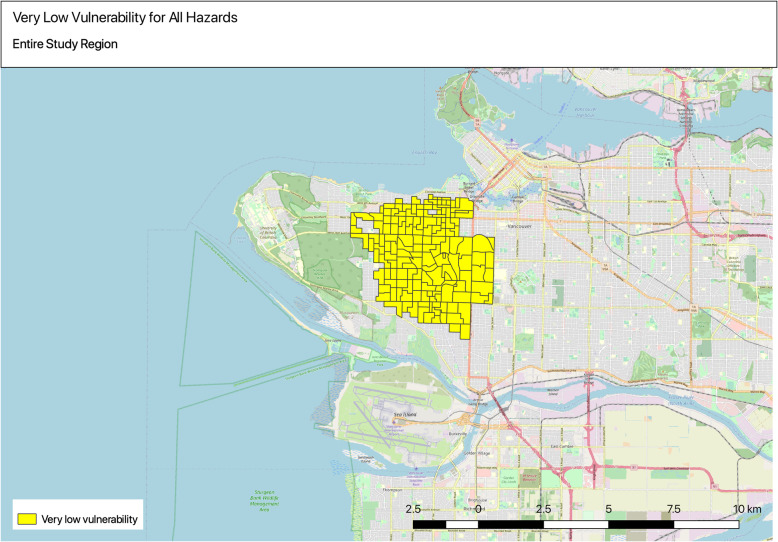
Although the frequency and magnitude of climate change-related health hazards (CCRHHs) are likely to increase, the population vulnerabilities and corresponding health impacts are dependent on a community's exposures, pre-existing sensitivities, and adaptive capacities in response to a hazard's impact. To evaluate spatial variability in relative vulnerability, we: 1) identified climate change-related risk factors at the dissemination area level; 2) created actionable health vulnerability index scores to map community risks to extreme heat, flooding, wildfire smoke, and ground-level ozone; and 3) spatially evaluated vulnerability patterns and priority areas of action to address inequity.
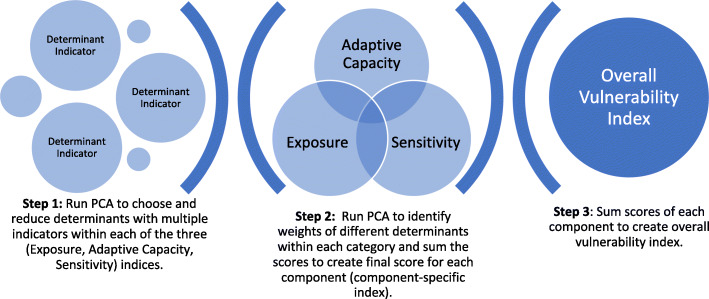
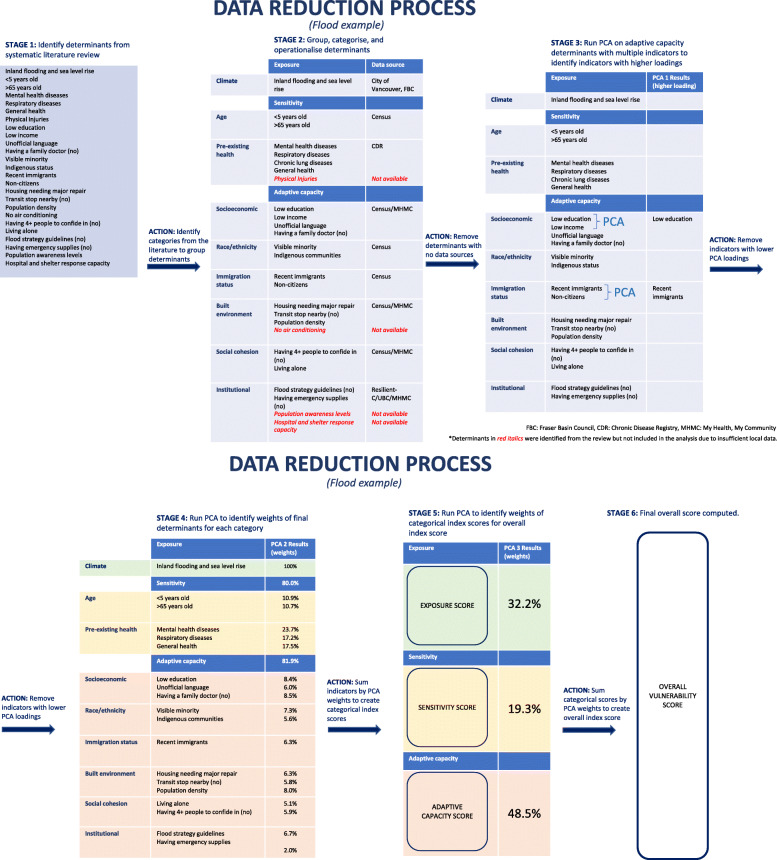
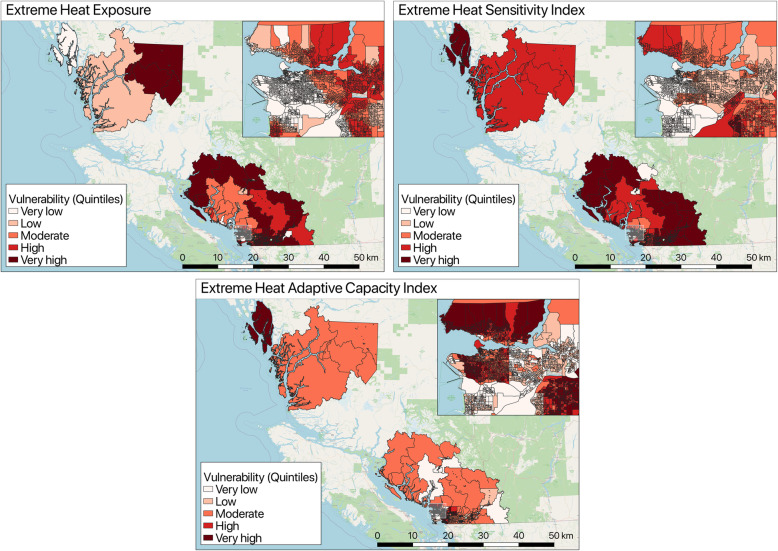
A systematic literature review was conducted to identify the determinants of health hazards among populations impacted by CCRHHs. Identified determinants were then grouped into categories of exposure, sensitivity, and adaptive capacity and aligned with available data. Data were aggregated to 4188 Census dissemination areas within two health authorities in British Columbia, Canada. A two-step principal component analysis (PCA) was then used to select and weight variables for each relative vulnerability score. In addition to an overall vulnerability score, exposure, adaptive capacity, and sensitivity sub-scores were computed for each hazard. Scores were then categorised into quintiles and mapped.
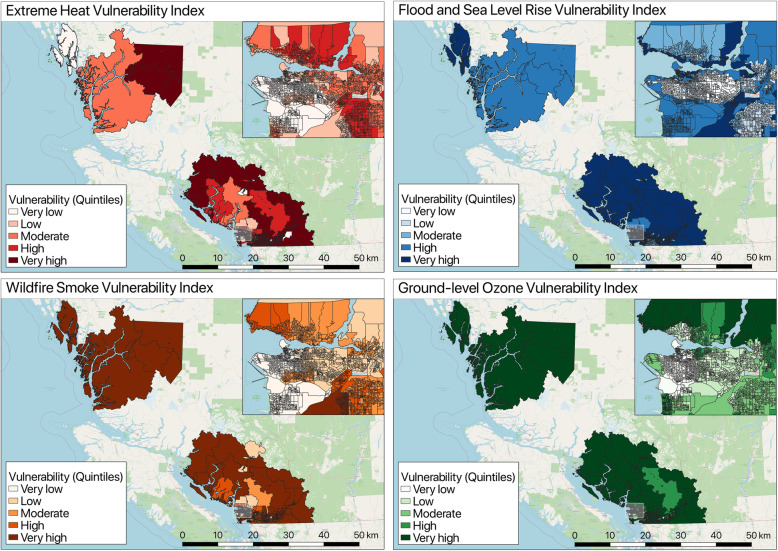
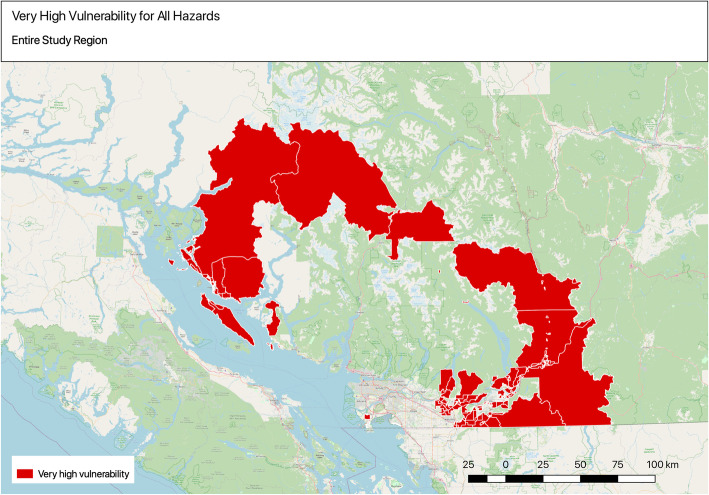
Two hundred eighty-one epidemiological papers met the study criteria and were used to identify 36 determinant indicators that were operationalized across all hazards. For each hazard, 3 to 5 principal components explaining 72 to 94% of the total variance were retained. Sensitivity was weighted much higher for extreme heat, wildfire smoke and ground-level ozone, and adaptive capacity was highly weighted for flooding vulnerability. There was overall varied contribution of adaptive capacity (16-49%) across all hazards. Distinct spatial patterns were observed - for example, although patterns varied by hazard, vulnerability was generally higher in more deprived and more outlying neighbourhoods of the study region.
The creation of hazard and category-specific vulnerability indices (exposure, adaptive capacity and sensitivity sub-scores) supports evidence-based approaches to prioritize public health responses to climate-related hazards and to reduce inequity by assessing relative differences in vulnerability along with absolute impacts. Future studies can build upon this methodology to further understand the spatial variation in vulnerability and to identify and prioritise actionable areas for adaptation.
尽管与气候变化相关的健康危害(CCRHHs)的频率和规模可能会增加,但人口脆弱性和相应的健康影响取决于社区对危害影响的暴露程度、固有敏感性和适应能力。为了评估相对脆弱性的空间变异性,我们:1)在传播区域层面确定与气候变化相关的风险因素;2)创建可操作的健康脆弱性指数得分,以绘制社区面临极端高温、洪水、野火烟雾和地面臭氧的风险图;3)对脆弱性模式和解决不平等问题的优先行动领域进行空间评估。
进行了系统文献综述,以确定受 CCRHHs 影响的人群中健康危害的决定因素。然后将确定的决定因素分为暴露、敏感性和适应能力三个类别,并与现有数据相匹配。数据被汇总到加拿大不列颠哥伦比亚省两个卫生当局的 4188 个普查传播区域。然后使用两步主成分分析(PCA)为每个相对脆弱性得分选择和加权变量。除了整体脆弱性得分外,还为每个危害计算了暴露、适应能力和敏感性子得分。然后将分数分为五分位数并进行映射。
281 篇流行病学论文符合研究标准,用于确定 36 个决定因素指标,这些指标在所有危害中都得到了实施。对于每个危害,保留了 3 到 5 个主成分,解释了总方差的 72%到 94%。对于极端高温、野火烟雾和地面臭氧,敏感性的权重要高得多,而对于洪水脆弱性,适应能力的权重要高得多。所有危害的适应能力的总体贡献各不相同(16-49%)。观察到明显的空间模式——例如,尽管每种危害的模式不同,但脆弱性通常在研究区域较贫困和较偏远的社区更高。
创建危害和特定类别脆弱性指数(暴露、适应能力和敏感性子得分)支持基于证据的方法,优先应对与气候相关的危害,通过评估脆弱性的相对差异以及绝对影响,减少不平等。未来的研究可以在此方法的基础上进一步了解脆弱性的空间变化,并确定和优先考虑适应的可操作领域。