Deakin University, Institute for Physical Activity and Nutrition (IPAN), School of Exercise and Nutrition Sciences, Geelong, VIC, Australia.
Centre for Human Factors and Sociotechnical Systems, Faculty of Arts, Business and Law, University of the Sunshine Coast, Queensland, Australia.
Int J Behav Nutr Phys Act. 2021 Mar 22;18(1):42. doi: 10.1186/s12966-021-01103-0.
Sustainable shifts in population behaviours require system-level implementation and embeddedness of large-scale health interventions. This paper aims to understand how different contexts of scaling up interventions affect mechanisms to produce intended and unintended scale up outcomes.
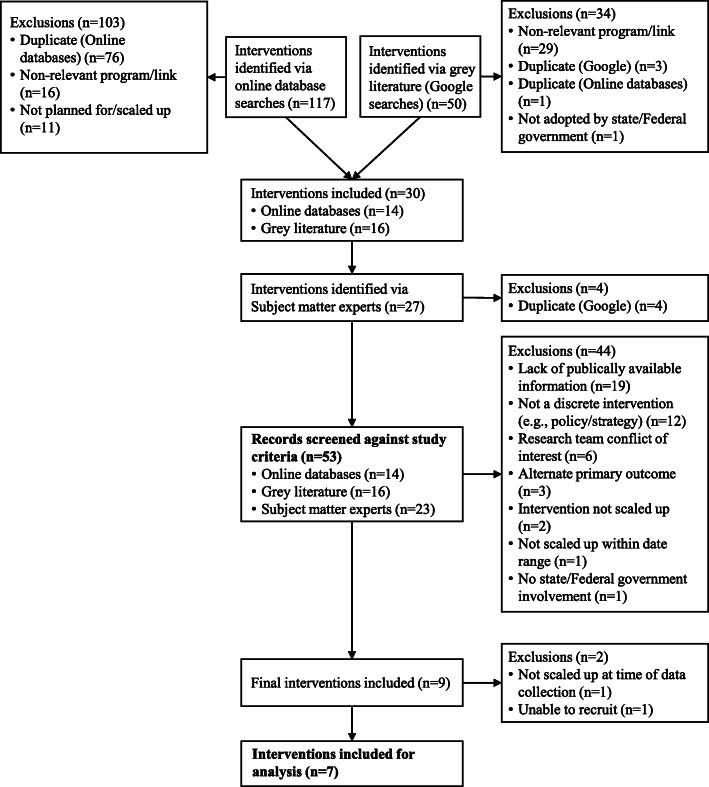
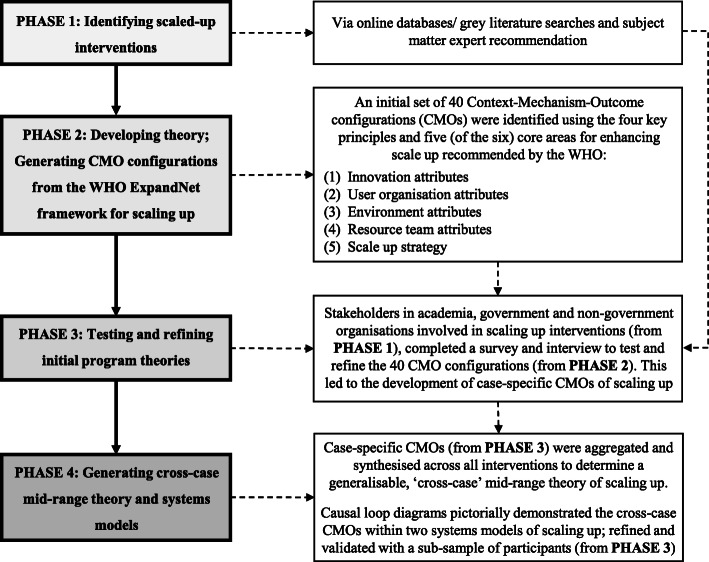
A mixed method study combining a realist perspective and systems analysis (causal loop diagrams) of scaled-up physical activity and/or nutrition interventions implemented at a state/national level in Australia (2010-18). The study involved four distinct phases: Phase 1 expert consultation, database and grey literature searches to identify scaled-up interventions; Phase 2 generating initial Context-Mechanism-Outcome configurations (CMOs) from the WHO ExpandNet framework for scaling up; Phase 3 testing and refining CMOs via online surveys and realist interviews with academics, government and non-government organisations (NGOs) involved in scale up of selected interventions (Phase 1); and Phase 4 generating cross-case mid-range theories represented in systems models of scaling up; validated by member checking. Descriptive statistics were reported for online survey data and realist analysis for interview data.
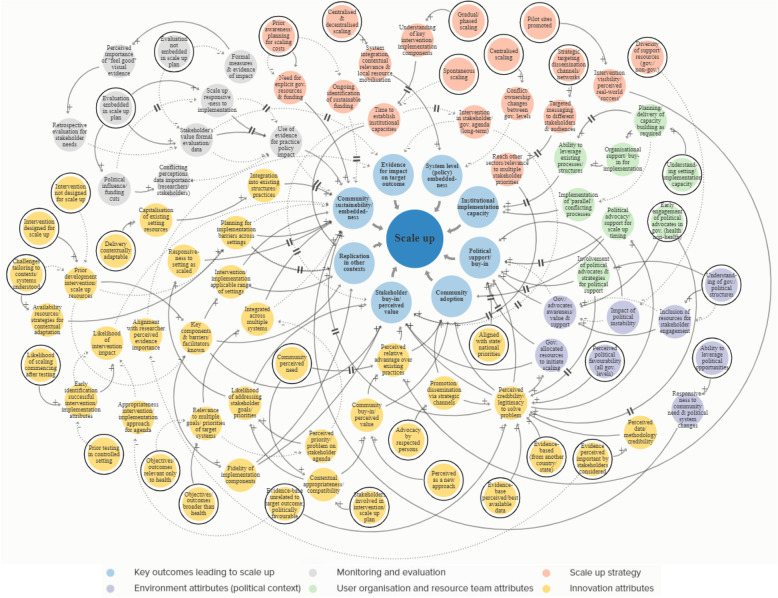
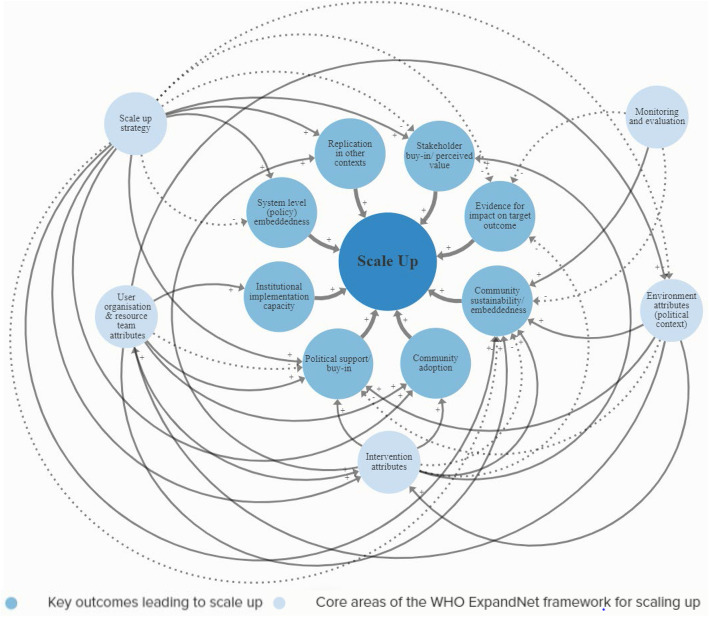
Seven interventions were analysed, targeting nutrition (n = 1), physical activity (n = 1), or a combination (n = 5). Twenty-six participants completed surveys; 19 completed interviews. Sixty-three CMO pathways underpinned successful scale up, reflecting 36 scale up contexts, 8 key outcomes; linked via 53 commonly occurring mechanisms. All five WHO framework domains were represented in the systems models. Most CMO pathways included 'intervention attributes' and led to outcomes 'community sustainability/embeddedness' and 'stakeholder buy-in/perceived value'. Irrespective of interventions being scaled in similar contexts (e.g., having political favourability); mechanisms still led to both intended and unintended scale up outcomes (e.g., increased or reduced sustainability).
This paper provides the first evidence for mechanisms underpinning outcomes required for successful scale up of state or nationally delivered interventions. Our findings challenge current prerequisites for effective scaling suggesting other conditions may be necessary. Future scale up approaches that plan for complexity and encourage iterative adaptation throughout, may enhance scale up outcomes. Current linear, context-to-outcome depictions of scale up oversimplify what is a clearly a complex interaction between perceptions, worldviews and goals of those involved. Mechanisms identified in this study could potentially be leveraged during future scale up efforts, to positively influence intervention scalability and sustainability.
人口行为的可持续转变需要在系统层面实施和嵌入大规模卫生干预措施。本文旨在了解不同的推广干预措施的背景如何影响产生预期和非预期推广结果的机制。
本研究结合了真实主义视角和系统分析(因果关系图),对澳大利亚在州/国家级实施的扩大体育活动和/或营养干预措施进行了混合方法研究(2010-18 年)。该研究包括四个不同阶段:第一阶段专家咨询、数据库和灰色文献检索,以确定扩大规模的干预措施;第二阶段从世卫组织扩大网络扩大框架生成初始背景-机制-结果配置(CMO);第三阶段通过在线调查和对参与选定干预措施扩大规模的学术界、政府和非政府组织(NGO)进行的真实主义访谈测试和完善 CMO(阶段 1);以及第四阶段生成以系统模型表示的跨案例中级理论,通过成员核对进行验证。对在线调查数据进行描述性统计,对访谈数据进行真实主义分析。
分析了 7 项干预措施,针对营养(n=1)、体育活动(n=1)或两者的组合(n=5)。26 名参与者完成了调查;19 名参与者完成了访谈。成功推广的 63 个 CMO 途径反映了 36 个推广背景、8 个关键结果;通过 53 个常见机制联系起来。所有五个世卫组织框架领域都在系统模型中得到体现。大多数 CMO 途径都包含“干预属性”,并导致“社区可持续性/嵌入性”和“利益相关者认同/感知价值”等结果。尽管干预措施在类似的背景下推广(例如,具有政治支持);但机制仍然导致了预期和非预期的推广结果(例如,可持续性增加或减少)。
本文为成功推广州或国家提供的干预措施所需的支持结果的机制提供了第一个证据。我们的研究结果挑战了当前有效推广的先决条件,表明可能需要其他条件。未来的推广方法,如果计划好复杂性并在整个过程中鼓励迭代适应,可能会提高推广效果。当前线性的、从背景到结果的推广描述过于简化,实际上这是一个涉及到参与方的看法、世界观和目标之间复杂的相互作用。本研究中确定的机制可能在未来的推广工作中得到利用,以积极影响干预措施的可扩展性和可持续性。