Department of Epidemiology and Gangarosa Department of Environmental Health, Rollins School of Public Health, Emory University, Atlanta, GA, USA.
Leibniz Institute for Prevention Research and Epidemiology-BIPS, Bremen, Germany.
Int J Obes (Lond). 2021 Jun;45(6):1321-1330. doi: 10.1038/s41366-021-00795-5. Epub 2021 Mar 22.
Childhood obesity is a complex multifaceted condition, which is influenced by genetics, environmental factors, and their interaction. However, these interactions have mainly been studied in twin studies and evidence from population-based cohorts is limited. Here, we analyze the interaction of an obesity-related genome-wide polygenic risk score (PRS) with sociodemographic and lifestyle factors for BMI and waist circumference (WC) in European children and adolescents.
The analyses are based on 8609 repeated observations from 3098 participants aged 2-16 years from the IDEFICS/I.Family cohort. A genome-wide polygenic risk score (PRS) was calculated using summary statistics from independent genome-wide association studies of BMI. Associations were estimated using generalized linear mixed models adjusted for sex, age, region of residence, parental education, dietary intake, relatedness, and population stratification.
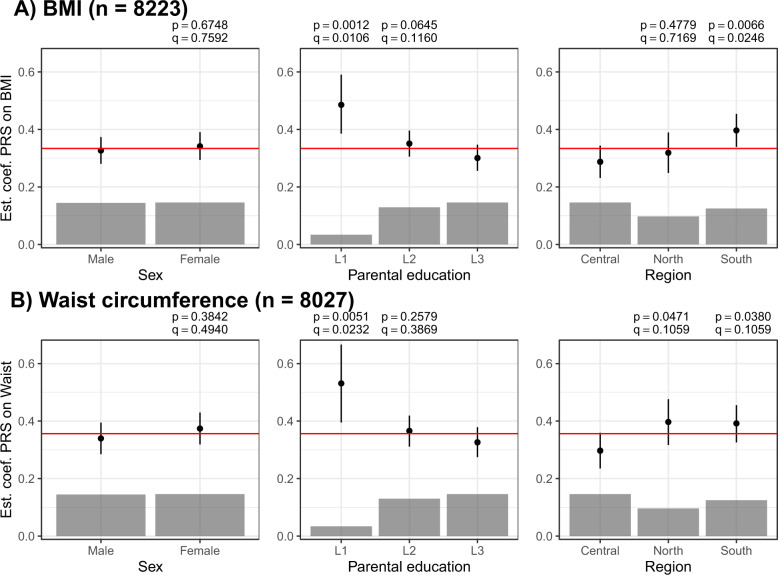
The PRS was associated with BMI (beta estimate [95% confidence interval (95%-CI)] = 0.33 [0.30, 0.37], r = 0.11, p value = 7.9 × 10) and WC (beta [95%-CI] = 0.36 [0.32, 0.40], r = 0.09, p value = 1.8 × 10). We observed significant interactions with demographic and lifestyle factors for BMI as well as WC. Children from Southern Europe showed increased genetic liability to obesity (BMI: beta [95%-CI] = 0.40 [0.34, 0.45]) in comparison to children from central Europe (beta [95%-CI] = 0.29 [0.23, 0.34]), p-interaction = 0.0066). Children of parents with a low level of education showed an increased genetic liability to obesity (BMI: beta [95%-CI] = 0.48 [0.38, 0.59]) in comparison to children of parents with a high level of education (beta [95%-CI] = 0.30 [0.26, 0.34]), p-interaction = 0.0012). Furthermore, the genetic liability to obesity was attenuated by a higher intake of fiber (BMI: beta [95%-CI] interaction = -0.02 [-0.04,-0.01]) and shorter screen times (beta [95%-CI] interaction = 0.02 [0.00, 0.03]).
Our results highlight that a healthy childhood environment might partly offset a genetic predisposition to obesity during childhood and adolescence.
儿童肥胖是一种复杂的多因素疾病,受遗传、环境因素及其相互作用的影响。然而,这些相互作用主要在双胞胎研究中进行了研究,基于人群队列的证据有限。在这里,我们分析了肥胖相关全基因组多基因风险评分 (PRS) 与社会人口统计学和生活方式因素对欧洲儿童和青少年 BMI 和腰围 (WC) 的相互作用。
该分析基于 IDEFICS/I.Family 队列中 3098 名 2-16 岁参与者的 8609 次重复观察。使用 BMI 的独立全基因组关联研究的汇总统计数据计算全基因组多基因风险评分 (PRS)。使用广义线性混合模型进行估计,模型调整了性别、年龄、居住地区、父母教育程度、饮食摄入、亲缘关系和人口分层。
PRS 与 BMI(β估计值[95%置信区间 (95%-CI)]=0.33[0.30, 0.37],r=0.11,p 值=7.9×10)和 WC(β[95%-CI]=0.36[0.32, 0.40],r=0.09,p 值=1.8×10)相关。我们观察到与 BMI 和 WC 的人口统计学和生活方式因素存在显著的相互作用。与来自中欧的儿童相比,来自南欧的儿童肥胖的遗传易感性增加(BMI:β[95%-CI]=0.40[0.34, 0.45]),p 交互值=0.0066)。父母受教育程度较低的儿童肥胖的遗传易感性增加(BMI:β[95%-CI]=0.48[0.38, 0.59]),与父母受教育程度较高的儿童相比(β[95%-CI]=0.30[0.26, 0.34]),p 交互值=0.0012)。此外,纤维摄入量较高(BMI:β[95%-CI]交互作用=-0.02[-0.04,-0.01])和屏幕时间较短(BMI:β[95%-CI]交互作用=0.02[0.00,0.03])可减轻肥胖的遗传易感性。
我们的结果强调,健康的儿童环境可能在一定程度上抵消儿童和青少年时期肥胖的遗传易感性。