Laboratório de Diversidade Viral, Instituto de Ciências Biológicas, Universidade Federal do Pará, Belém, Pará, Brazil.
Secretary of Health of Tocantins, Tocantins, Brazil.
PLoS One. 2021 Mar 23;16(3):e0248486. doi: 10.1371/journal.pone.0248486. eCollection 2021.
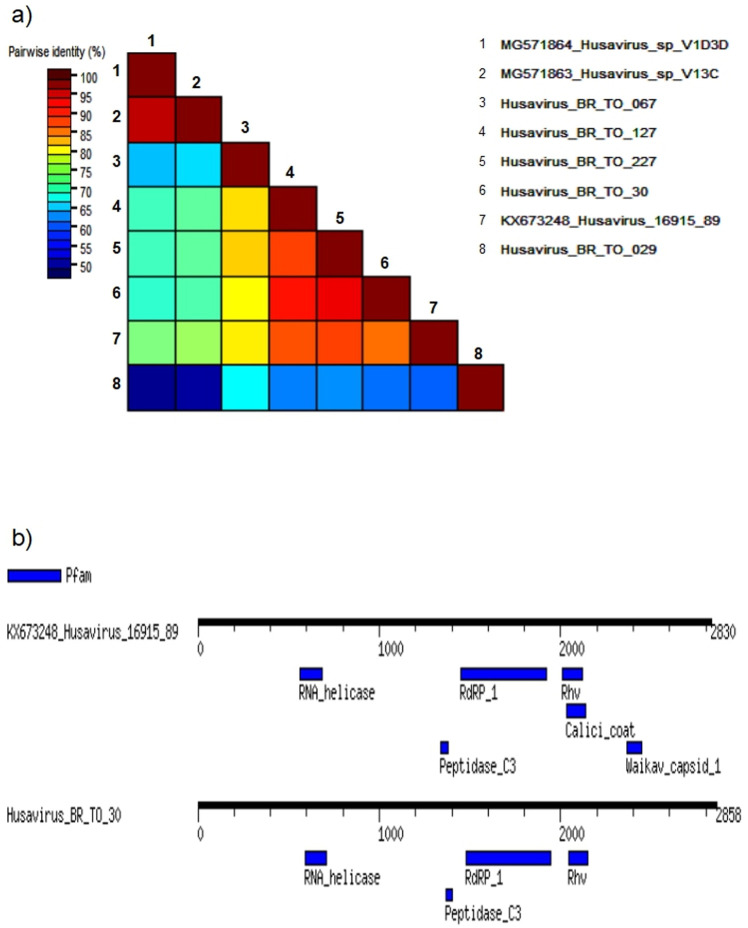
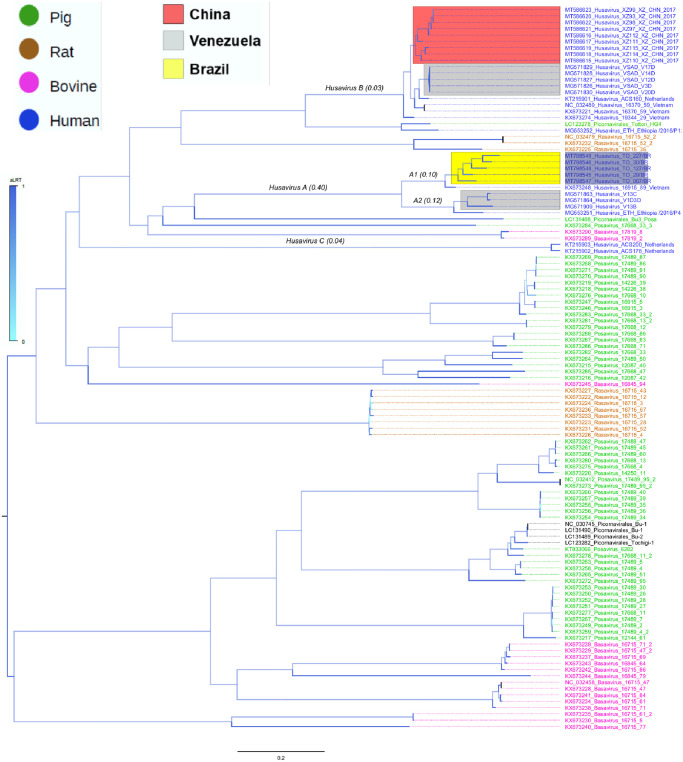
Husavirus (HuV) is an unclassified virus of the order Picornavirales that has already been identified worldwide in various locations. The genetic, epidemiological, and pathogenic characteristics are, however, little understood. In children with acute gastroenteritis, this study used next-generation sequencing to recognize unknown sources of viruses. In particular, 251 fecal samples obtained from individuals were sequenced in southern, northeastern, and northern Brazil. all samples were also analyzed using culture methods and parasitological tests to classify other enteric pathogens such as bacteria, parasites, and viruses. 1.9% of the samples tested positive for HuV, for a total of 5 positive children, with a mean age of 2 year, with three males and two females. Detailed molecular characterization of full genomes showed that Brazilian HuVs' nucleotide divergence is less than 11%. The genetic gap between Brazilian sequences and the closest HuV reported previously, on the other hand, is 18%. The study showed that Brazilian sequences are closely related to the HuV defined in Viet Nam in 2013, further characterization based on phylogenetics. At least two divergent clades of HuV in South America were also seen in the phylogenetic study.
人杯状病毒(HuV)是一种未分类的小核糖核酸病毒,属于小RNA 病毒目,目前已在世界范围内的不同地区被发现。然而,其遗传、流行病学和发病机制的特征仍知之甚少。在患有急性胃肠炎的儿童中,本研究使用下一代测序技术来识别未知来源的病毒。特别是,对巴西南部、东北部和北部的 251 个人的粪便样本进行了测序。所有样本还使用培养方法和寄生虫学检测进行了分析,以分类其他肠道病原体,如细菌、寄生虫和病毒。1.9%的样本检测出 HuV 阳性,共有 5 名阳性儿童,平均年龄为 2 岁,男性 3 名,女性 2 名。对全长基因组的详细分子特征分析表明,巴西 HuV 的核苷酸差异小于 11%。另一方面,与之前报道的最接近的 HuV(2013 年在越南报道)相比,巴西序列之间的遗传差距为 18%。研究表明,巴西序列与人杯状病毒在越南 2013 年定义的病毒密切相关,进一步基于系统发生学进行了特征描述。在系统发生研究中还观察到南美洲至少有两个不同的 HuV 分支。