Department of Nephrology and Mineral Metabolism, Instituto Nacional de Ciencias Médicas y Nutrición "Salvador Zubirán", Tlalpan, Mexico.
Liver Unit, Department of Gastroenterology, Instituto Nacional de Ciencias Médicas y Nutrición "Salvador Zubirán", Tlalpan, Mexico.
Ren Fail. 2021 Dec;43(1):577-584. doi: 10.1080/0886022X.2021.1901740.
Uremic encephalopathy is defined as cerebral dysfunction due to toxin accumulation in patients with chronic kidney disease (CKD). This condition is characterized by subtle to florid symptoms, and its clinical course is always progressive when untreated but partially reversible with renal replacement therapy. While no test exists to measure subclinical uremic encephalopathy, two tests have been validated to measure minimal hepatic encephalopathy: the critical flicker frequency (CFF) test and the psychometric hepatic encephalopathy score (PHES).
To use CFF and PHES to measure the prevalence of cerebral dysfunction in individuals with CKD.
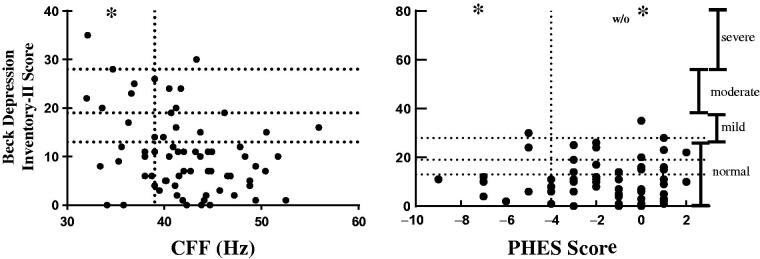
This cross-sectional study included a total of 69 patients with stage-5 CKD. Cutoff points for minimal encephalopathy were established using existing clinical guidelines: ≤39 Hz for CFF and < -4 for PHES. All participants were also screened for cognitive function and depression.
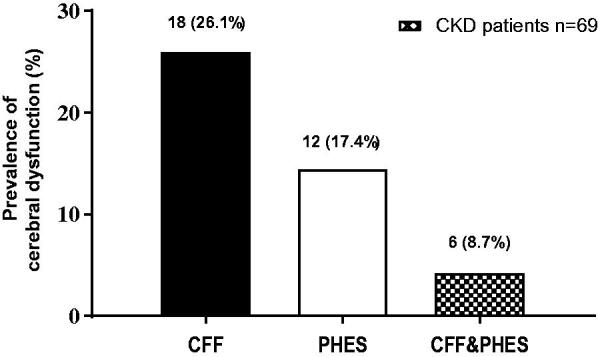
Eighteen cases (26.1%) of cerebral dysfunction linked to uremic encephalopathy were detected with CFF, while twelve (17.4%) were detected by PHES; only six cases (8.7%) were diagnosed by both methods. Half of the cases (50%) had diabetes, and 61% were on hemodialysis. Cognitive function scores did not differ significantly between those receiving dialysis, hemodialysis, or no renal replacement therapy.
It is essential to identify cerebral dysfunction when uremic encephalopathy is in early subclinical stages to reduce preventable events as traffic and work accidents.
尿毒症性脑病是指由于慢性肾脏病(CKD)患者体内毒素积聚而导致的大脑功能障碍。这种情况的特点是症状从轻微到明显,未经治疗时其临床病程总是进展性的,但通过肾脏替代治疗可部分逆转。虽然目前还没有用于测量亚临床尿毒症性脑病的测试,但已有两种测试方法被验证可用于测量轻微肝性脑病:临界闪烁频率(CFF)测试和精神测量肝性脑病评分(PHES)。
使用 CFF 和 PHES 来测量 CKD 患者大脑功能障碍的患病率。
这项横断面研究共纳入了 69 名处于 5 期 CKD 的患者。使用现有的临床指南来确定轻微脑病的临界值:CFF 为 ≤39 Hz,PHES 为 <-4。所有参与者还接受了认知功能和抑郁的筛查。
通过 CFF 检测到 18 例(26.1%)与尿毒症性脑病相关的大脑功能障碍,通过 PHES 检测到 12 例(17.4%);只有 6 例(8.7%)通过两种方法诊断。半数病例(50%)患有糖尿病,61%的患者正在接受血液透析。接受透析、血液透析或无肾脏替代治疗的患者之间的认知功能评分没有显著差异。
当尿毒症性脑病处于早期亚临床阶段时,识别大脑功能障碍至关重要,以减少可预防的事件,如交通事故和工作事故。