MOE Key Laboratory of Bioinorganic and Synthetic Chemistry, School of Chemistry, Sun Yat-sen University, Guangzhou, 510275, China.
Nat Commun. 2021 Mar 23;12(1):1835. doi: 10.1038/s41467-021-21923-9.
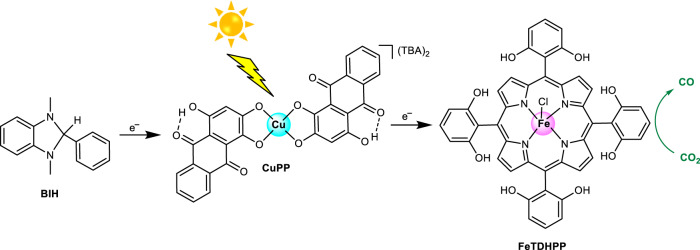
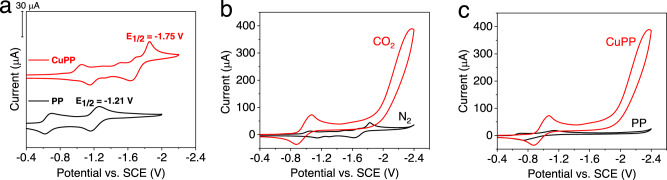
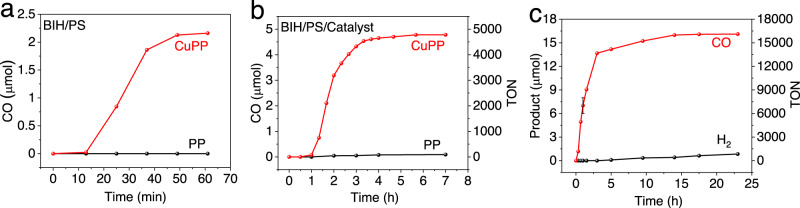
CO reduction through artificial photosynthesis represents a prominent strategy toward the conversion of solar energy into fuels or useful chemical feedstocks. In such configuration, designing highly efficient chromophores comprising earth-abundant elements is essential for both light harvesting and electron transfer. Herein, we report that a copper purpurin complex bearing an additional redox-active center in natural organic chromophores is capable to shift the reduction potential 540 mV more negative than its organic dye component. When this copper photosensitizer is employed with an iron porphyrin as the catalyst and 1,3-dimethyl-2-phenyl-2,3-dihydro-1H-benzo[d]imidazole as the sacrificial reductant, the system achieves over 16100 turnover number of CO from CO with a 95% selectivity (CO vs H) under visible-light irradiation, which is among the highest reported for a homogeneous noble metal-free system. This work may open up an effective approach for the rational design of highly efficient chromophores in artificial photosynthesis.
通过人工光合作用将 CO 还原为代表着一种将太阳能转化为燃料或有用化学原料的重要策略。在这种配置中,设计由丰富元素组成的高效发色团对于光捕获和电子转移都是至关重要的。在此,我们报告了一种含有天然有机发色团中额外氧化还原活性中心的铜卟啉配合物,能够将还原电势向更负方向移动 540 mV 以上,超过其有机染料部分。当将这种铜敏化剂与铁卟啉作为催化剂以及 1,3-二甲基-2-苯基-2,3-二氢-1H-苯并[d]咪唑作为牺牲还原剂一起使用时,该体系在可见光照射下可实现超过 16100 个 CO 的转化数,CO 的选择性达到 95%(CO 对 H),这是报道的均相非贵金属体系中最高的之一。这项工作可能为人工光合作用中高效发色团的合理设计开辟了一条有效途径。