Wu Yahua, Li Jiancheng
Department of Radiation Oncology, Fujian Medical University Cancer Hospital, Fujian Cancer Hospital, Fuzhou, Fujian, 350014, People's Republic of China.
Cancer Manag Res. 2021 Mar 15;13:2433-2445. doi: 10.2147/CMAR.S295646. eCollection 2021.
This study aimed to evaluate the relationship of the percentage decrease of maximal esophageal wall thickness with pathological complete response (pCR) and recurrence in esophageal squamous cell carcinoma (ESCC).
A total of 146 ESCC patients treated with neoadjuvant chemoradiotherapy (NCRT) and surgery were included. The prognostic factors for overall survival (OS) and disease-free survival (DFS) were analyzed. The recurrence site, time, and frequency were included in the analysis. The percentage decrease of maximal esophageal wall thickness after NCRT was determined with the formula: [(pre-post)/pre] × 100.
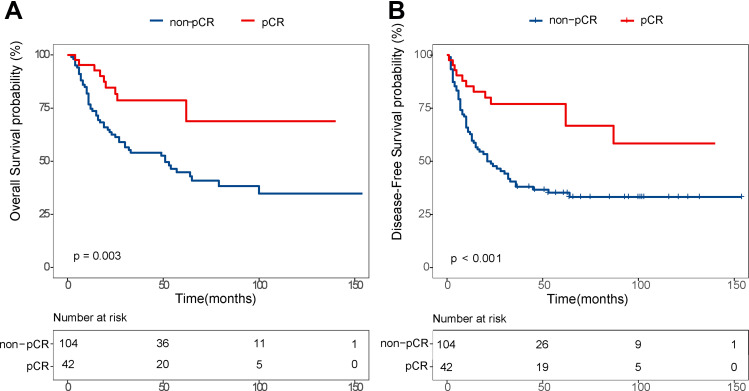
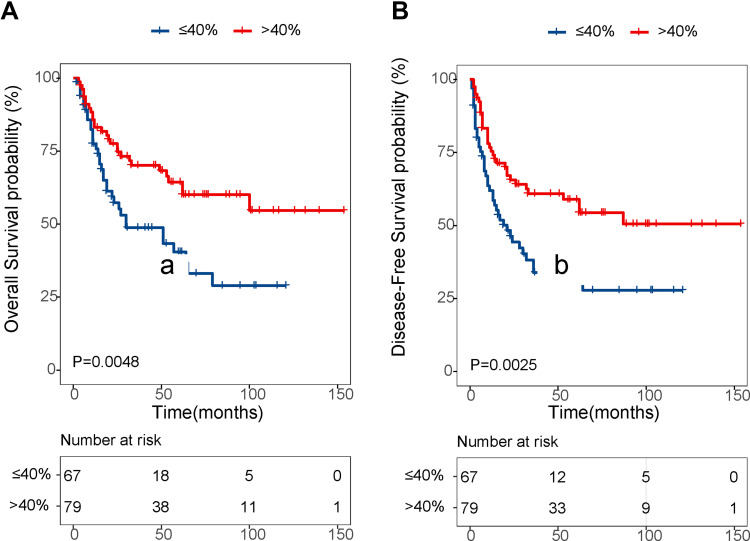
Overall, only 42 patients achieved pCR. Multivariable logistic analyses showed that the percentage decrease of maximal esophageal wall thickness (HR: 2.504; 95% CI: 1.112-5.638, P=0.027) was independently correlated with pCR. In multivariable Cox analyses, a ≤40% percentage decrease of maximal esophageal wall thickness was an independent adverse factor for both OS (HR: 1.907, 95% CI: 1.149-3.165; P=0.012) and DFS (HR: 2.054, 95% CI: 1.288-3.277; P=0.003). Compared with patients with a ≤40% percentage decrease, those with a >40% percentage decrease had better 5-year OS (29.0% vs 60.1%, P<0.05) and DFS (27.8% vs 54.4%, P<0.05). Perineural invasion (PNI) was also an unfavorable factor for OS (HR: 2.138, 95% CI: 0.094-4.178; P=0.026). Lymph vessel invasion (HR: 2.874, 95% CI: 1.574-5.248; P=0.001) and PNI (HR: 2.050; 95% CI: 1.044-4.023; P=0.037) were independent prognosticators for DFS. The rates of local and distant recurrence were also significantly difference between those with a percentage decrease of ≤40% and of >40% (P<0.05).
The percentage decrease of maximal esophageal wall thickness is associated with pCR and recurrence in ESCC patients who undergo NCRT and surgery and can thus be used to independently predict prognosis.
本研究旨在评估食管壁最大厚度的降低百分比与食管鳞状细胞癌(ESCC)的病理完全缓解(pCR)及复发之间的关系。
共纳入146例接受新辅助放化疗(NCRT)及手术治疗的ESCC患者。分析总生存期(OS)和无病生存期(DFS)的预后因素。分析复发部位、时间及频率。NCRT后食管壁最大厚度的降低百分比采用公式[(术前-术后)/术前]×100计算。
总体而言,仅42例患者达到pCR。多变量逻辑回归分析显示,食管壁最大厚度的降低百分比(HR:2.504;95%CI:1.112 - 5.638,P = 0.027)与pCR独立相关。在多变量Cox分析中,食管壁最大厚度降低百分比≤40%是OS(HR:1.907,95%CI:1.149 - 3.165;P = 0.012)和DFS(HR:2.054,95%CI:1.288 - 3.277;P = 0.003)的独立不良因素。与降低百分比≤40%的患者相比,降低百分比>40%的患者5年OS(29.0%对60.1%,P<0.05)和DFS(27.8%对54.4%,P<0.05)更好。神经周围侵犯(PNI)也是OS的不利因素(HR:2.138,95%CI:0.094 - 4.178;P = 0.026)。淋巴管侵犯(HR:2.874,95%CI:1.574 - 5.248;P = 0.001)和PNI(HR:2.050;95%CI:1.044 - 4.023;P = 0.037)是DFS的独立预后因素。降低百分比≤40%和>40%的患者局部和远处复发率也有显著差异(P<0.05)。
食管壁最大厚度的降低百分比与接受NCRT及手术治疗的ESCC患者的pCR及复发相关,因此可用于独立预测预后。