Rasmussen Linda Aagaard, Jensen Henry, Virgilsen Line Flytkjaer, Hölmich Lisbet Rosenkrantz, Vedsted Peter
Research Centre for Cancer Diagnosis in Primary Care (CaP), Research Unit for General Practice, Aarhus, Denmark.
Department of Plastic Surgery, Herlev and Gentofte Hospital, Herlev, Denmark.
Clin Epidemiol. 2021 Mar 15;13:207-214. doi: 10.2147/CLEP.S295844. eCollection 2021.
Information on cancer recurrence is rarely available outside clinical trials. Wide exclusion criteria used in clinical trials tend to limit the generalizability of findings to the entire population of people living beyond a cancer disease. Therefore, population-level evidence is needed. The aim of this study was to develop and validate a register-based algorithm to identify patients diagnosed with recurrence after curative treatment of malignant melanoma.
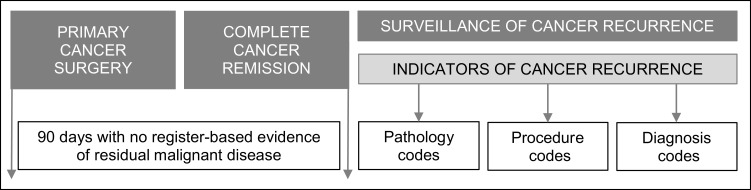
Indicators of recurrence were diagnosis and procedure codes recorded in the Danish National Patient Register and pathology results recorded in the Danish National Pathology Register. Medical records on recurrence status and recurrence date in the Danish Melanoma Database served as the gold standard to assess the accuracy of the algorithm.
The study included 1747 patients diagnosed with malignant melanoma; 95 (5.4%) were diagnosed with recurrence of malignant melanoma according to the gold standard. The algorithm reached a sensitivity of 93.7% (95% confidence interval (CI) 86.8-97.6), a specificity of 99.2% (95% CI: 98.6-99.5), a positive predictive value of 86.4% (95% CI: 78.2-92.4), and negative predictive value of 99.6% (95% CI: 99.2-99.9). Lin's concordance correlation coefficient was 0.992 (95% CI: 0.989-0.996) for the agreement between the recurrence dates generated by the algorithm and by the gold standard.
The algorithm can be used to identify patients diagnosed with recurrence of malignant melanoma and to establish the timing of recurrence. This can generate population-level evidence on disease-free survival and diagnostic pathways for recurrence of malignant melanoma.
除临床试验外,癌症复发信息很少能获取到。临床试验中广泛使用的排除标准往往会限制研究结果对所有癌症患者群体的普遍适用性。因此,需要基于人群层面的证据。本研究的目的是开发并验证一种基于登记册的算法,以识别恶性黑色素瘤根治性治疗后被诊断为复发的患者。
复发指标为丹麦国家患者登记册中记录的诊断和手术编码,以及丹麦国家病理登记册中记录的病理结果。丹麦黑色素瘤数据库中关于复发状态和复发日期的医疗记录作为评估该算法准确性的金标准。
该研究纳入了1747例被诊断为恶性黑色素瘤的患者;根据金标准,95例(5.4%)被诊断为恶性黑色素瘤复发。该算法的灵敏度为93.7%(95%置信区间(CI)86.8 - 97.6),特异度为99.2%(95% CI:98.6 - 99.5),阳性预测值为86.4%(95% CI:78.2 - 92.4),阴性预测值为99.6%(95% CI:99.2 - 99.9)。该算法生成的复发日期与金标准生成的复发日期之间的一致性,林氏一致性相关系数为0.992(95% CI:0.989 - 0.996)。
该算法可用于识别被诊断为恶性黑色素瘤复发的患者,并确定复发时间。这可以生成关于恶性黑色素瘤无病生存期和复发诊断途径的人群层面证据。