TIMI Study Group, Division of Cardiovascular Medicine, Brigham and Women's Hospital, Harvard Medical School, 60 Fenwood Road, Suite 7022, Boston, MA 02115, USA.
Department of Cardiovascular Medicine, Tohoku University Graduate School of Medicine, 1-1 Seiryo-machi, Aoba-ku, Sendai 980-8574, Japan.
Eur Heart J. 2021 May 1;42(17):1698-1706. doi: 10.1093/eurheartj/ehab141.
We investigated whether patients with atrial fibrillation (AF) demonstrate detectable changes in biomarkers including high-sensitivity troponin T (hsTnT), N-terminal B-type natriuretic peptide (NT-proBNP), and growth differentiation factor-15 (GDF-15) over 12 months and whether such changes from baseline to 12 months are associated with the subsequent risk of stroke or systemic embolic events (S/SEE) and bleeding.
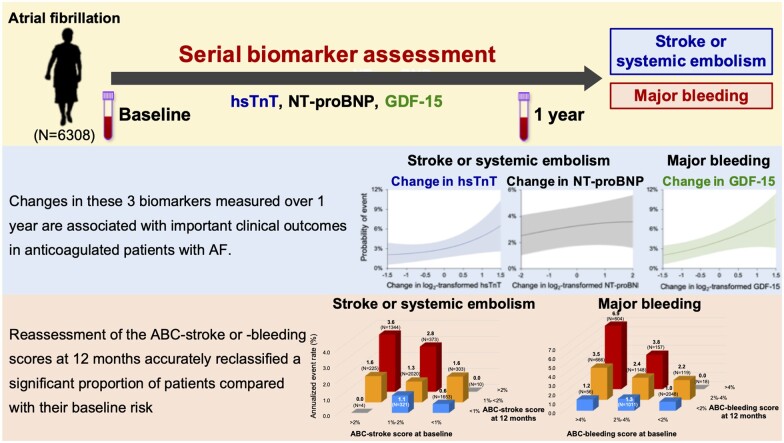
ENGAGE AF-TIMI 48 was a randomized trial of the oral factor Xa inhibitor edoxaban in patients with AF and a CHADS2 score of ≥2. We performed a nested prospective biomarker study in 6308 patients, analysing hsTnT, NT-proBNP, and GDF-15 at baseline and 12 months. hsTnT was dynamic in 46.9% (≥2 ng/L change), NT-proBNP in 51.9% (≥200 pg/mL change), GDF-15 in 45.6% (≥300 pg/mL change) during 12 months. In a Cox regression model, upward changes in log2-transformed hsTnT and NT-proBNP were associated with increased risk of S/SEE [adjusted hazard ratio (adj-HR) 1.74; 95% confidence interval (CI) 1.36-2.23 and adj-HR 1.27; 95% CI 1.07-1.50, respectively] and log2-transformed GDF-15 with bleeding (adj-HR 1.40; 95% CI 1.02-1.92). Reassessment of ABC-stroke (age, prior stroke/transient ischaemic attack, hsTnT, and NT-proBNP) and ABC-bleeding (age, prior bleeding, haemoglobin, hsTnT, and GDF-15) risk scores at 12 months accurately reclassified a significant proportion of patients compared with their baseline risk [net reclassification improvement (NRI) 0.50; 95% CI 0.36-0.65; NRI 0.42; 95% CI 0.33-0.51, respectively].
Serial assessment of hsTnT, NT-proBNP, and GDF-15 revealed that a substantial proportion of patients with AF had dynamic values. Greater increases in these biomarkers measured over 1 year are associated with important clinical outcomes in anticoagulated patients with AF.
我们旨在研究房颤(AF)患者在 12 个月期间是否存在包括高敏肌钙蛋白 T(hsTnT)、N 末端 B 型利钠肽前体(NT-proBNP)和生长分化因子 15(GDF-15)等生物标志物的可检测变化,以及这些从基线到 12 个月的变化是否与随后的中风或全身性栓塞事件(S/SEE)和出血风险相关。
ENGAGE AF-TIMI 48 是一项针对口服 Xa 因子抑制剂依度沙班在 AF 合并 CHADS2 评分≥2 的患者中的随机试验。我们在 6308 例患者中进行了一项嵌套前瞻性生物标志物研究,分析了基线和 12 个月时的 hsTnT、NT-proBNP 和 GDF-15。在 12 个月期间,hsTnT 有 46.9%(≥2ng/L 变化)、NT-proBNP 有 51.9%(≥200pg/mL 变化)、GDF-15 有 45.6%(≥300pg/mL 变化)呈动态变化。在 Cox 回归模型中,log2 转化后的 hsTnT 和 NT-proBNP 升高与 S/SEE 风险增加相关[校正后风险比(adj-HR)1.74;95%置信区间(CI)1.36-2.23 和 adj-HR 1.27;95%CI 1.07-1.50],log2 转化后的 GDF-15 与出血相关(adj-HR 1.40;95%CI 1.02-1.92)。与基线风险相比,12 个月时 ABC 中风(年龄、既往中风/短暂性脑缺血发作、hsTnT 和 NT-proBNP)和 ABC 出血(年龄、既往出血、血红蛋白、hsTnT 和 GDF-15)风险评分的重新评估准确地对更大比例的患者进行了重新分类[净重新分类改善(NRI)0.50;95%CI 0.36-0.65;NRI 0.42;95%CI 0.33-0.51]。
hsTnT、NT-proBNP 和 GDF-15 的连续评估显示,相当一部分 AF 患者的检测值存在动态变化。这些生物标志物在 1 年内的测量值增加越多,与接受抗凝治疗的 AF 患者的重要临床结局相关。