Department of Radiation Oncology, University Hospital, LMU Munich, Munich, Germany.
Medical Faculty, Department of Diagnostic and Interventional Radiology, University Dusseldorf, D-40225, Dusseldorf, Germany.
Eur J Nucl Med Mol Imaging. 2021 Nov;48(12):3975-3989. doi: 10.1007/s00259-021-05211-8. Epub 2021 Mar 24.
The advent of immune checkpoint inhibitors (ICIs) has revolutionized the treatment of advanced NSCLC, leading to a string of approvals in recent years. Herein, a narrative review on the role of 18F-fluorodeoxyglucose positron emission tomography/computed tomography (FDG PET/CT) in the ever-evolving treatment landscape of advanced NSCLC is presented.
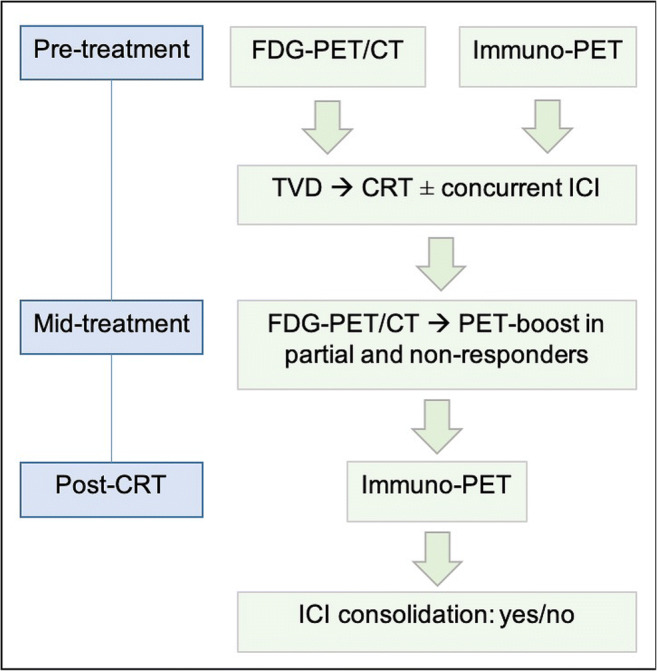
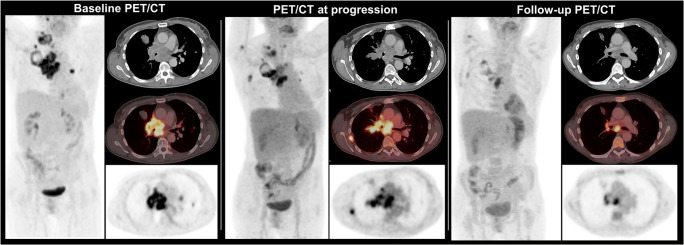
This comprehensive review will begin with an introduction into current treatment paradigms incorporating ICIs; the evolution of CT-based criteria; moving onto novel phenomena observed with ICIs and the current state of hybrid imaging for diagnosis, treatment planning, evaluation of treatment efficacy and toxicity in advanced NSCLC, also taking into consideration its limitations and future directions.
The advent of ICIs marks the dawn of a new era bringing forth new challenges particularly vis-à-vis treatment response assessment and observation of novel phenomena accompanied by novel systemic side effects. While FDG PET/CT is widely adopted for tumor volume delineation in locally advanced disease, response assessment to immunotherapy based on current criteria is of high clinical value but has its inherent limitations. In recent years, modifications of established (PET)/CT criteria have been proposed to provide more refined approaches towards response evaluation. Not only a comprehensive inclusion of PET-based response criteria in prospective randomized controlled trials, but also a general harmonization within the variety of PET-based response criteria is pertinent to strengthen clinical implementation and widespread use of hybrid imaging for response assessment in NSCLC.
免疫检查点抑制剂(ICIs)的出现彻底改变了晚期 NSCLC 的治疗方式,近年来相继获得批准。本文对 18F-氟脱氧葡萄糖正电子发射断层扫描/计算机断层扫描(FDG PET/CT)在晚期 NSCLC 不断发展的治疗领域中的作用进行了综述。
本综述将首先介绍当前纳入 ICIs 的治疗模式;基于 CT 的标准演变;接着介绍与 ICIs 相关的新型现象以及当前晚期 NSCLC 诊断、治疗计划、治疗效果评估和毒性评估的混合成像现状,同时考虑其局限性和未来方向。
ICIs 的出现标志着一个新时代的到来,带来了新的挑战,特别是在治疗反应评估和观察伴随新型全身副作用的新型现象方面。虽然 FDG PET/CT 广泛应用于局部晚期疾病的肿瘤体积勾画,但基于当前标准的免疫治疗反应评估具有很高的临床价值,但也存在固有局限性。近年来,已经提出了对既定(PET)/CT 标准的修改,以提供更精细的反应评估方法。不仅需要将基于 PET 的反应标准全面纳入前瞻性随机对照试验,还需要在各种基于 PET 的反应标准之间进行普遍协调,以加强 NSCLC 反应评估中混合成像的临床实施和广泛应用。