University of Health Sciences Fatih Sultan Mehmet Health Application and Research Center, Anesthesiology and Reanimation Department, Istanbul, Turkey.
University of Health Sciences Fatih Sultan Mehmet Health Application and Research Center, Anesthesiology and Reanimation Department, Istanbul, Turkey.
Braz J Anesthesiol. 2021 Jul-Aug;71(4):381-386. doi: 10.1016/j.bjane.2020.12.027. Epub 2021 Mar 21.
The risk of emergence agitation (EA) is high in patients undergoing nasal surgery. The aim of the present study was to investigate the incidence of EA in adults undergoing septoplasty and the effect of ketamine on EA.
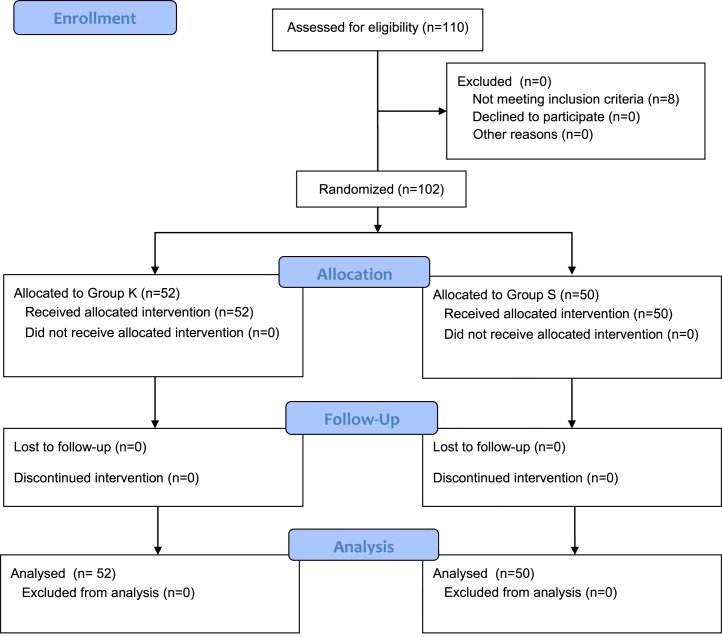
In this randomized study, a total of 102 ASA I-II patients who underwent septoplasty between July 2018 and April 2019 were divided into two groups: ketamine (Group-K, n=52) and saline (Group-S, n=50). After anesthesia induction, Group-K was intravenously administered 20mL of saline containing 1mgkg ketamine, whereas Group-S was administered 20mL of saline. Sedation and agitation scores at emergence from anesthesia, incidence of cough, emergence time, and response to verbal stimuli time were recorded. The sedation/agitation and pain levels were recorded for 30minutes in the recovery unit.
There was no significant difference between the groups in terms of the incidence of EA (Group-K: 15.4%, Group-S: 24%). The incidence of cough during emergence was higher in Group-S than in Group-K, but the response time to verbal stimuli and emergence time were shorter in Group-S. The sedation and agitation scores were similar after surgery. Pain scores were higher in Group-S at the time of admission to the recovery unit and were similar between groups in the other time points.
Administration of 1mgkg ketamine after anesthesia induction does not affect the incidence of EA in patients undergoing septoplasty, but it prolongs the emergence and response time to verbal stimuli and reduces the incidence of cough.
行鼻部手术的患者发生苏醒期躁动(EA)的风险较高。本研究旨在调查行鼻中隔成形术的成年人中 EA 的发生率,以及氯胺酮对 EA 的影响。
在这项随机研究中,将 2018 年 7 月至 2019 年 4 月间行鼻中隔成形术的 102 例 ASA I-II 级患者分为两组:氯胺酮组(Group-K,n=52)和生理盐水组(Group-S,n=50)。麻醉诱导后,Group-K 组静脉给予含 1mgkg 氯胺酮的 20mL 生理盐水,而 Group-S 组给予 20mL 生理盐水。记录麻醉苏醒时的镇静/躁动评分、咳嗽发生率、苏醒时间和对言语刺激的反应时间。在恢复室中记录 30 分钟内的镇静/躁动和疼痛程度。
两组 EA 的发生率无显著差异(Group-K:15.4%,Group-S:24%)。与 Group-K 组相比,Group-S 组在苏醒时咳嗽的发生率更高,但对言语刺激的反应时间和苏醒时间更短。手术后两组的镇静和躁动评分相似。在进入恢复室时,Group-S 的疼痛评分较高,而在其他时间点两组之间的疼痛评分相似。
麻醉诱导后给予 1mgkg 氯胺酮不会影响行鼻中隔成形术患者的 EA 发生率,但会延长苏醒时间和对言语刺激的反应时间,并降低咳嗽的发生率。