Department of Health Sciences Education, University of Cape Town, Cape Town.
Curationis. 2021 Mar 8;44(1):e1-e12. doi: 10.4102/curationis.v44i1.2073.
South Africa has made enormous progress in reducing mother-to-child transmission (MTCT) of human immunodeficiency virus (HIV), however, MTCT and AIDS related death persist among children particularly in the rural areas. Lack of adherence to health policies and guidelines implementation remain one of the contributory factors to poor management of HIV-exposed children. Hence, the need to deeply explore the complexity of the problems and understand the barriers to the management of HIV exposed children in the rural areas.
To explore and synthesise the barriers to the management of children under 5 years old exposed to HIV in rural areas in South Africa.
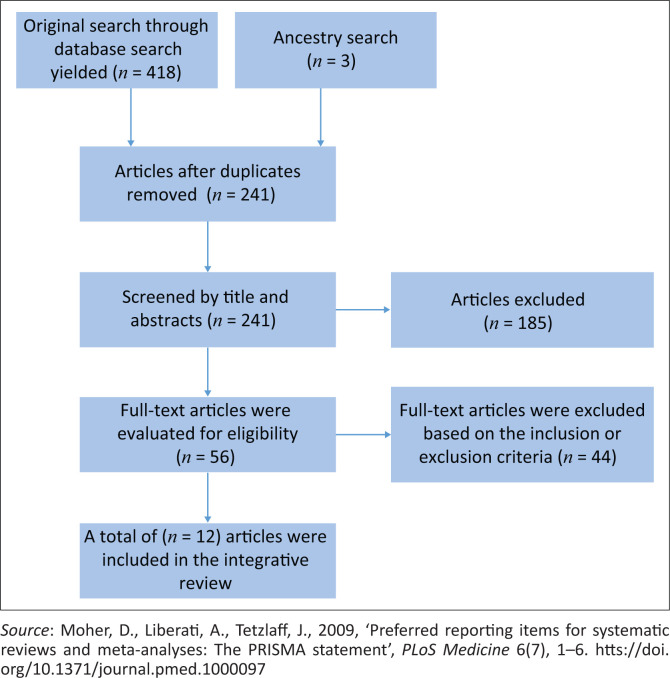
An integrative literature review was conducted. An electronic search was conducted on several databases. The researchers applied the Boolean ' AND'/'OR' in combination with phrases such as 'HIV infection*', 'HIV transmission', 'HIV-exposed infant*, child*, and neonate*' and 'South Africa*'. Included studies were limited to South Africa, and articles were written in English and published in peer-reviewed journals from 2005 to 2018. Both qualitative and quantitative studies between 2005 and 2018 were utilised.
The findings highlighted that healthcare institution-related barriers, healthcare provider-related barriers, patient-related barriers and Socio-economic-related barriers were the significant barriers to the management of HIV-exposed children in the rural areas.
Continuous engagement with all relevant stakeholders should remain a priority in protecting HIV-exposed children. It is evident that there exist gaps in the current implementation of prevention of mother-to-child transmission (PMTCT), especially in rural areas. Therefore, intervention strategies that could improve implementation of PMTCT policy guidelines for HIV-exposed children in rural areas are needed.
南非在减少母婴传播(MTCT)艾滋病毒(HIV)方面取得了巨大进展,但 MTCT 和艾滋病相关死亡仍在儿童中持续存在,尤其是在农村地区。未能坚持执行卫生政策和准则仍然是导致 HIV 暴露儿童管理不善的原因之一。因此,需要深入探讨问题的复杂性,并了解农村地区管理 HIV 暴露儿童的障碍。
探索和综合分析南非农村地区管理 5 岁以下 HIV 暴露儿童的障碍。
进行了综合文献回顾。在多个数据库中进行了电子搜索。研究人员使用了布尔逻辑运算符 'AND'/'OR',并结合了一些短语,如 'HIV 感染*'、'HIV 传播'、'HIV 暴露婴儿*'、'儿童*' 和 '新生儿*' 以及 '南非*'。纳入的研究仅限于南非,并且文章必须为英文,发表于 2005 年至 2018 年的同行评审期刊上。研究使用了 2005 年至 2018 年间的定性和定量研究。
研究结果强调,医疗保健机构相关障碍、医疗保健提供者相关障碍、患者相关障碍和社会经济相关障碍是农村地区管理 HIV 暴露儿童的重要障碍。
与所有相关利益攸关方保持持续接触应仍然是保护 HIV 暴露儿童的优先事项。显然,目前预防母婴传播(PMTCT)的实施存在差距,特别是在农村地区。因此,需要制定干预策略,以改善农村地区 HIV 暴露儿童 PMTCT 政策指南的实施。