Oncology, Hematology, and Cell Therapy Department, French National Agency for Medicines and Health Product Safety (ANSM), Saint-Denis, France.
Faculty of Medicine, University of Montpellier, Montpellier, France.
Cancer. 2021 Jul 1;127(13):2262-2270. doi: 10.1002/cncr.33492. Epub 2021 Mar 25.
The arrival of immunotherapies and targeted therapies challenged the authorities to make them available as soon as possible. France has effective tools, such as clinical trials (CTs) and a national early access program (temporary authorizations for use [ATUs] and temporary recommendations for use [RTUs]), allowing the use of innovative drugs, whether or not they have been authorized or used off-label, for cases that have reached a therapeutic impasse.
The methodology involved real-time data collection from ATUs, RTUs (between September 1, 2009 and September 1, 2019), and CT authorizations (from December 1, 2017 to September 1, 2019) that were filed and reviewed by the French National Agency for Medicines for metastatic melanoma (MM).
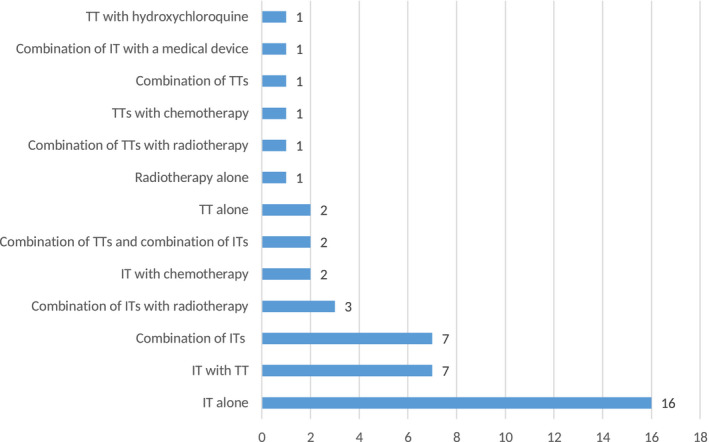
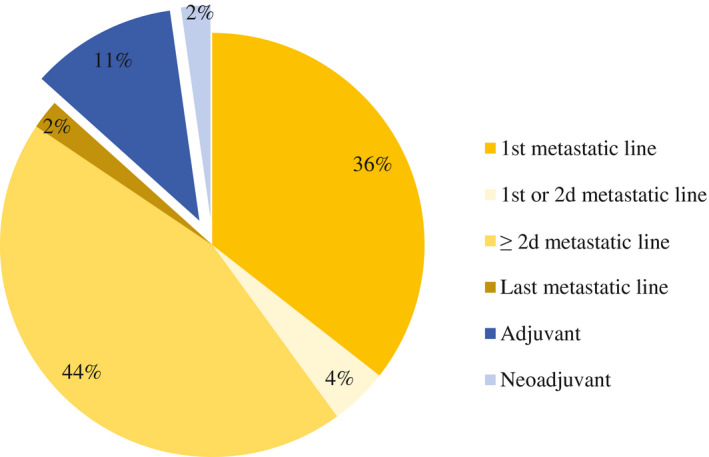
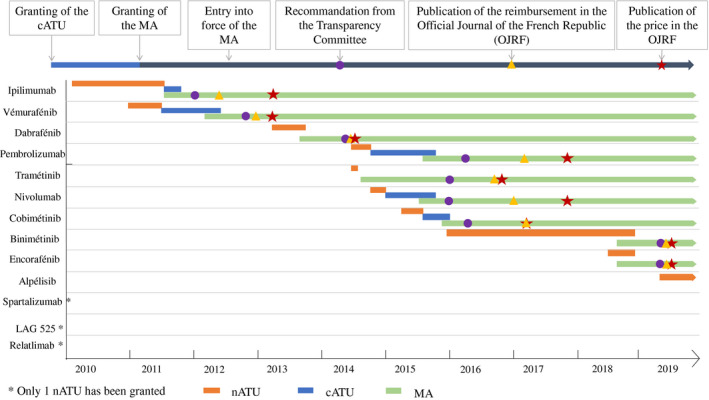
In total, 45 CTs were authorized for MM (51% early phase trials and 44% phase 2 and 3 trials), mainly for the metastatic line (86%) and with an industrial sponsor (73%). Immunotherapies and targeted therapies (63% and 24%, respectively) mostly were used in combination. Three RTUs were authorized for the adjuvant treatment of MM, whereas 13 drugs were available through nominal ATUs (nATUs), of which 5 were awarded a cohort ATU (cATU). This enabled the treatment of 6538 patients (28% through nATUs and 72% through cATUs). All of these drugs were granted marketing authorization and were included in the reimbursement list.
Thanks to CTs and the national early access program, patients in France have been able to benefit from innovative MM treatments.
Several tools allow the use of innovative drugs in France, even if they are not yet authorized or used off-label. From December 1, 2017 to September 1, 2019, 45 clinical trials have been authorized for metastatic melanoma, mostly using immunotherapy (63%) and targeted therapy (24%) at an early phase (51%). Since 2010, the national early access program has treated 6538 patients, including 28% under nominative temporary authorizations for use and 72% under cohort temporary authorizations for use. Fourteen drugs are available through nominative temporary authorizations for use, and 5 are available through cohort temporary authorizations for use, and all of these drugs were granted marketing authorization.
免疫疗法和靶向疗法的出现,使得当局面临尽快将其提供给患者的挑战。法国拥有有效的工具,如临床试验(CTs)和国家早期准入计划(临时使用授权[ATUs]和临时使用建议[RTUs]),允许使用创新药物,无论是否已获得批准或未经批准使用,用于治疗已达到治疗僵局的病例。
该方法涉及从 ATUs、RTUs(2009 年 9 月 1 日至 2019 年 9 月 1 日)和 CT 授权(2017 年 12 月 1 日至 2019 年 9 月 1 日)中实时收集数据,这些授权由法国国家药品管理局(ANSM)审查和备案。
共有 45 项 CT 被授权用于 MM(51%的早期阶段试验和 44%的 2 期和 3 期试验),主要用于转移性疾病(86%),且由工业赞助商赞助(73%)。免疫疗法和靶向疗法(分别为 63%和 24%)主要联合使用。有 3 项 RTU 被授权用于 MM 的辅助治疗,而有 13 种药物通过名义临时授权(nATUs)获得,其中 5 种药物获得了队列临时授权(cATUs)。这使得 6538 名患者得到了治疗(28%通过 nATUs,72%通过 cATUs)。所有这些药物都获得了上市许可,并被列入了报销清单。
由于 CTs 和国家早期准入计划,法国的患者能够受益于创新的 MM 治疗方法。
有几种工具可在法国使用创新药物,即使这些药物尚未获得批准或未经批准使用。自 2017 年 12 月 1 日至 2019 年 9 月 1 日,已有 45 项转移性黑色素瘤临床试验获得授权,主要采用免疫疗法(63%)和靶向疗法(24%)在早期阶段(51%)。自 2010 年以来,国家早期准入计划已治疗了 6538 名患者,其中 28%接受了名义临时使用授权,72%接受了队列临时使用授权。有 14 种药物可通过名义临时授权获得,有 5 种药物可通过队列临时授权获得,所有这些药物都获得了上市许可。