Department of Biology, University of Florida, Gainesville, Florida, United States of America.
Emerging Pathogens Institute, University of Florida, Gainesville, Florida, United States of America.
PLoS Negl Trop Dis. 2021 Mar 25;15(3):e0009063. doi: 10.1371/journal.pntd.0009063. eCollection 2021 Mar.
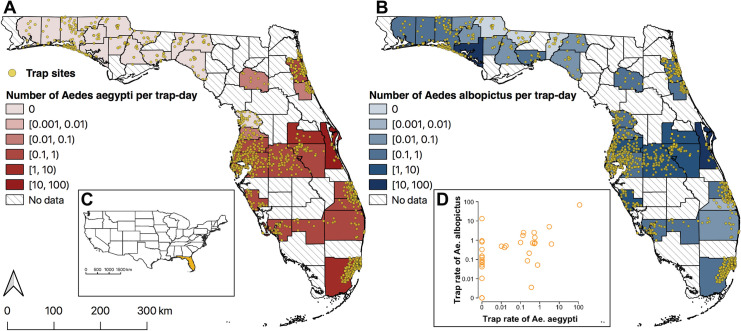
Florida faces the challenge of repeated introduction and autochthonous transmission of arboviruses transmitted by Aedes aegypti and Aedes albopictus. Empirically-based predictive models of the spatial distribution of these species would aid surveillance and vector control efforts. To predict the occurrence and abundance of these species, we fit a mixed-effects zero-inflated negative binomial regression to a mosquito surveillance dataset with records from more than 200,000 trap days, representative of 53% of the land area and ranging from 2004 to 2018 in Florida. We found an asymmetrical competitive interaction between adult populations of Aedes aegypti and Aedes albopictus for the sampled sites. Wind speed was negatively associated with the occurrence and abundance of both vectors. Our model predictions show high accuracy (72.9% to 94.5%) in validation tests leaving out a random 10% subset of sites and data since 2017, suggesting a potential for predicting the distribution of the two Aedes vectors.
佛罗里达州面临着由埃及伊蚊和白纹伊蚊传播的虫媒病毒反复传入和本地传播的挑战。基于经验的这些物种的空间分布预测模型将有助于监测和病媒控制工作。为了预测这些物种的发生和丰度,我们对超过 20 万 Trap 天的蚊子监测数据集进行了混合效应零膨胀负二项回归拟合,这些数据代表了佛罗里达州 53%的土地面积,时间范围从 2004 年到 2018 年。我们发现,在采样点,埃及伊蚊和白纹伊蚊成蚊种群之间存在不对称的竞争相互作用。风速与两种病媒的发生和丰度呈负相关。我们的模型预测在验证测试中表现出很高的准确性(72.9%到 94.5%),验证测试中排除了随机选择的 10%的站点和 2017 年以来的数据,这表明预测两种埃及伊蚊传播的病媒的分布具有一定潜力。