Department of Industrial Engineering, Pontifical Catholic University of Rio de Janeiro, Rio de Janeiro, RJ, Brazil.
Instituto Tecgraf, Pontifical Catholic University of Rio de Janeiro, Rio de Janeiro, RJ, Brazil.
PLoS One. 2021 Mar 25;16(3):e0248920. doi: 10.1371/journal.pone.0248920. eCollection 2021.
Tests are scarce resources, especially in low and middle-income countries, and the optimization of testing programs during a pandemic is critical for the effectiveness of the disease control. Hence, we aim to use the combination of symptoms to build a predictive model as a screening tool to identify people and areas with a higher risk of SARS-CoV-2 infection to be prioritized for testing.
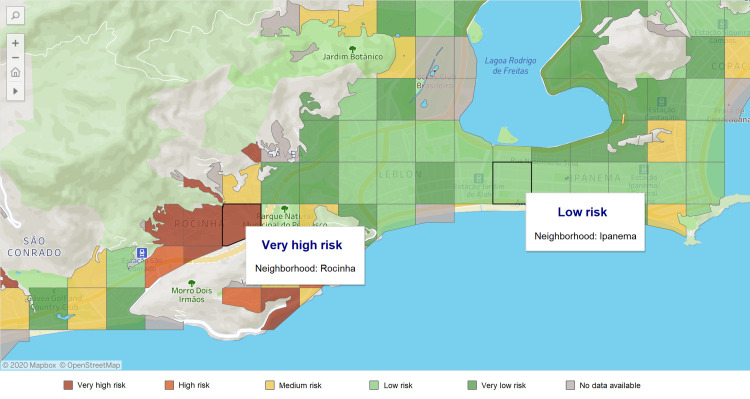
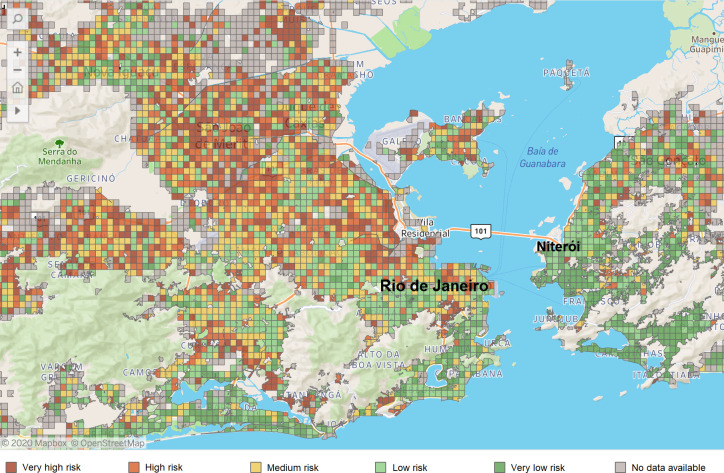
We performed a retrospective analysis of individuals registered in "Dados do Bem," a Brazilian app-based symptom tracker. We applied machine learning techniques and provided a SARS-CoV-2 infection risk map of Rio de Janeiro city.
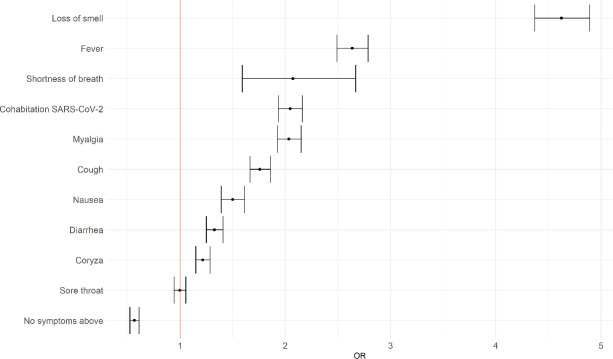
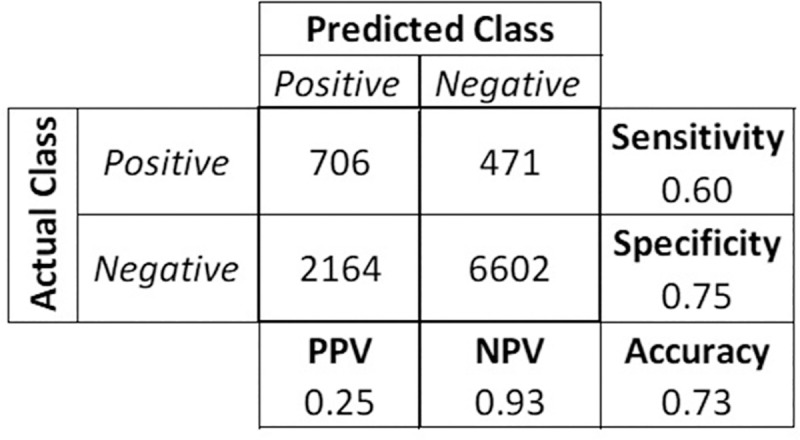
From April 28 to July 16, 2020, 337,435 individuals registered their symptoms through the app. Of these, 49,721 participants were tested for SARS-CoV-2 infection, being 5,888 (11.8%) positive. Among self-reported symptoms, loss of smell (OR[95%CI]: 4.6 [4.4-4.9]), fever (2.6 [2.5-2.8]), and shortness of breath (2.1 [1.6-2.7]) were independently associated with SARS-CoV-2 infection. Our final model obtained a competitive performance, with only 7% of false-negative users predicted as negatives (NPV = 0.93). The model was incorporated by the "Dados do Bem" app aiming to prioritize users for testing. We developed an external validation in the city of Rio de Janeiro. We found that the proportion of positive results increased significantly from 14.9% (before using our model) to 18.1% (after the model).
Our results showed that the combination of symptoms might predict SARS-Cov-2 infection and, therefore, can be used as a tool by decision-makers to refine testing and disease control strategies.
检测资源稀缺,尤其是在中低收入国家,因此大流行期间优化检测计划对于疾病控制的有效性至关重要。因此,我们旨在使用症状组合建立预测模型作为筛查工具,以识别具有更高 SARS-CoV-2 感染风险的人群和地区,以便优先进行检测。
我们对在巴西基于应用程序的症状跟踪器“Dados do Bem”中注册的个体进行了回顾性分析。我们应用了机器学习技术,并提供了里约热内卢市的 SARS-CoV-2 感染风险图。
从 2020 年 4 月 28 日至 7 月 16 日,有 337435 人通过该应用程序登记了他们的症状。其中,有 49721 名参与者接受了 SARS-CoV-2 感染检测,有 5888 人(11.8%)呈阳性。在自我报告的症状中,嗅觉丧失(OR[95%CI]:4.6 [4.4-4.9])、发热(2.6 [2.5-2.8])和呼吸急促(2.1 [1.6-2.7])与 SARS-CoV-2 感染独立相关。我们的最终模型表现出色,只有 7%的假阴性用户被预测为阴性(NPV=0.93)。该模型已被“Dados do Bem”应用程序采用,旨在优先为用户进行检测。我们在里约热内卢市进行了外部验证。我们发现,阳性结果的比例从使用模型前的 14.9%显著增加到使用模型后的 18.1%。
我们的结果表明,症状组合可能预测 SARS-CoV-2 感染,因此可以作为决策者完善检测和疾病控制策略的工具。