Diagnostic and Pediatric Sciences, University of Pavia, Pavia, Italy.
Indian Council of Medical Research, New Delhi, India.
Crit Rev Clin Lab Sci. 2022 Nov;59(7):445-459. doi: 10.1080/10408363.2022.2045250. Epub 2022 Mar 15.
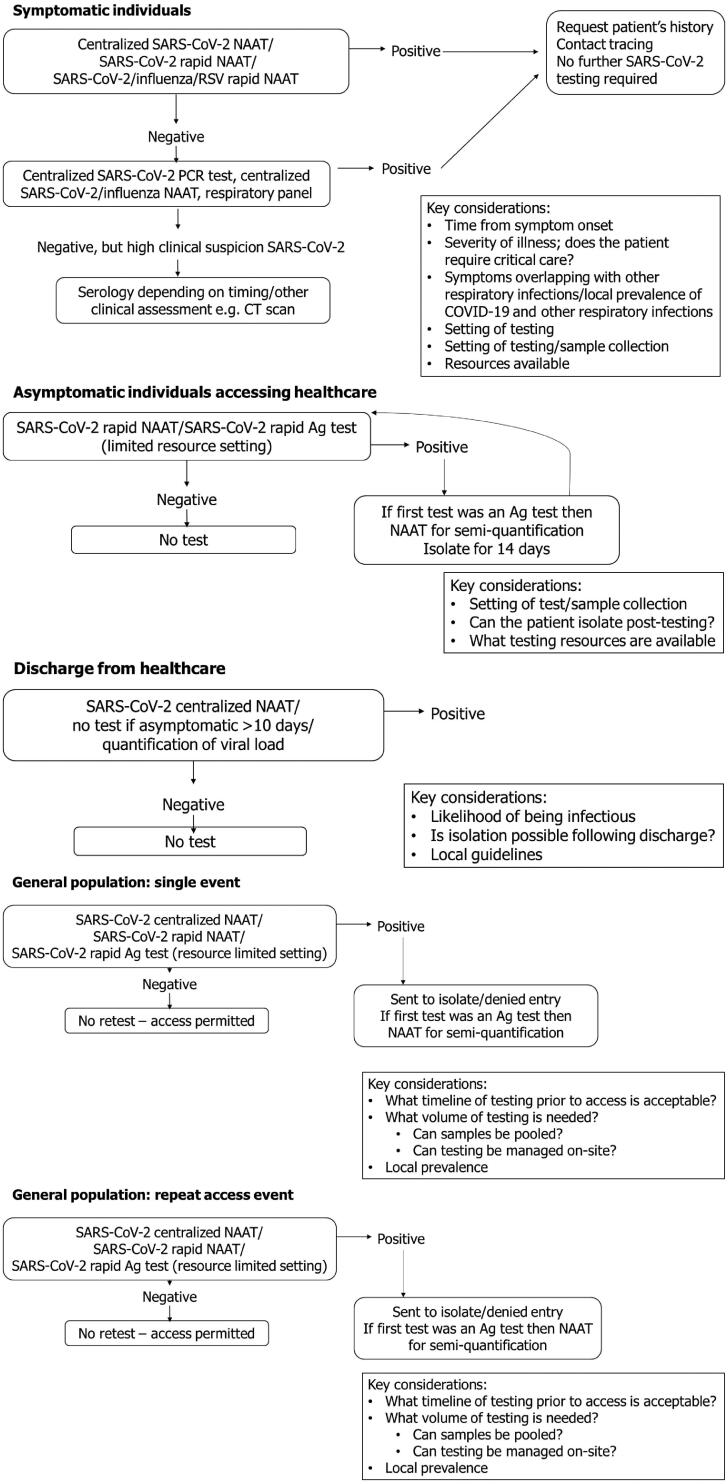
A plethora of severe acute respiratory syndrome coronavirus 2 (SARS-CoV-2) diagnostic tests are available, each with different performance specifications, detection methods, and targets. This narrative review aims to summarize the diagnostic technologies available and how they are best selected to tackle SARS-CoV-2 infection as the pandemic evolves. Seven key settings have been identified where diagnostic tests are being deployed: symptomatic individuals presenting for diagnostic testing and/or treatment of COVID-19 symptoms; asymptomatic individuals accessing healthcare for planned non-COVID-19-related reasons; patients needing to access emergency care (symptom status unknown); patients being discharged from healthcare following hospitalization for COVID-19; healthy individuals in both single event settings (e.g. airports, restaurants, hotels, concerts, and sporting events) and repeat access settings (e.g. workplaces, schools, and universities); and vaccinated individuals. While molecular diagnostics remain central to SARS-CoV-2 testing strategies, we have offered some discussion on the considerations for when other tools and technologies may be useful, when centralized/point-of-care testing is appropriate, and how the various additional diagnostics can be deployed in differently resourced settings. As the pandemic evolves, molecular testing remains important for definitive diagnosis, but increasingly widespread point-of-care testing is essential to the re-opening of society.
有大量的严重急性呼吸综合征冠状病毒 2 (SARS-CoV-2) 诊断检测方法可供选择,每种方法都具有不同的性能规格、检测方法和检测目标。本综述旨在总结现有的诊断技术,以及在大流行不断发展的情况下,如何根据具体情况选择合适的诊断方法来应对 SARS-CoV-2 感染。已确定了七种使用诊断测试的关键环境:有症状的个体因 COVID-19 症状就诊进行诊断测试和/或治疗;因计划进行非 COVID-19 相关的医疗原因而寻求医疗服务的无症状个体;需要紧急护理的患者(症状状况未知);因 COVID-19 住院后出院的患者;在单次活动场所(如机场、餐厅、酒店、音乐会和体育赛事)和重复活动场所(如工作场所、学校和大学)的健康个体;以及接种疫苗的个体。虽然分子诊断仍然是 SARS-CoV-2 检测策略的核心,但我们还讨论了在何时其他工具和技术可能有用、何时集中/床边检测合适以及如何在资源不同的环境中部署各种其他诊断方法的考虑因素。随着大流行的发展,分子检测仍然是明确诊断的重要手段,但越来越广泛的床边检测对于社会重新开放至关重要。