Department of Pediatrics, Faculty of Medicine, Menoufia University, Shebin Elkom, Egypt.
Department of Public Health and community Medicine, Faculty of Medicine, Menoufia University, Shebin Elkom, Egypt.
BMC Pediatr. 2021 Mar 25;21(1):144. doi: 10.1186/s12887-021-02614-2.
Emergence of 2019-nCoV attracted global attention and WHO declared COVID-19 a public health emergency of international concern. Therefore we aimed to explore the severity and atypical manifestations of COVID-19 among children.
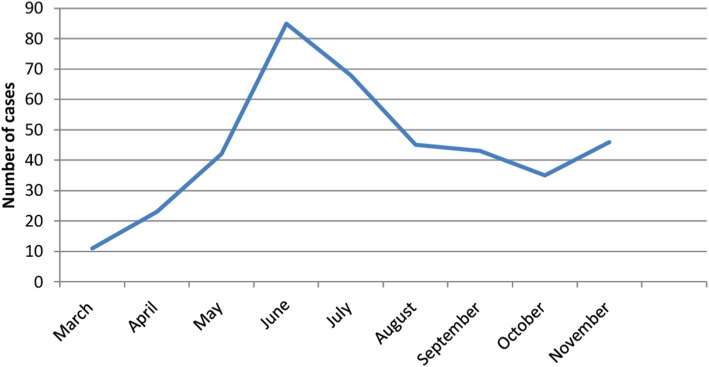
This is an observational cohort study conducted on 398 children with confirmed COVID-19 by using real-time reverse transcriptase polymerase chain reaction assay for detection of 2019-nCoV nucleic acid during the period from March to November 2020. Patients were subdivided regarding the severity of COVID-19 presentation into Group I (Non-severe COVID-19) was admitted into wards and Group II (Severe COVID-19) admitted into the PICU.
Non- severe cases were 295cases (74.1%) and 103cases (25.9%) of severe cases. There was a significant difference between age groups of the affected children (P < 0.001) with a median (0-15 years). Boys (52%) are more affected than girls (48%) with significant differences (P < 0.001). 68.6%of confirmed cases had contact history to family members infected with COVID-19. 41.7% of severe patients needed mechanical ventilation. Death of 20.4% of severe cases. In COVID-19 patients, fever, headache, fatigue and shock were the most prominent presentations (95, 60.3, 57.8, and 21.8% respectively). 3.5% of children were manifested with atypical presentations; 1.25% manifested by pictures of acute pancreatitis, 1.25% presented by manifestations of deep venous thrombosis and 1.0% had multisystem inflammatory syndrome (MIS-C). Multivariate regression analysis showed that COVID-19 severity in children was significantly higher among children with higher levels of D-dimer, hypoxia, shock and mechanical ventilation.
Most children had a non-severe type of COVID-19 and children with severe type had higher levels of D-dimer, hypoxia, shock and mechanical ventilation.
2019 年新型冠状病毒的出现引起了全球关注,世界卫生组织宣布 COVID-19 为国际关注的突发公共卫生事件。因此,我们旨在探讨儿童 COVID-19 的严重程度和非典型表现。
这是一项观察性队列研究,对 2020 年 3 月至 11 月期间通过实时逆转录聚合酶链反应检测 2019 年新型冠状病毒核酸确诊的 398 例儿童进行了研究。根据 COVID-19 表现的严重程度将患者分为两组:I 组(非严重 COVID-19)为病房住院患者,II 组(严重 COVID-19)为 PICU 住院患者。
非严重病例 295 例(74.1%),严重病例 103 例(25.9%)。受影响儿童的年龄组之间存在显著差异(P<0.001),中位数(0-15 岁)。男孩(52%)比女孩(48%)受影响更严重,差异有统计学意义(P<0.001)。68.6%的确诊病例有与 COVID-19 感染家庭成员的接触史。41.7%的严重患者需要机械通气。20.4%的严重病例死亡。在 COVID-19 患者中,发热、头痛、乏力和休克是最突出的表现(分别为 95%、60.3%、57.8%和 21.8%)。3.5%的儿童表现为非典型表现;1.25%表现为急性胰腺炎,1.25%表现为深静脉血栓形成,1.0%表现为多系统炎症综合征(MIS-C)。多变量回归分析显示,儿童 COVID-19 严重程度与 D-二聚体、缺氧、休克和机械通气水平较高显著相关。
大多数儿童为非严重型 COVID-19,严重型儿童的 D-二聚体、缺氧、休克和机械通气水平较高。