University Department of Surgery, Royal Free Hospital, Pond Street, London, NW3 2QG, UK.
BMC Med Educ. 2021 Mar 25;21(1):181. doi: 10.1186/s12909-021-02609-8.
In the context of the ongoing pandemic, e-learning has become essential to maintain existing medical educational programmes. Evaluation of such courses has thus far been on a small scale at single institutions. Further, systematic appraisal of the large volume of qualitative feedback generated by massive online e-learning courses manually is time consuming. This study aimed to evaluate the impact of an e-learning course targeting medical students collaborating in an international cohort study, with semi-automated analysis of feedback using text mining and machine learning methods.
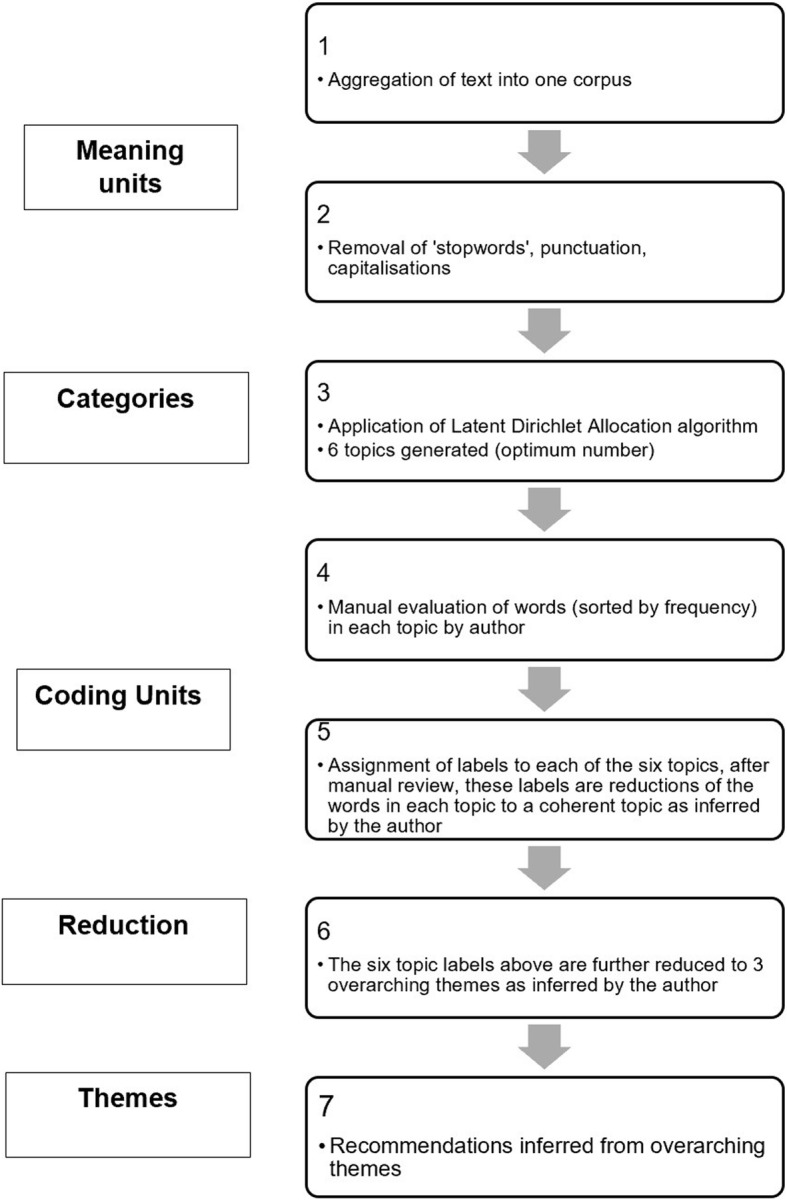
This study was based on a multi-centre cohort study exploring gastrointestinal recovery following elective colorectal surgery. Collaborators were invited to complete a series of e-learning modules on key aspects of the study and complete a feedback questionnaire on the modules. Quantitative data were analysed using simple descriptive statistics. Qualitative data were analysed using text mining with most frequent words, sentiment analysis with the AFINN-111 and syuzhet lexicons and topic modelling using the Latent Dirichlet Allocation (LDA).
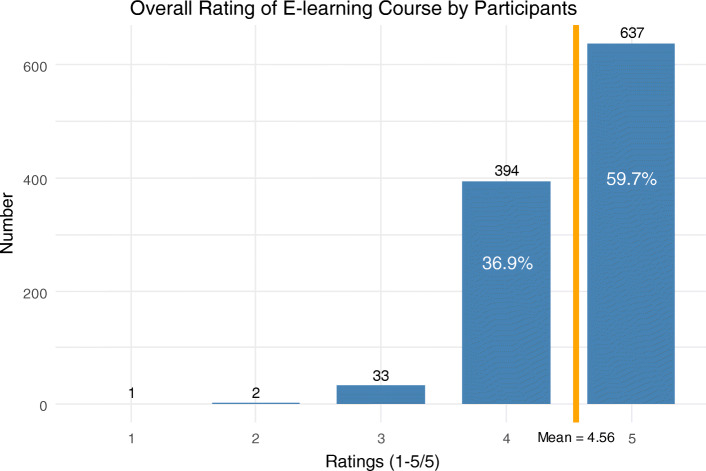
One thousand six hundred and eleventh collaborators from 24 countries completed the e-learning course; 1396 (86.7%) were medical students; 1067 (66.2%) entered feedback. 1031 (96.6%) rated the quality of the course a 4/5 or higher (mean 4.56; SD 0.58). The mean sentiment score using the AFINN was + 1.54/5 (5: most positive; SD 1.19) and + 0.287/1 (1: most positive; SD 0.390) using syuzhet. LDA generated topics consolidated into the themes: (1) ease of use, (2) conciseness and (3) interactivity.
E-learning can have high user satisfaction for training investigators of clinical studies and medical students. Natural language processing may be beneficial in analysis of large scale educational courses.
在当前大流行的背景下,电子学习对于维持现有的医学教育计划变得至关重要。迄今为止,此类课程的评估规模较小,仅限于单个机构。此外,手动系统评估大规模在线电子学习课程生成的大量定性反馈非常耗时。本研究旨在评估针对合作进行国际队列研究的医学生的电子学习课程的影响,并使用文本挖掘和机器学习方法对半自动化分析反馈。
本研究基于一项多中心队列研究,该研究探索了择期结直肠手术后胃肠道的恢复情况。合作者被邀请完成一系列关于研究关键方面的电子学习模块,并完成模块反馈问卷。使用简单描述性统计分析定量数据。使用最频繁的词进行文本挖掘、使用 AFINN-111 和 syuzhet 词汇进行情感分析以及使用潜在狄利克雷分配 (LDA) 进行主题建模,分析定性数据。
来自 24 个国家的 1611 名合作者完成了电子学习课程;其中 1396 名(86.7%)是医学生;1067 名(66.2%)输入了反馈。1031 名(96.6%)对课程质量评为 4/5 或更高(平均 4.56;SD 0.58)。使用 AFINN 的平均情感得分为+1.54/5(5:最积极;SD 1.19),使用 syuzhet 的平均情感得分为+0.287/1(1:最积极;SD 0.390)。LDA 生成的主题整合为三个主题:(1)易用性,(2)简洁性和(3)交互性。
电子学习对于培训临床研究调查员和医学生来说,可以获得很高的用户满意度。自然语言处理可能有益于分析大规模教育课程。