Kühl Susanne J, Toberer Matthias, Keis Oliver, Tolks Daniel, Fischer Martin R, Kühl Michael
Ulm University, Institute of Biochemistry and Molecular Biology, Ulm, Germany.
Ulm University, Medical Faculty Ulm, Office of Student Affairs, Ulm, Germany.
GMS J Med Educ. 2017 Aug 15;34(3):Doc31. doi: 10.3205/zma001108. eCollection 2017.
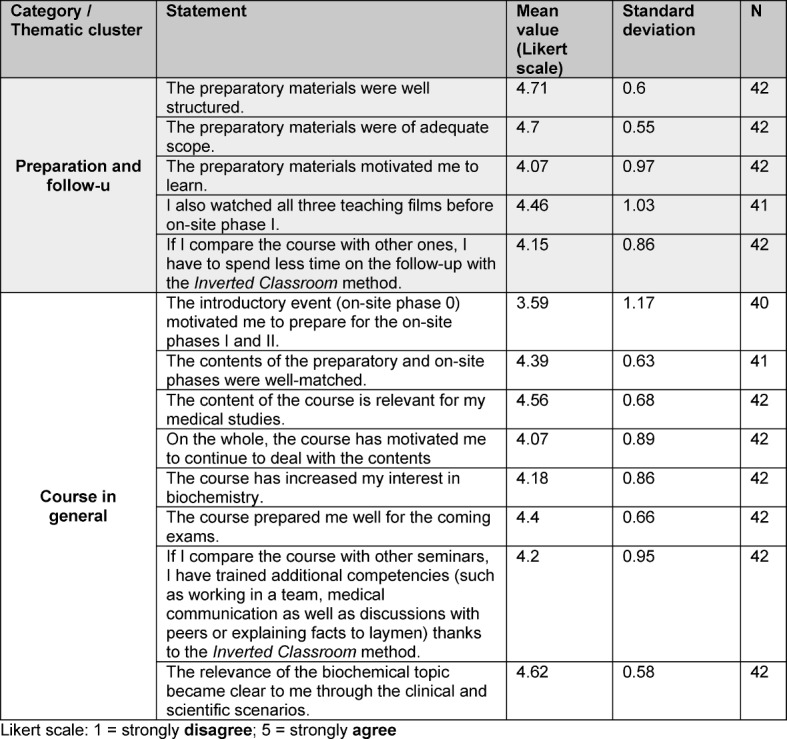
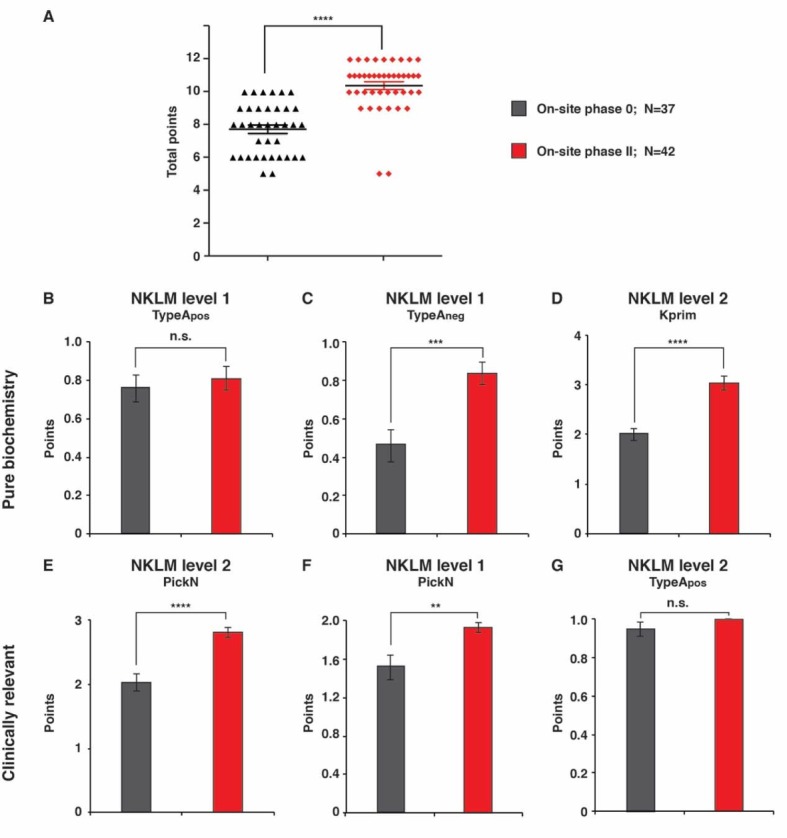
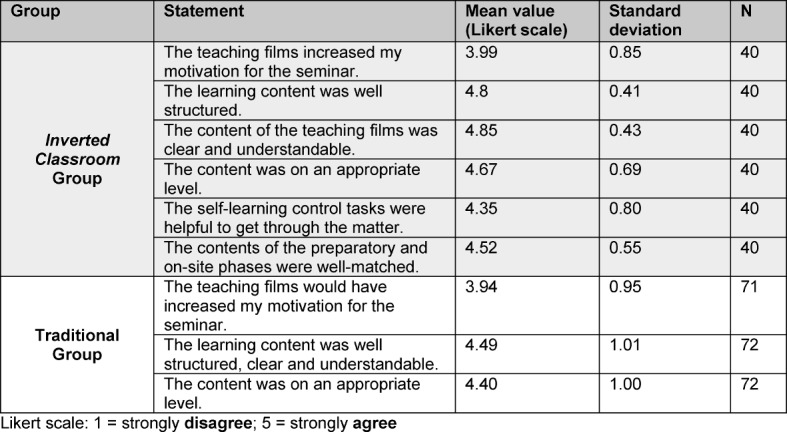
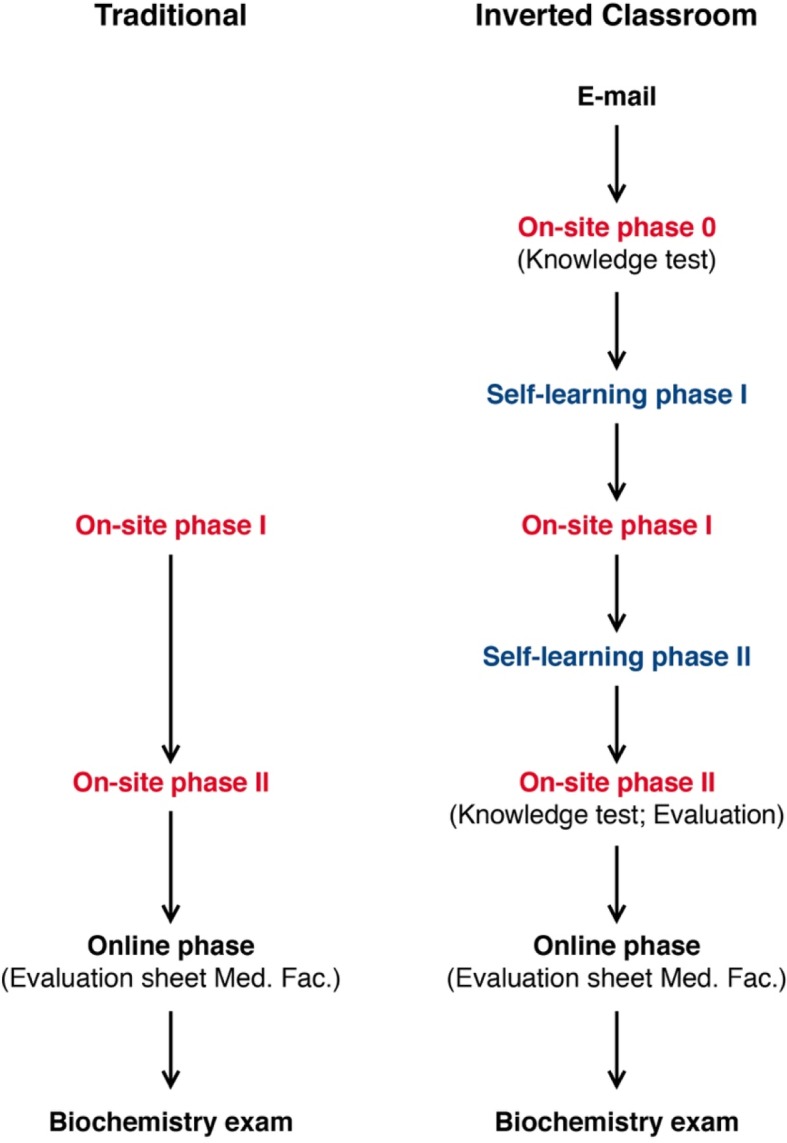
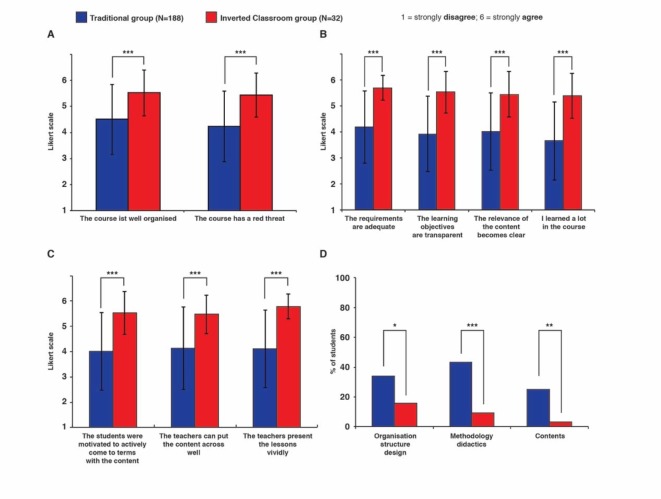
Medical students often have a problem recognising the relevance of basic science subjects for their later professional work in the pre-clinical stage of their studies. This can lead to a lower motivation to learn biochemical content and dissatisfaction in the courses amongst the students. Alternative teaching methods such as the Inverted Classroom (IC) method can address this deficiency. The goal of this study was: to analyse the motivation and satisfaction of the students in a biochemistry seminar through the use of the e-learning-based IC method, to investigate the acceptance against the IC teaching method in biochemistry, and to compare the learning success achieved using the IC approach with that of a traditional course. We also investigated how a biochemistry course in the pre-clinical stage of a human medicine course of studies can be successfully organised according to the IC method. Furthermore, we examined the benefits of the IC method over conventional teaching formats. The IC method was implemented in accordance with the guidelines of the GMA committee "New Media" [30] in a biochemistry seminar for two student IC intervention groups with 42 students. A part of the factual knowledge from the on-site phase in the form of teaching videos together with self-learning control tasks were provided online before the seminar for both IC intervention groups. Exporting content to the self-learning phase creates new free time in the on-site phase, during which the content can be critically considered and processed and additional competency-based learning objectives can be taught. Identical biochemistry teaching content was taught in parallel control groups (14 student groups with n=299 students), but no material was handed out beforehand for a self-learning phase. These students only received the materials after the on-site phase. Motivation and satisfaction as well as the acceptance for the teaching methods were recorded by questionnaires, the acquisition of knowledge by MC exams. On a Likert scale from 1 (strongly disagree) to 6 (strongly agree), the students in the IC intervention groups could be seen to be much more motivated (5.53) than students in the control group (4.01). Students in the IC intervention groups also recognised the relevance of the learning content much more clearly (5.44) than students in the control group (4.01). Furthermore, the IC group also observed that additional competencies were trained in addition to the biochemistry content. In addition, the IC intervention group award the event a school grade of 1.53, the traditional control group a grade of 2.96. The teaching videos were rated very positively by both groups with an average school grade of 1.3 in each case. A qualitative analysis showed that the motivation and a positive attitude of the lecturers played a decisive role in the successful implementation of the IC method. Pre-clinical students display a high acceptance of the e-learning-based IC method. Teaching communication competencies in a biochemistry seminar was also rated very positively by the students. The quality of the teaching video and the motivation of the lecturers were shown to be a critical parameter for the successful performance of the IC method. What's more, the IC method can contribute to implementing a competence orientation in medical studies.
医学生在学习的临床前阶段往往难以认识到基础科学学科与他们日后专业工作的相关性。这可能导致他们学习生物化学内容的积极性降低,以及对课程的不满。诸如翻转课堂(IC)法等替代教学方法可以解决这一不足。本研究的目的是:通过使用基于电子学习的IC法分析生物化学研讨课中学生的动机和满意度,调查对生物化学IC教学法的接受程度,并将使用IC方法取得的学习成果与传统课程的学习成果进行比较。我们还研究了如何根据IC方法成功组织医学专业临床前阶段的生物化学课程。此外,我们考察了IC方法相对于传统教学形式的优势。IC方法是按照GMA委员会“新媒体”[30]的指导方针,在一个有42名学生的生物化学研讨课中对两个学生IC干预组实施的。在研讨课之前,两个IC干预组都在线提供了一部分现场教学阶段的事实性知识,以教学视频的形式以及自我学习控制任务。将内容导出到自我学习阶段在现场教学阶段创造了新的自由时间,在此期间可以批判性地思考和处理这些内容,并教授额外的基于能力的学习目标。在平行对照组(14个学生小组,n = 299名学生)中教授相同的生物化学教学内容,但没有提前发放用于自我学习阶段的材料。这些学生只在现场教学阶段之后才收到材料。通过问卷调查记录动机和满意度以及对教学方法的接受程度,通过MC考试记录知识的掌握情况。在从1(强烈不同意)到6(强烈同意)的李克特量表上,可以看出IC干预组的学生比对照组的学生积极性高得多(5.53)。IC干预组的学生也比对照组的学生更清楚地认识到学习内容的相关性(5.44)。此外,IC组还观察到除了生物化学内容之外还培养了其他能力。此外,IC干预组给该课程的评分是1.53,传统对照组的评分是2.96。两组对教学视频的评价都非常积极,平均课程评分均为1.3。定性分析表明,教师的积极性和积极态度在IC方法的成功实施中起决定性作用。临床前学生对基于电子学习的IC方法表现出高度接受。学生对生物化学研讨课中教学沟通能力的评价也非常积极。教学视频的质量和教师的积极性被证明是IC方法成功实施的关键参数。此外,IC方法有助于在医学学习中实施能力导向。