School of Population and Public Health, University of British Columbia, Vancouver, British Columbia, Canada
British Columbia Centre for Excellence in HIV/AIDS, Vancouver, British Columbia, Canada.
BMJ Open. 2021 Mar 25;11(3):e040928. doi: 10.1136/bmjopen-2020-040928.
Innovative methods are needed for identification of transgender people in administrative records for health research purposes. This study investigated the feasibility of using transgender-specific healthcare utilisation in a Canadian population-based health records database to develop a computable phenotype (CP) and identify the proportion of transgender people within the HIV-positive population as a public health priority.
The Comparative Outcomes and Service Utilization Trends (COAST) Study cohort comprises a data linkage between two provincial data sources: The British Columbia (BC) Centre for Excellence in HIV/AIDS Drug Treatment Program, which coordinates HIV treatment dispensation across BC and Population Data BC, a provincial data repository holding individual, longitudinal data for all BC residents (1996-2013).
British Columbia, Canada.
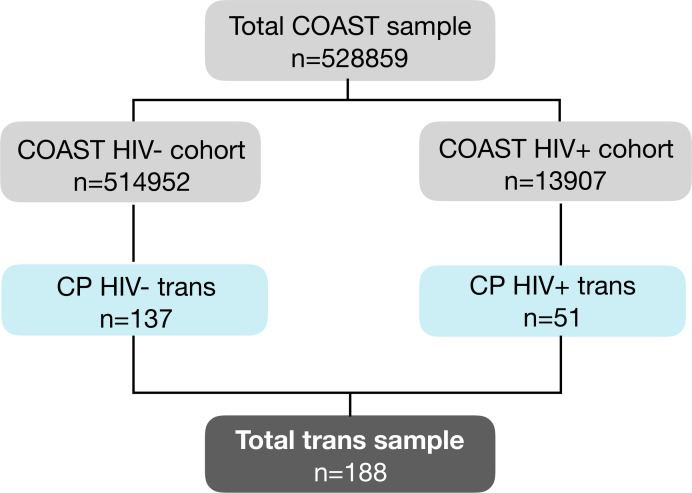
COAST participants include 13 907 BC residents living with HIV (≥19 years of age) and a 10% random sample comparison group of the HIV-negative general population (514 952 individuals).
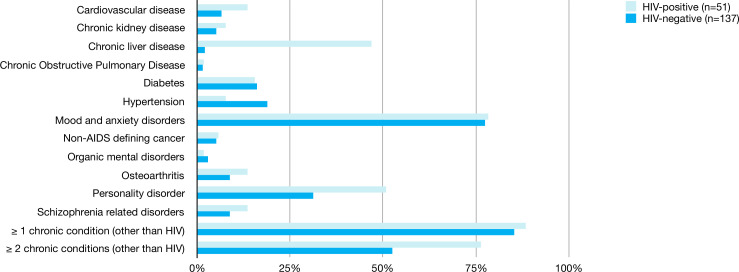
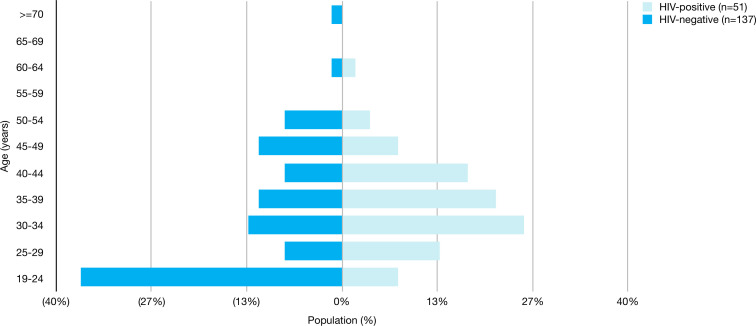
Healthcare records were used to identify transgender people via a CP algorithm (diagnosis codes+androgen blocker/hormone prescriptions), to examine related diagnoses and prescription concordance and to validate the CP using an independent provider-reported transgender status measure. Demographics and chronic illness burden were also characterised for the transgender sample.
The best-performing CP identified 137 HIV-negative and 51 HIV-positive transgender people (total 188). In validity analyses, the best-performing CP had low sensitivity (27.5%, 95% CI: 17.8% to 39.8%), high specificity (99.8%, 95% CI: 99.6% to 99.8%), low agreement using Kappa statistics (0.3, 95% CI: 0.2 to 0.5) and moderate positive predictive value (43.2%, 95% CI: 28.7% to 58.9%). There was high concordance between exogenous sex hormone use and transgender-specific diagnoses.
The development of a validated CP opens up new opportunities for identifying transgender people for inclusion in population-based health research using administrative health data, and offers the potential for much-needed and heretofore unavailable evidence on health status, including HIV status, and the healthcare use and needs of transgender people.
为了进行医学研究,我们需要创新的方法来识别跨性别者在行政记录中的身份。本研究旨在调查在加拿大基于人群的健康记录数据库中使用特定于跨性别者的医疗保健利用情况来开发可计算表型(CP)并确定艾滋病毒阳性人群中跨性别者比例作为公共卫生重点的可行性。
比较结果和服务利用趋势(COAST)研究队列包括两个省级数据源之间的数据链接:不列颠哥伦比亚省(BC)艾滋病病毒/艾滋病药物治疗卓越中心,负责协调 BC 各地的艾滋病毒治疗分配,以及人口数据 BC,这是一个省级数据存储库,保存着所有 BC 居民的个人、纵向数据(1996-2013 年)。
加拿大不列颠哥伦比亚省。
COAST 参与者包括 13907 名 BC 地区年龄在 19 岁及以上的艾滋病毒感染者(HIV)和 10%的 HIV 阴性普通人群随机样本对照(514952 人)。
医疗保健记录通过 CP 算法(诊断代码+雄激素阻滞剂/激素处方)用于识别跨性别者,检查相关诊断和处方一致性,并使用独立的提供者报告的跨性别者身份衡量标准验证 CP。还对跨性别者样本的人口统计学和慢性疾病负担进行了特征描述。
表现最佳的 CP 确定了 137 名 HIV 阴性和 51 名 HIV 阳性的跨性别者(总计 188 人)。在有效性分析中,表现最佳的 CP 具有较低的灵敏度(27.5%,95%CI:17.8%至 39.8%)、高特异性(99.8%,95%CI:99.6%至 99.8%)、kappa 统计的低一致性(0.3,95%CI:0.2 至 0.5)和中等阳性预测值(43.2%,95%CI:28.7%至 58.9%)。外源性性激素使用与特定于跨性别的诊断之间存在高度一致性。
经过验证的 CP 的开发为使用行政健康数据在基于人群的健康研究中纳入跨性别者开辟了新的机会,并为包括艾滋病毒状况在内的健康状况以及跨性别者的医疗保健使用和需求方面提供了急需的和迄今为止无法获得的证据。