Department of Social and Preventive Medicine, Center for Public Health, Medical University of Vienna, Austria.
Neuroscience Institute, Aging Branch, National Research Council, Padua, Italy.
Clin Infect Dis. 2020 Apr 15;70(9):1809-1815. doi: 10.1093/cid/ciz539.
Our aim was to assess both the credibility and strength of evidence arising from systematic reviews with meta-analyses of observational studies and physical health outcomes associated with human immunodeficiency virus (HIV) but not acquired immunodeficiency syndrome.
We performed an umbrella review of observational studies. Evidence was graded as convincing, highly suggestive, suggestive, weak, or nonsignificant.
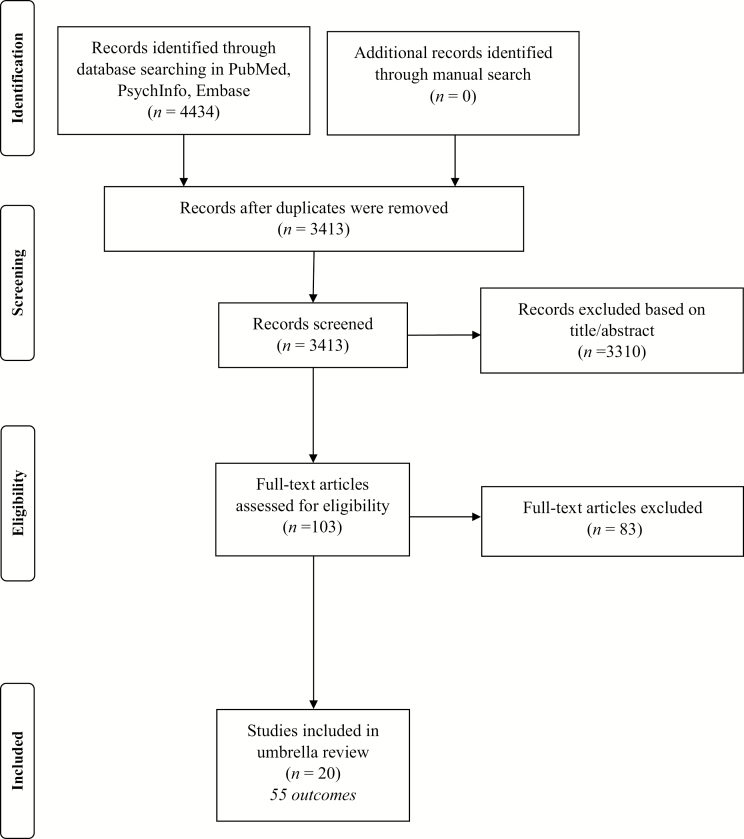
From 3413 studies returned, 20 were included, covering 55 health outcomes. Median number of participants was 18 743 (range 403-225 000 000). Overall, 45 (81.8%) of the 55 unique outcomes reported nominally significant summary results (P < .05). Only 5 outcomes (9.0%; higher likelihood of presence of breathlessness, higher chronic obstructive pulmonary disease [COPD] prevalence, maternal sepsis, higher risk of anemia, and higher risk of all fractures among people living with HIV [PLWHIV]) showed suggestive evidence, with P values < 10-3; only 3 (5.5%; higher prevalence of cough in cross-sectional studies, higher incidence of pregnancy-related mortality, and higher incidence of ischemic heart disease among PLWHIV in cohort studies) outcomes showed stronger evidence using a stringent P value (<10-6). None of the unique outcomes presented convincing evidence (Class I), yet 3 outcomes presented highly suggestive evidence, 5 outcomes presented suggestive evidence, and 37 outcomes presented weak evidence.
Results show highly suggestive and suggestive evidence for HIV and the presence of a cough, COPD, ischemic heart disease, pregnancy-related mortality, maternal sepsis, and bone fractures. Public health policies should reflect and accommodate these changes, especially in light of the increases in the life expectancy and the incidence of comorbidities in this population.
我们旨在评估与人类免疫缺陷病毒(HIV)相关但不伴有获得性免疫缺陷综合征的观察性研究系统评价和身体健康结果的可信度和证据力度。
我们进行了观察性研究的伞式综述。证据被评为有说服力、高度提示、提示、微弱或无意义。
从返回的 3413 项研究中,纳入了 20 项研究,涵盖了 55 项健康结果。中位数参与者人数为 18743 人(范围为 403-2250000000)。总体而言,55 个独特结果中有 45 个(81.8%)报告了名义上显著的汇总结果(P<.05)。仅有 5 个结果(9.0%;HIV 感染者呼吸困难的可能性更高、慢性阻塞性肺疾病[COPD]患病率更高、产妇败血症、贫血风险更高、所有骨折风险更高)显示出有提示意义的证据,P 值<10-3;仅有 3 个结果(5.5%;横断面研究中咳嗽的患病率更高、队列研究中 HIV 感染者妊娠相关死亡率和缺血性心脏病的发病率更高)使用严格的 P 值(<10-6)显示出更强的证据。没有一个独特的结果呈现出有说服力的证据(I 类),但有 3 个结果呈现出高度提示性证据,5 个结果呈现出提示性证据,37 个结果呈现出微弱证据。
结果显示,HIV 与咳嗽、COPD、缺血性心脏病、妊娠相关死亡率、产妇败血症和骨折的存在具有高度提示性和提示性证据。公共卫生政策应反映并适应这些变化,特别是考虑到该人群预期寿命的增加和合并症的发病率增加。