Marron Institute of Urban Management, New York University, New York, NY, USA.
Stern School of Business, New York University, New York, NY, USA.
Nat Commun. 2021 Mar 25;12(1):1870. doi: 10.1038/s41467-021-22160-w.
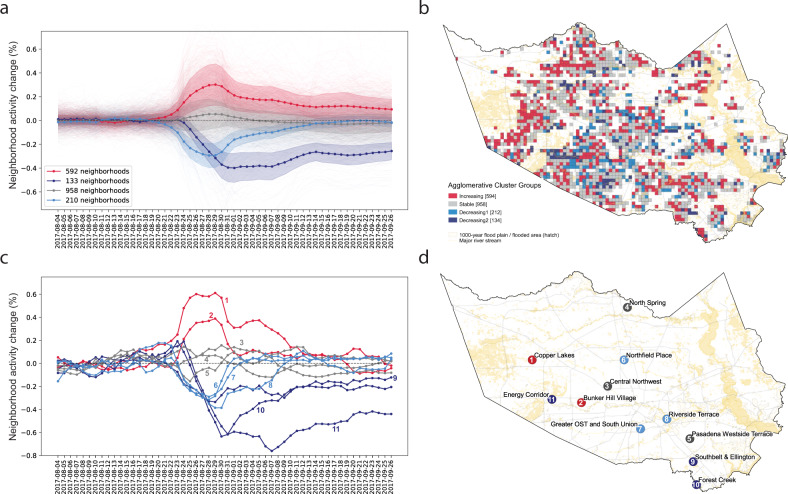
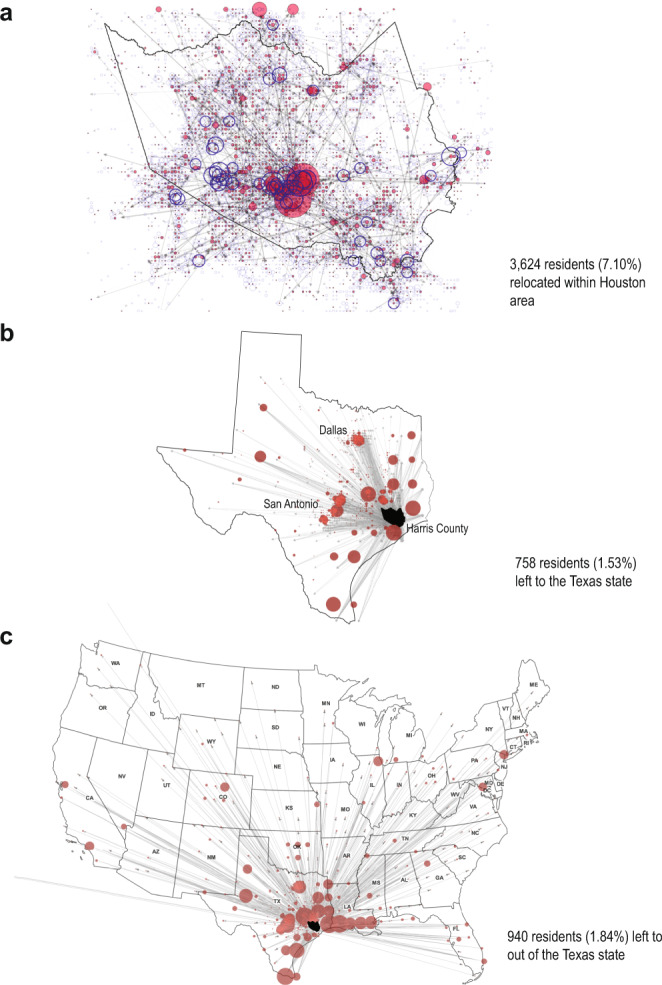
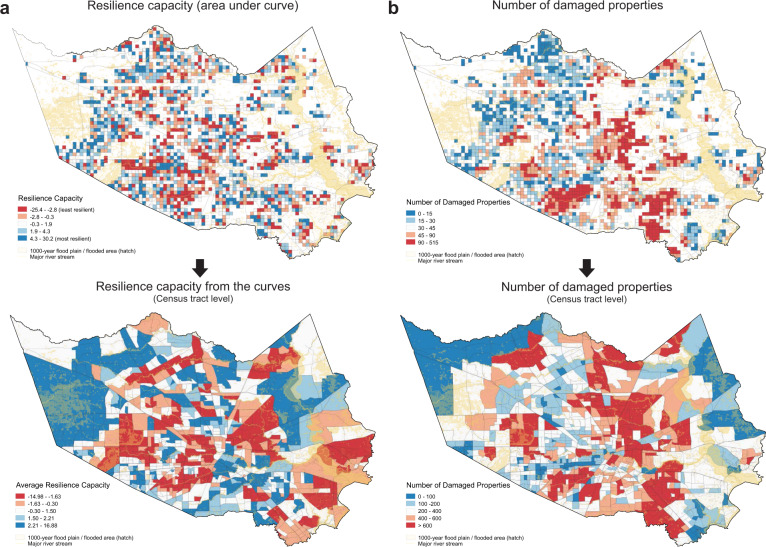
While conceptual definitions provide a foundation for the study of disasters and their impacts, the challenge for researchers and practitioners alike has been to develop objective and rigorous measures of resilience that are generalizable and scalable, taking into account spatiotemporal dynamics in the response and recovery of localized communities. In this paper, we analyze mobility patterns of more than 800,000 anonymized mobile devices in Houston, Texas, representing approximately 35% of the local population, in response to Hurricane Harvey in 2017. Using changes in mobility behavior before, during, and after the disaster, we empirically define community resilience capacity as a function of the magnitude of impact and time-to-recovery. Overall, we find clear socioeconomic and racial disparities in resilience capacity and evacuation patterns. Our work provides new insight into the behavioral response to disasters and provides the basis for data-driven public sector decisions that prioritize the equitable allocation of resources to vulnerable neighborhoods.
虽然概念定义为灾害及其影响的研究提供了基础,但研究人员和实践者所面临的挑战一直是开发具有可推广性和可扩展性的、客观而严格的弹性衡量标准,同时考虑到本地化社区应对和恢复的时空动态。在本文中,我们分析了 2017 年休斯顿,德克萨斯州 80 多万台匿名移动设备的移动模式,这些设备代表了当地人口的大约 35%。利用灾难前后的移动行为变化,我们将社区弹性能力实证定义为影响程度和恢复时间的函数。总体而言,我们发现弹性能力和疏散模式存在明显的社会经济和种族差异。我们的工作为人们对灾害的行为反应提供了新的见解,并为数据驱动的公共部门决策提供了基础,这些决策优先考虑将资源公平分配给弱势社区。