Department of Microbiology and Immunology, University of Western Ontario, London, ON, Canada.
Department of Biochemistry, MaRS Centre, Toronto, ON, Canada.
Nat Commun. 2021 Mar 25;12(1):1887. doi: 10.1038/s41467-021-22175-3.
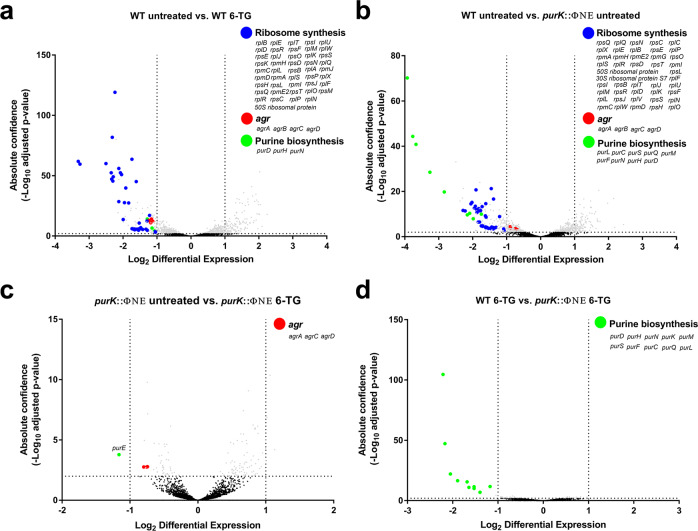
Coagulase-negative staphylococci and Staphylococcus aureus colonize similar niches in mammals and conceivably compete for space and nutrients. Here, we report that a coagulase-negative staphylococcus, Staphylococcus chromogenes ATCC43764, synthesizes and secretes 6-thioguanine (6-TG), a purine analog that suppresses S. aureus growth by inhibiting de novo purine biosynthesis. We identify a 6-TG biosynthetic gene cluster in S. chromogenes and other coagulase-negative staphylococci including S. epidermidis, S. pseudintermedius and S. capitis. Recombinant S. aureus strains harbouring this operon produce 6-TG and, when used in subcutaneous co-infections in mice with virulent S. aureus USA300, protect the host from necrotic lesion formation. Used prophylactically, 6-TG reduces necrotic skin lesions in mice infected with USA300, and this effect is mediated by abrogation of toxin production. RNAseq analyses reveal that 6-TG downregulates expression of genes coding for purine biosynthesis, the accessory gene regulator (agr) and ribosomal proteins in S. aureus, providing an explanation for its effect on toxin production.
凝固酶阴性葡萄球菌和金黄色葡萄球菌在哺乳动物中定植于相似的小生境,理论上会为了空间和营养物质而竞争。在这里,我们报告称,凝固酶阴性葡萄球菌(Staphylococcus chromogenes ATCC43764)合成并分泌 6-硫鸟嘌呤(6-TG),这是一种嘌呤类似物,通过抑制从头嘌呤生物合成来抑制金黄色葡萄球菌的生长。我们在 S. chromogenes 以及其他凝固酶阴性葡萄球菌(包括表皮葡萄球菌、中间葡萄球菌和头状葡萄球菌)中鉴定出一个 6-TG 生物合成基因簇。携带该操纵子的重组金黄色葡萄球菌菌株会产生 6-TG,当与毒性金黄色葡萄球菌 USA300 一起在皮下共感染小鼠时,可保护宿主免受坏死性病变的形成。预防性使用 6-TG 可减少感染 USA300 的小鼠的坏死性皮肤病变,这一作用是通过抑制毒素产生来介导的。RNAseq 分析表明,6-TG 下调了金黄色葡萄球菌中嘌呤生物合成、辅助基因调节因子(agr)和核糖体蛋白基因的表达,这解释了它对毒素产生的影响。