Department of Biomedical Engineering, Carnegie Mellon University, Pittsburgh, PA, USA.
University of Minnesota, Minneapolis, MN, USA.
Sci Rep. 2021 Mar 25;11(1):6818. doi: 10.1038/s41598-021-86215-0.
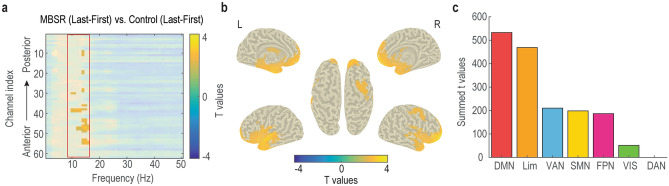
Brain-computer interfaces (BCIs) are capable of translating human intentions into signals controlling an external device to assist patients with severe neuromuscular disorders. Prior work has demonstrated that participants with mindfulness meditation experience evince improved BCI performance, but the underlying neural mechanisms remain unclear. Here, we conducted a large-scale longitudinal intervention study by training participants in mindfulness-based stress reduction (MBSR; a standardized mind-body awareness training intervention), and investigated whether and how short-term MBSR affected sensorimotor rhythm (SMR)-based BCI performance. We hypothesize that MBSR training improves BCI performance by reducing mind wandering and enhancing self-awareness during the intentional rest BCI control, which would mainly be reflected by modulations of default-mode network and limbic network activity. We found that MBSR training significantly improved BCI performance compared to controls and these behavioral enhancements were accompanied by increased frontolimbic alpha activity (9-15 Hz) and decreased alpha connectivity among limbic network, frontoparietal network, and default-mode network. Furthermore, the modulations of frontolimbic alpha activity were positively correlated with the duration of meditation experience and the extent of BCI performance improvement. Overall, these data suggest that mindfulness allows participant to reach a state where they can modulate frontolimbic alpha power and improve BCI performance for SMR-based BCI control.
脑机接口(BCI)能够将人类的意图转化为控制外部设备的信号,以帮助患有严重神经肌肉疾病的患者。先前的工作已经表明,具有正念冥想体验的参与者表现出改善的 BCI 性能,但潜在的神经机制仍不清楚。在这里,我们通过训练参与者进行基于正念减压(MBSR;一种标准化的身心意识训练干预)进行了一项大规模的纵向干预研究,并调查了短期 MBSR 是否以及如何影响基于感觉运动节律(SMR)的 BCI 性能。我们假设 MBSR 训练通过减少意图休息期间的思维漫游和增强自我意识来改善 BCI 性能,这主要反映在默认模式网络和边缘网络活动的调制上。我们发现,与对照组相比,MBSR 训练显著提高了 BCI 性能,并且这些行为上的增强伴随着额叶-边缘区域的α活动(9-15 Hz)增加和边缘网络、额顶网络和默认模式网络之间的α连通性降低。此外,额叶-边缘区域的α活动的调制与冥想经验的持续时间和 BCI 性能改善的程度呈正相关。总的来说,这些数据表明,正念可以使参与者达到一种能够调节额叶-边缘区域α功率并改善基于 SMR 的 BCI 控制的 BCI 性能的状态。