Yang Jian, Lin Xin-Zhu, Guo Qian-Wen, Wang Cheng-Ling, Yang Ren-Yan, Zhang Jun-Wen, Zeng Yan
Department of Gastroenterology, The First Affiliated Hospital of Chongqing Medical University, Chongqing 400016, China.
Department of Psychology, The Second Affiliated Hospital of Chongqing Medical University, Chongqing 400010, China.
World J Clin Cases. 2023 Apr 26;11(12):2729-2739. doi: 10.12998/wjcc.v11.i12.2729.
Postpartum depression refers to a depressive episode or depressive symptoms up to 12 mo after delivery. Trait mindfulness has presented a protective factor for postpartum depressive symptoms and proved efficient in improving relationship satisfaction among couples.
To investigate the correlations among mindfulness, marital quality, anxiety, and depression in a large city in western China during the post-corona virus infectious disease-2019 era and determine whether trait mindfulness mediates the relationship between marital quality and postpartum anxiety and depression among primiparas.
A cross-sectional study was conducted. The self-administered questionnaire was submitted online through smartphones. The levels of mindfulness, anxiety, depression, and marital quality were respectively investigated by the mindful attention awareness scale (MAAS), the self-rating anxiety scale (SAS), the self-rating depression scale (SDS), and the marriage perception scale (MPS) in these enrolled Han and Tujia primiparas.
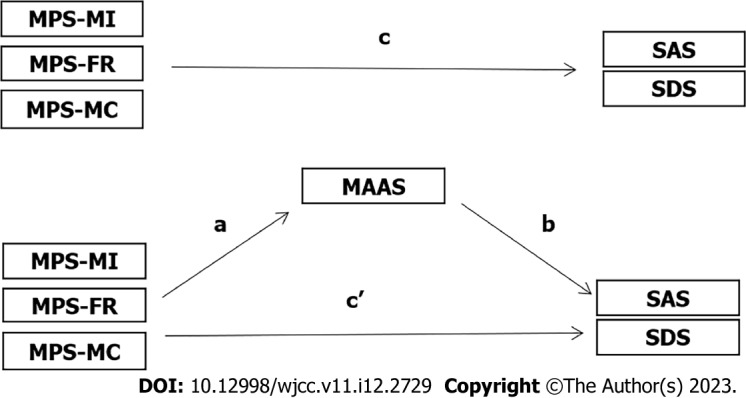
No statistical significance was observed in the prevalence of postpartum anxiety and depression, nor scores of MAAS and MPS-Total in different regions or ethnicities ( > 0.05). However, MPS-Marital interaction ( < 0.05), MPS-Family relationship (MPS-FR) ( < 0.01), and MPS-Marital conflict (MPS-MC) ( < 0.01) scores of urban primiparas were higher than those of rural primiparas. The MPS-MC score of Han primiparas was higher than that of Tujia primiparas ( < 0.05). Negative correlations were observed between MAAS and SAS (r = -0.457, < 0.01), and MAAS and SDS (r = -0.439, < 0.01). SAS has revealed a highly positive correlation with SDS (r = 0.720, < 0.01) and a weak negative correlation with MPS (r = -0.200, < 0.05). Besides, a weak negative correlation was observed between MAAS and MPS-MC (r = -0.184, < 0.05), and a weak positive correlation was noticed between SAS and MPS-MC (r = -0.225, < 0.01). Mediation analysis demonstrated a full mediation effect of mindfulness level on the relationship between MPS-FR and postpartum anxiety ( < 0.05, 95%CI: -0.384 to 0.033), MPS-MC and postpartum anxiety ( < 0.01, 95%CI: 0.027-0.193), MPS-FR and postpartum depression ( < 0.05, 95%CI: -0.365 to 0.031), and MPS-MC and postpartum depression ( < 0.01, 95%CI: 0.022-0.206).
Mindfulness demonstrates negative correlations with marital conflict, postpartum anxiety and depression, and it may have cross-ethnic and trans-regional characteristics. Although the mindfulness levels have revealed no significant mediating effect between the total score of marital quality and postpartum depression in this study, it demonstrates a full mediation effect on the relationships between family relationships, marital conflict, and postpartum anxiety and depression.
产后抑郁是指产后12个月内出现的抑郁发作或抑郁症状。特质正念已成为产后抑郁症状的一个保护因素,并被证明能有效提高夫妻关系满意度。
调查中国西部某大城市在新型冠状病毒感染疾病-2019大流行后时代正念、婚姻质量、焦虑和抑郁之间的相关性,并确定特质正念是否介导初产妇婚姻质量与产后焦虑和抑郁之间的关系。
进行一项横断面研究。通过智能手机在线提交自填式问卷。采用正念注意觉知量表(MAAS)、自评焦虑量表(SAS)、自评抑郁量表(SDS)和婚姻感知量表(MPS)分别调查纳入研究的汉族和土家族初产妇的正念、焦虑、抑郁和婚姻质量水平。
产后焦虑和抑郁的患病率以及不同地区或民族的MAAS和MPS总分均无统计学意义(P>0.05)。然而,城市初产妇的MPS-婚姻互动(P<0.05)、MPS-家庭关系(MPS-FR)(P<0.01)和MPS-婚姻冲突(MPS-MC)(P<0.01)得分高于农村初产妇。汉族初产妇的MPS-MC得分高于土家族初产妇(P<0.05)。MAAS与SAS之间呈负相关(r=-0.457,P<0.01),MAAS与SDS之间呈负相关(r=-0.439,P<0.01)。SAS与SDS呈高度正相关(r=0.720,P<0.01),与MPS呈弱负相关(r=-0.200,P<0.05)。此外,MAAS与MPS-MC之间呈弱负相关(r=-0.184,P<0.05),SAS与MPS-MC之间呈弱正相关(r=-0.225,P<0.01)。中介分析表明,正念水平对MPS-FR与产后焦虑之间的关系(P<0.05,95%CI:-0.384至0.033)、MPS-MC与产后焦虑之间的关系(P<0.01,95%CI:0.027-0.193)、MPS-FR与产后抑郁之间的关系(P<0.05,95%CI:-0.365至0.031)以及MPS-MC与产后抑郁之间的关系(P<0.01,95%CI:0.022-0.206)具有完全中介效应。
正念与婚姻冲突、产后焦虑和抑郁呈负相关,可能具有跨民族和跨地区特征。尽管本研究中正念水平在婚姻质量总分与产后焦虑和抑郁之间未显示出显著的中介作用,但它对家庭关系、婚姻冲突与产后焦虑和抑郁之间的关系具有完全中介效应。
