Department of Ecology and Evolutionary Biology, University of California Santa Cruz, Santa Cruz, CA.
Department of Biomolecular Engineering, University of California Santa Cruz, Santa Cruz, CA.
J Hered. 2021 May 24;112(3):241-249. doi: 10.1093/jhered/esab012.
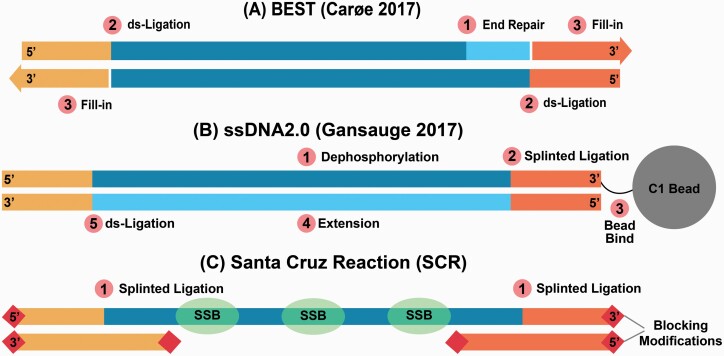
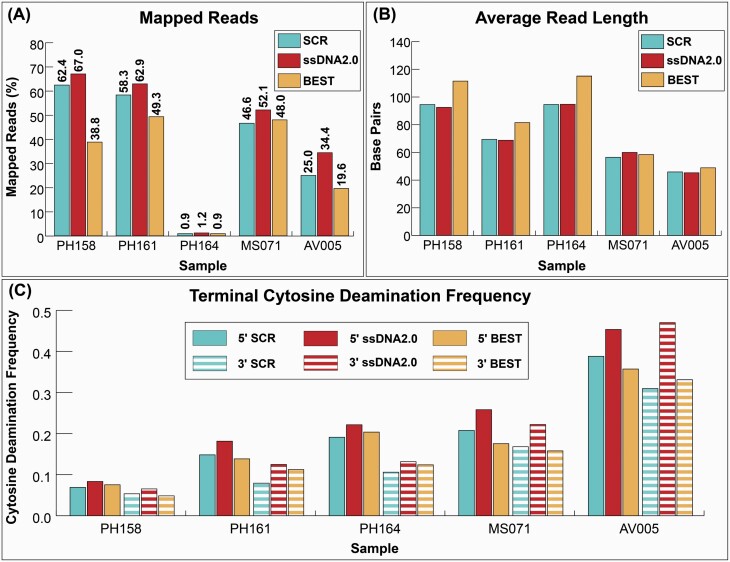
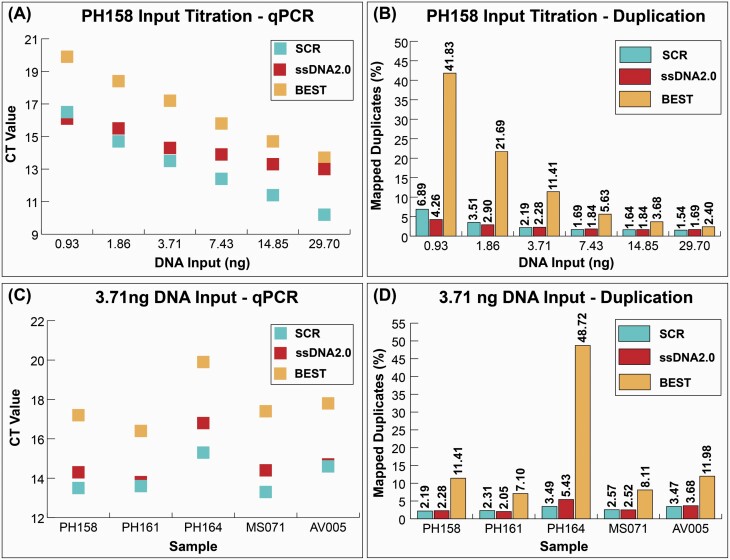
We present a protocol to prepare extracted DNA for sequencing on the Illumina sequencing platform that has been optimized for ancient and degraded DNA. Our approach, the Santa Cruz Reaction or SCR, uses directional splinted ligation of Illumina's P5 and P7 adapters to convert natively single-stranded DNA and heat denatured double-stranded DNA into sequencing libraries in a single enzymatic reaction. To demonstrate its efficacy in converting degraded DNA molecules, we prepare 5 ancient DNA extracts into sequencing libraries using the SCR and 2 of the most commonly used approaches for preparing degraded DNA for sequencing: BEST, which targets and converts double-stranded DNA, and ssDNA2.0, which targets and converts single-stranded DNA. We then compare the efficiency with which each approach recovers unique molecules, or library complexity, given a standard amount of DNA input. We find that the SCR consistently outperforms the BEST protocol in recovering unique molecules and, despite its relative simplicity to perform and low cost per library, has similar performance to ssDNA2.0 across a wide range of DNA inputs. The SCR is a cost- and time-efficient approach that minimizes the loss of unique molecules and makes accessible a taxonomically, geographically, and a temporally broader sample of preserved remains for genomic analysis.
我们提出了一种方案,用于为 Illumina 测序平台制备提取的 DNA,该方案经过了优化,可用于古老和降解的 DNA。我们的方法称为圣克鲁斯反应(Santa Cruz Reaction 或 SCR),使用 Illumina 的 P5 和 P7 接头的定向分裂连接,将天然单链 DNA 和热变性双链 DNA 在单个酶促反应中转化为测序文库。为了证明其在转化降解 DNA 分子方面的功效,我们使用 SCR 将 5 种古老的 DNA 提取物制备成测序文库,并使用两种最常用于为测序制备降解 DNA 的方法:BEST,其靶向并转化双链 DNA,以及 ssDNA2.0,其靶向并转化单链 DNA。然后,我们比较了每种方法在给定标准 DNA 输入量的情况下回收独特分子的效率,即文库复杂性。我们发现,SCR 在回收独特分子方面始终优于 BEST 方案,并且尽管其执行相对简单且每个文库的成本较低,但在广泛的 DNA 输入范围内,其性能与 ssDNA2.0 相似。SCR 是一种具有成本效益和时间效益的方法,可最大程度地减少独特分子的损失,并为基因组分析提供更广泛的保存遗骸的分类学、地理和时间范围。