University of Minnesota School of Public Health, Minneapolis, MN, USA.
Inquiry. 2021 Jan-Dec;58:469580211005191. doi: 10.1177/00469580211005191.
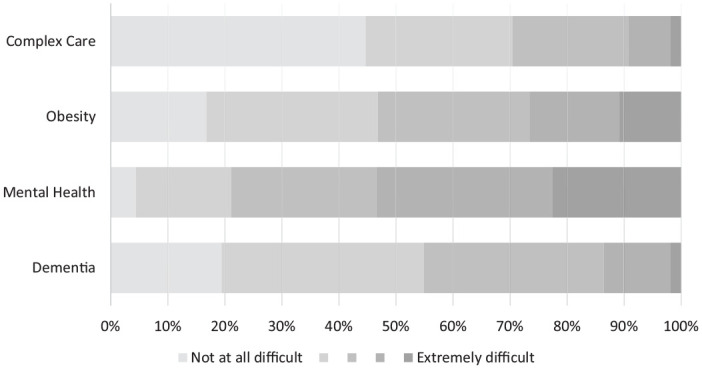
Rural residents are older, on average, than urban residents, with more underlying health conditions and higher rates of disability. Rural nursing homes face unique challenges admitting medically-complex patients and meeting their needs throughout their stay. These challenges may be amplified for certain health conditions. Greater geographic distances also strain transitional care coordination practices with health system referral hubs in urban areas. In this study, we assess perceptions of difficulty rural nursing homes encounter in admitting and serving individuals with dementia, obesity, mental and behavioral health conditions, and medically complex conditions. Using a survey of nursing home administrators located in non-metropolitan counties across the U.S. (n = 209), we assessed the self-reported degree of difficulty identified in serving each of the 4 type of conditions, coupled with qualitative analysis of open-ended questions identifying specific challenges. Rural nursing homes have capacity constraints owing to lower population density, limited financial resources, and unique challenges recruiting and retaining workforce to rural areas. Nursing home administrators reported the most challenges to providing high-quality care to residents with mental and behavioral health challenges, followed by obesity. For specific challenges, administrators focused primarily on staffing concerns, as well as space and equipment needs. Rural nursing home administrators identified challenges related to specific conditions and capacity constraints. To ensure appropriate and high-quality nursing home placement for rural residents, and to minimize the disruption of transitions into nursing home settings, more attention is needed on addressing the constraints identified by rural nursing home administrators in this study.
农村居民的平均年龄比城市居民大,且患有更多潜在疾病,残疾率更高。农村养老院在接收和满足患有多种疾病的患者的需求方面面临着独特的挑战。对于某些健康状况而言,这些挑战可能会更加突出。更大的地理距离也对与城市地区的卫生系统转诊中心的过渡性护理协调实践造成了压力。在这项研究中,我们评估了农村养老院在接收和服务患有痴呆症、肥胖症、精神和行为健康问题以及复杂医疗状况的患者方面所遇到的困难。我们对位于美国非大都市县的养老院管理员进行了一项调查(n=209),评估了他们在为每一种疾病类型服务时所识别出的困难程度,并对开放式问题进行了定性分析,以确定具体的挑战。由于人口密度较低、财政资源有限以及在农村地区招募和留住劳动力的独特挑战,农村养老院的能力受到限制。养老院管理员报告说,为患有精神和行为健康问题的居民提供高质量护理的挑战最大,其次是肥胖症。对于具体的挑战,管理员主要关注人员配备问题,以及空间和设备需求。农村养老院管理员确定了与特定条件和能力限制有关的挑战。为了确保农村居民获得适当和高质量的养老院安置,并最大限度地减少向养老院过渡的中断,需要更多地关注解决农村养老院管理员在本研究中确定的限制。