Khan Kamran, Arain Mudassar Iqbal, Asghar Muhammad Arif, Rehman Ahad Abdul, Ghoto Muhammad Ali, Dayo Abdullah, Imtiaz Muhammad Suleman, Rana Mohsin Hamied, Asghar Muhammad Asif
Department of Pharmaceutics, Institute of Pharmaceutical Sciences, Jinnah Sindh Medical University, Karachi, Pakistan.
Department of Pharmacy Practice, Faculty of Pharmacy, University of Sindh, Jamshoro, Pakistan.
PLoS One. 2021 Mar 26;16(3):e0248761. doi: 10.1371/journal.pone.0248761. eCollection 2021.
The persistence pattern of anti-migraine drugs' use among migraineurs is very low in the United States and different European countries. However, the cost and persistence of antimigraine drugs in Asian countries have not been well-studied. Hence, the present study aimed to evaluate the treatment cost and persistence among migraineurs in Pakistan.
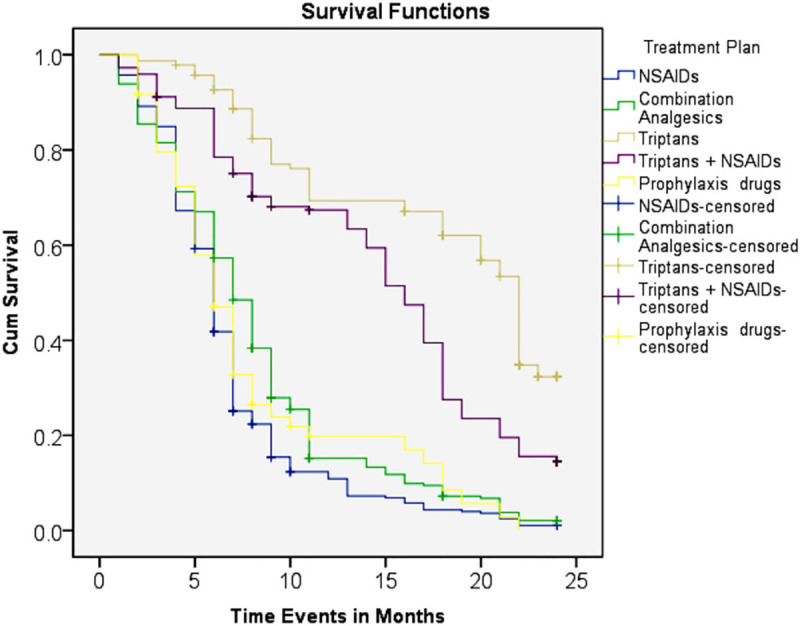
Data from prescriptions collected from migraineurs who visited the Outpatient Department (OPD) of different public and private sector tertiary-care hospitals of Karachi, Pakistan were used to conduct this retrospective cohort study from 2017 to 2019. The minimum follow up period for each migraineur was about 12 months for persistence analysis while dropped-out patients data were also included in survival analysis as right censored data. Pairwise comparisons from Cox regression/hazards ratio were used to assess the predictors of persistence with the reference category of non-binary variables i.e. hazard ratio = 1 for low frequency migraineurs and NSAIDs users. Persistence with anti-migraine drugs was estimated using the Kaplan-Meier curve along with the Log Rank test.
A total of 1597 patients were included in this study, 729 (45.6%) were male and 868 (54.3%) were female. Non-steroidal anti-inflammatory drugs (NSAIDs) were the most prescribed class of drug initially for all classes of migraineurs (26.1%). Of them, 57.3% of migraineurs discontinued their treatment, 28.5% continued while 14.8% were switched to other treatment approaches. Persistence with initial treatment was more profound in female (58.8%) patients compared to males while the median age of continuers was 31 years. The total cost of migraine treatment in the entire study cohort was 297532.5 Pakistani Rupees ($1901.1). By estimating the hazard ratios (HR) using the Cox regression analysis, it can be observed that patients with high frequency (HR, 1.628; 95%CI, 1.221-2.179; p<0.0001) migraine, depression (HR, 1.268; 95%CI, 1.084-1.458; p<0.0001), increasing age (HR, 1.293; 95%CI, 1.092-1.458; p<0.0001), combination analgesics (HR, 1.817; 95%CI, 0.841-2.725; p = 0.0004) and prophylaxis drugs (HR, 1.314; 95%CI, 0.958-1.424; p<0.0001) users were at a higher risk of treatment discontinuation. However, patients with chronic migraine (HR, 0.881; 95%CI, 0.762-0.912; p = 0.0002), epileptic seizure (HR, 0.922; 95%CI, 0.654-1.206; p = 0.0002), other comorbidities (HR, 0.671; 95%CI, 0.352-1.011; p = 0.0003) and users of triptan(s) (HR, 0.701; 95%CI, 0.182-1.414; p = 0.0005) and triptan(s) with NSAIDs (HR, 0.758; 95%CI, 0.501-1.289; p<0.0001) had more chances to continue their initial therapy.
Similar to western countries, the majority of migraineurs exhibited poor persistence to migraine treatments. Various factors of improved persistence were identified in this study.
在美国和不同欧洲国家,偏头痛患者中抗偏头痛药物的持续使用模式非常低。然而,亚洲国家抗偏头痛药物的成本和持续性尚未得到充分研究。因此,本研究旨在评估巴基斯坦偏头痛患者的治疗成本和持续性。
本回顾性队列研究使用了从巴基斯坦卡拉奇不同公立和私立三级护理医院门诊部(OPD)就诊的偏头痛患者收集的处方数据,时间跨度为2017年至2019年。每位偏头痛患者的最短随访期约为12个月以进行持续性分析,而失访患者的数据也作为右删失数据纳入生存分析。使用Cox回归/风险比进行成对比较,以评估持续性的预测因素,非二元变量的参考类别即低频偏头痛患者和非甾体抗炎药使用者的风险比=1。使用Kaplan-Meier曲线和对数秩检验估计抗偏头痛药物的持续性。
本研究共纳入1597例患者,其中729例(45.6%)为男性,868例(54.3%)为女性。非甾体抗炎药(NSAIDs)是最初为所有类型偏头痛患者最常开具的药物类别(26.1%)。其中,57.3%的偏头痛患者停止治疗,28.5%继续治疗,14.8%改用其他治疗方法。与男性相比,女性(58.8%)患者对初始治疗的持续性更强,继续治疗者的中位年龄为31岁。整个研究队列中偏头痛治疗的总成本为297532.5巴基斯坦卢比(1901.1美元)。通过使用Cox回归分析估计风险比(HR),可以观察到高频(HR,1.628;95%CI,1.221 - 2.179;p<0.0001)偏头痛患者、抑郁症患者(HR,1.268;95%CI,1.084 - 1.458;p<0.0001)、年龄增长(HR,1.293;95%CI,1.092 - 1.458;p<0.0001)、复方镇痛药使用者(HR,1.817;95%CI,0.841 - 2.725;p = 0.0004)和预防性药物使用者(HR,1.314;95%CI,0.958 - 1.424;p<0.0001)停药风险更高。然而,慢性偏头痛患者(HR,0.881;95%CI,0.762 - 0.912;p = 0.0002)、癫痫发作患者(HR,0.922;95%CI,0.654 - 1.206;p = 0.0002)、其他合并症患者(HR,0.671;95%CI,0.352 - 1.011;p = 0.0003)以及曲坦类药物使用者(HR,0.701;95%CI,0.182 - 1.414;p = 0.0005)和曲坦类药物与非甾体抗炎药联合使用者(HR,0.758;95%CI,0.501 - 1.289;p<0.0001)更有可能继续其初始治疗。
与西方国家类似,大多数偏头痛患者对偏头痛治疗的持续性较差。本研究确定了多种改善持续性的因素。