Maastricht MultiModal Molecular Imaging (M4i) Institute, Division of Imaging Mass Spectrometry, Maastricht University, 6229 ER, Maastricht, The Netherlands.
Janssen Research & Development, 2340, Beerse, Belgium.
Anal Bioanal Chem. 2021 Apr;413(10):2779-2791. doi: 10.1007/s00216-021-03210-0. Epub 2021 Mar 26.
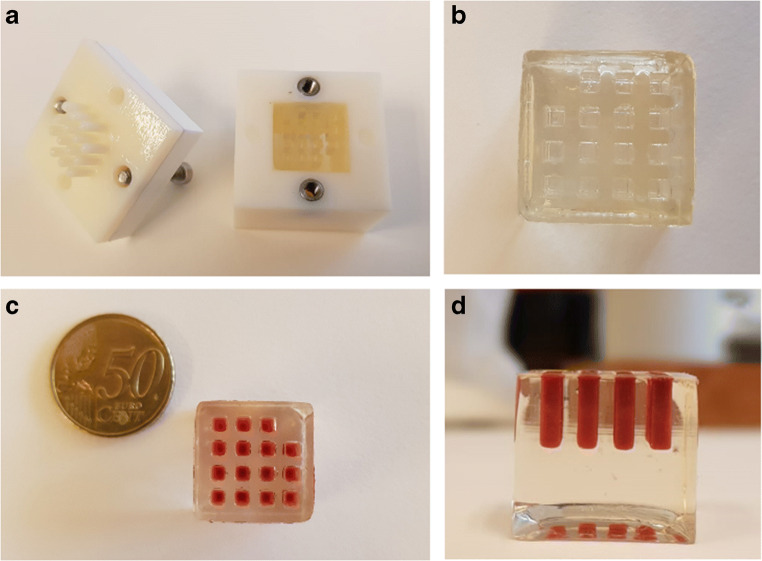
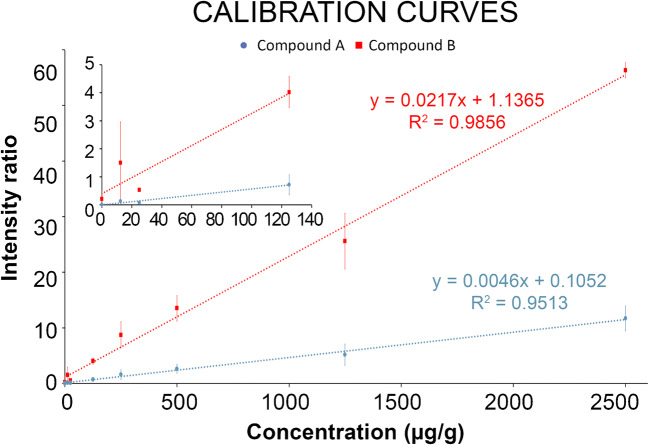
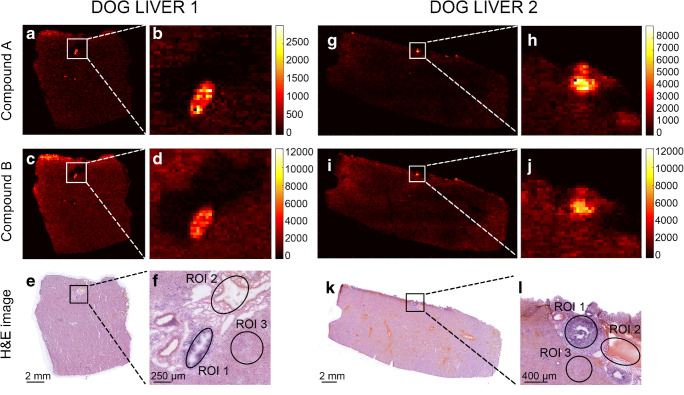
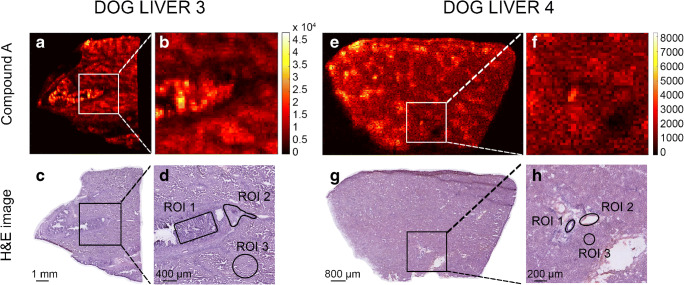
Mass spectrometry imaging (MSI) provides insight into the molecular distribution of a broad range of compounds and, therefore, is frequently applied in the pharmaceutical industry. Pharmacokinetic and toxicological studies deploy MSI to localize potential drugs and their metabolites in biological tissues but currently require other analytical tools to quantify these pharmaceutical compounds in the same tissues. Quantitative mass spectrometry imaging (Q-MSI) is a field with challenges due to the high biological variability in samples combined with the limited sample cleanup and separation strategies available prior to MSI. In consequence, more selectivity in MSI instruments is required. This can be provided by multiple reaction monitoring (MRM) which uses specific precursor ion-product ion transitions. This targeted approach is in particular suitable for pharmaceutical compounds because their molecular identity is known prior to analysis. In this work, we compared different analytical platforms to assess the performance of MRM detection compared to other MS instruments/MS modes used in a Q-MSI workflow for two drug candidates (A and B). Limit of detection (LOD), linearity, and precision and accuracy of high and low quality control (QC) samples were compared between MS instruments/modes. MRM mode on a triple quadrupole mass spectrometer (QqQ) provided the best overall performance with the following results for compounds A and B: LOD 35.5 and 2.5 μg/g tissue, R 0.97 and 0.98 linearity, relative standard deviation QC <13.6%, and 97-112% accuracy. Other MS modes resulted in LOD 6.7-569.4 and 2.6-119.1 μg/g tissue, R 0.86-0.98 and 0.86-0.98 linearity, relative standard deviation QC < 19.4 and < 37.5%, and 70-356% and 64-398% accuracy for drug candidates A and B, respectively. In addition, we propose an optimized 3D printed mimetic tissue model to increase the overall analytical throughput of our approach for large animal studies. The MRM imaging platform was applied as proof-of-principle for quantitative detection of drug candidates A and B in four dog livers and compared to LC-MS. The Q-MSI concentrations differed <3.5 times with the concentrations observed by LC-MS. Our presented MRM-based Q-MSI approach provides a more selective and high-throughput analytical platform due to MRM specificity combined with an optimized 3D printed mimetic tissue model.
质谱成像(MSI)提供了对广泛化合物的分子分布的深入了解,因此经常应用于制药行业。药代动力学和毒理学研究利用 MSI 来定位生物组织中的潜在药物及其代谢物,但目前需要其他分析工具来定量同一组织中的这些药物化合物。定量质谱成像(Q-MSI)是一个具有挑战性的领域,因为样品中存在高度的生物学变异性,并且在进行 MSI 之前可用的样品净化和分离策略有限。因此,MSI 仪器需要更高的选择性。这可以通过多反应监测(MRM)来提供,MRM 利用特定的前体离子-产物离子转换。这种靶向方法特别适用于药物化合物,因为在分析之前就知道它们的分子身份。在这项工作中,我们比较了不同的分析平台,以评估 MRM 检测与 Q-MSI 工作流程中用于两种候选药物(A 和 B)的其他 MS 仪器/模式的性能。在 MS 仪器/模式之间比较了高、低质控(QC)样品的检测限(LOD)、线性度、精密度和准确度。三重四极杆质谱仪(QqQ)上的 MRM 模式提供了最佳的整体性能,对于化合物 A 和 B ,结果如下:LOD 为 35.5 和 2.5 μg/g 组织,线性度 R 为 0.97 和 0.98,相对标准偏差 QC <13.6%,准确度为 97-112%。其他 MS 模式的 LOD 为 6.7-569.4 和 2.6-119.1 μg/g 组织,线性度 R 为 0.86-0.98 和 0.86-0.98,相对标准偏差 QC <19.4% 和 <37.5%,准确度为 70-356%和 64-398%,分别为候选药物 A 和 B。此外,我们提出了一种优化的 3D 打印仿生组织模型,以提高我们的方法在大型动物研究中的整体分析通量。MRM 成像平台被应用于定量检测四种狗肝中的候选药物 A 和 B,并与 LC-MS 进行了比较。Q-MSI 浓度与 LC-MS 观察到的浓度相差<3.5 倍。我们提出的基于 MRM 的 Q-MSI 方法由于 MRM 的特异性与优化的 3D 打印仿生组织模型相结合,提供了一种更具选择性和高通量的分析平台。