Department of Pediatrics, Kiang Wu Hospital, Macao SAR, China.
State Key Laboratory of Quality Research in Chinese Medicine, Institute of Chinese Medical Sciences, University of Macau, Macao SAR, China.
BMC Infect Dis. 2021 Mar 26;21(1):306. doi: 10.1186/s12879-021-05996-x.
Acute respiratory infections (ARIs) are among the leading causes of hospitalization in children. Understanding the local dominant viral etiologies is important to inform infection control practices and clinical management. This study aimed to investigate the viral etiology and epidemiology of respiratory infections among pediatric inpatients in Macao.
A retrospective study using electronic health records between 2014 and 2017 at Kiang Wu Hospital was performed. Nasopharyngeal swab specimens were obtained from hospitalized children aged 13 years or younger with respiratory tract diseases. xMAP multiplex assays were employed to detect respiratory agents including 10 respiratory viruses. Data were analyzed to describe the frequency and seasonality.
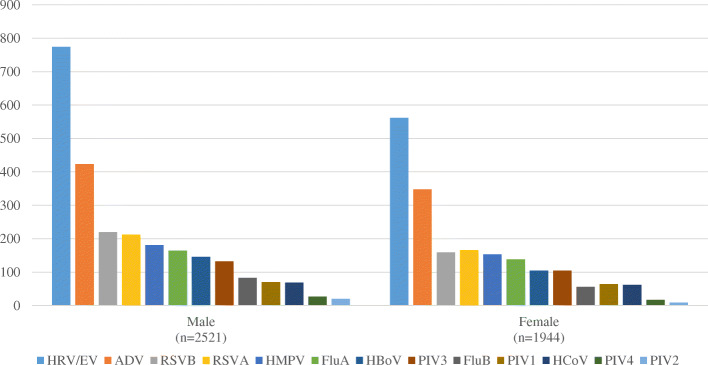
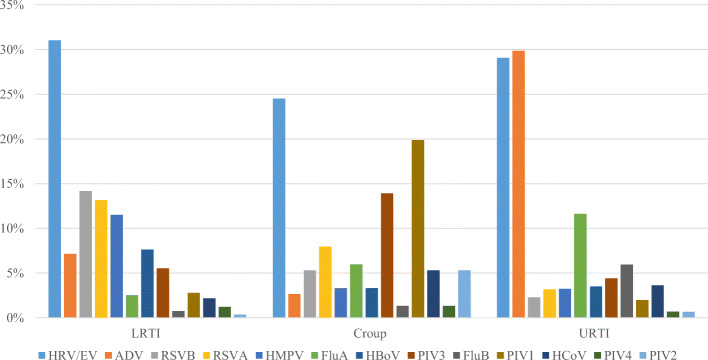
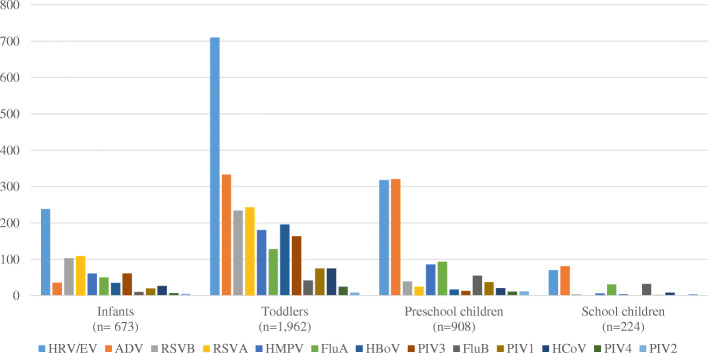
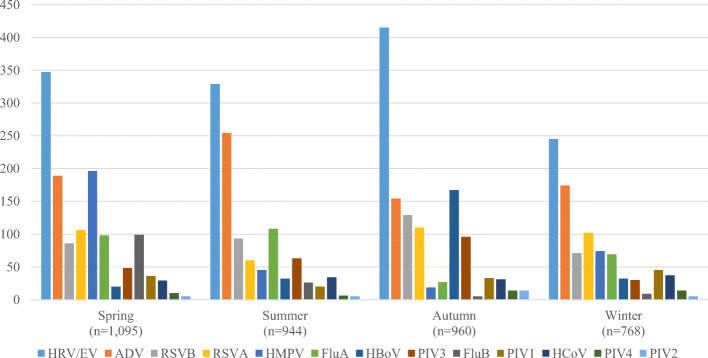
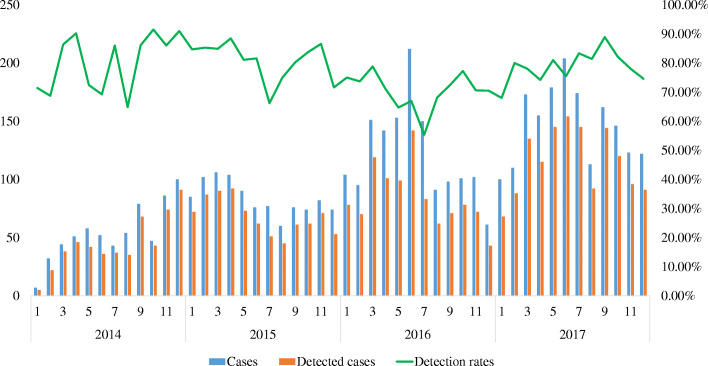
Of the 4880 children enrolled in the study, 3767 (77.1%) were positive for at least one of the 13 viral pathogens tested, of which 2707 (55.5%) being male and 2635 (70.0%) under 2 years old. Among the positive results, there were 3091 (82.0%) single infections and 676 (18.0%) multiple infections. The predominant viruses included human rhinovirus/enterovirus (HRV/EV 27.4%), adenovirus (ADV, 15.8%), respiratory syncytial virus B (RSVB, 7.8%) and respiratory syncytial virus A (RSVA, 7.8%). The detection of viral infection was the most prevalent in autumn (960/1176, 81.6%), followed by spring (1095/1406, 77.9%), winter (768/992, 77.4%), and summer (944/1306, 72.3%), with HRV/EV and ADV being most commonly detected throughout the 4 years of study period. The detection rate of viral infection was highest among ARI patients presented with croup (123/141, 87.2%), followed by lower respiratory tract infection (1924/2356, 81.7%) and upper respiratory tract infection (1720/2383, 72.2%). FluA, FluB and ADV were positive factors for upper respiratory tract infections. On the other hand, infection with RSVA, RSVB, PIV3, PIV4, HMPV, and EV/RHV were positively associated with lower respiratory tract infections; and PIV1, PIV2, and PIV3 were positively associated with croup.
This is the first study in Macao to determine the viral etiology and epidemiology of pediatric patients hospitalized for ARIs. The study findings can contribute to the awareness of pathogen, appropriate preventative measure, accurate diagnosis, and proper clinical management of respiratory viral infections among children in Macao.
急性呼吸道感染(ARI)是导致儿童住院的主要原因之一。了解当地主要的病毒病因对于告知感染控制措施和临床管理非常重要。本研究旨在调查澳门儿科住院患者呼吸道感染的病毒病因和流行病学。
对 2014 年至 2017 年在澳门科大医院进行的电子病历进行回顾性研究。对年龄在 13 岁或以下、有呼吸道疾病的住院儿童采集鼻咽拭子标本。采用 xMAP 多重检测法检测包括 10 种呼吸道病毒在内的呼吸道病原体。对数据进行分析以描述频率和季节性。
在纳入研究的 4880 名儿童中,有 3767 名(77.1%)至少检测到 13 种病毒病原体中的一种,其中 2707 名(55.5%)为男性,2635 名(70.0%)年龄在 2 岁以下。在阳性结果中,有 3091 名(82.0%)为单一感染,676 名(18.0%)为多重感染。主要病毒包括人鼻病毒/肠道病毒(HRV/EV 27.4%)、腺病毒(ADV,15.8%)、呼吸道合胞病毒 B(RSVB,7.8%)和呼吸道合胞病毒 A(RSVA,7.8%)。病毒感染的检出率在秋季(1176 例中的 960 例,81.6%)最高,其次是春季(1406 例中的 1095 例,77.9%)、冬季(992 例中的 768 例,77.4%)和夏季(1306 例中的 944 例,72.3%),在整个 4 年的研究期间,HRV/EV 和 ADV 最为常见。在因哮吼就诊的 ARI 患者中,病毒感染的检出率最高(141 例中的 123 例,87.2%),其次是下呼吸道感染(2356 例中的 1924 例,81.7%)和上呼吸道感染(2383 例中的 1720 例,72.2%)。流感 A、流感 B 和 ADV 是上呼吸道感染的阳性因素。另一方面,RSVA、RSVB、PIV3、PIV4、HMPV 和 EV/RHV 感染与下呼吸道感染呈正相关;而 PIV1、PIV2 和 PIV3 与哮吼呈正相关。
这是澳门首例确定儿科住院患者因 ARI 而感染的病毒病因和流行病学的研究。研究结果有助于提高对澳门儿童呼吸道病毒感染的病原体、适当预防措施、准确诊断和适当临床管理的认识。