Herrod Scott K, Stevenson Alex, Vaucher Yvonne E, Lambert Scott R, Isenberg Sherwin J, Yap Vivien L, Ezeaka V Chinyere, Carlo Waldemar A
Brigham Young University, Provo, UT, USA.
University of Zimbabwe, Harare, Zimbabwe.
J Perinatol. 2021 Nov;41(11):2631-2638. doi: 10.1038/s41372-021-01040-7. Epub 2021 Mar 26.
To provide more comprehensive data on the management of oxygen supplementation in neonates in sub-Saharan Africa.
An online survey on the management of oxygen supplementation for infants in neonatal units was sent to 278 healthcare personnel in sub-Saharan Africa.
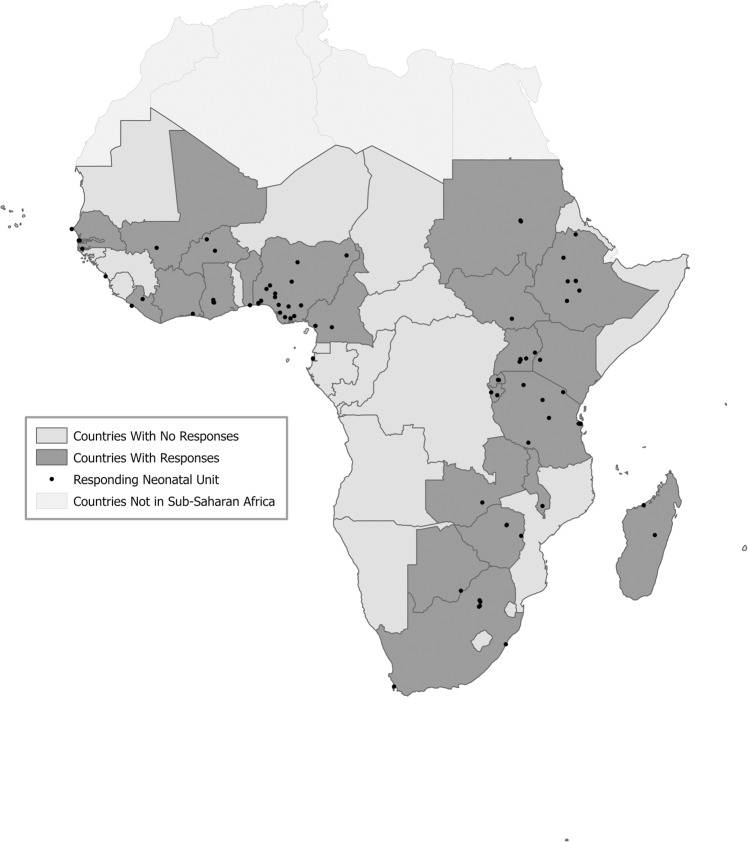
One hundred and nine responses from 82 neonatal care units in 54% (26/48) sub-Saharan African countries were received. All units had the capacity to provide oxygen supplementation. However, only 50% (38/76) had access to blend oxygen with medical air and 1% (1/75) had the capacity to blend oxygen/air for every infant. Although 96% (72/75) of units could monitor oxygen saturation, monitoring was mostly intermittent and only 32% (24/75) were able to monitor oxygen saturation in every infant receiving oxygen supplementation.
Findings indicate that oxygen supplementation is inadequately managed in neonatal units in sub-Saharan Africa, which may put infants at risk of developing severe ROP.
提供关于撒哈拉以南非洲地区新生儿氧疗管理更全面的数据。
向撒哈拉以南非洲地区的278名医护人员发送了一份关于新生儿病房婴儿氧疗管理的在线调查问卷。
收到了来自撒哈拉以南非洲54%(26/48)国家的82个新生儿护理单位的109份回复。所有单位都有提供氧疗的能力。然而,只有50%(38/76)的单位能够将氧气与医用空气混合,1%(1/75)的单位有能力为每个婴儿混合氧气/空气。尽管96%(72/75)的单位能够监测血氧饱和度,但监测大多是间歇性的,只有32%(24/75)的单位能够为每个接受氧疗的婴儿监测血氧饱和度。
研究结果表明,撒哈拉以南非洲地区新生儿病房的氧疗管理不足,这可能使婴儿面临发生严重视网膜病变的风险。