Graduate Training Centre of Neuroscience, University of Tübingen, Tübingen, Germany.
Donders Institute for Brain, Cognition, and Behaviour, Radboud University, Nijmegen, The Netherlands.
Eur J Neurosci. 2022 Jun;55(11-12):3352-3364. doi: 10.1111/ejn.15208. Epub 2021 May 4.
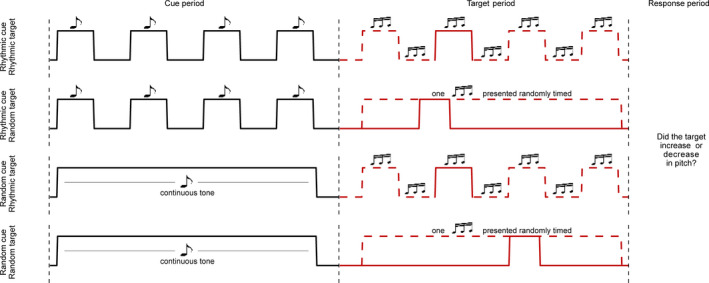
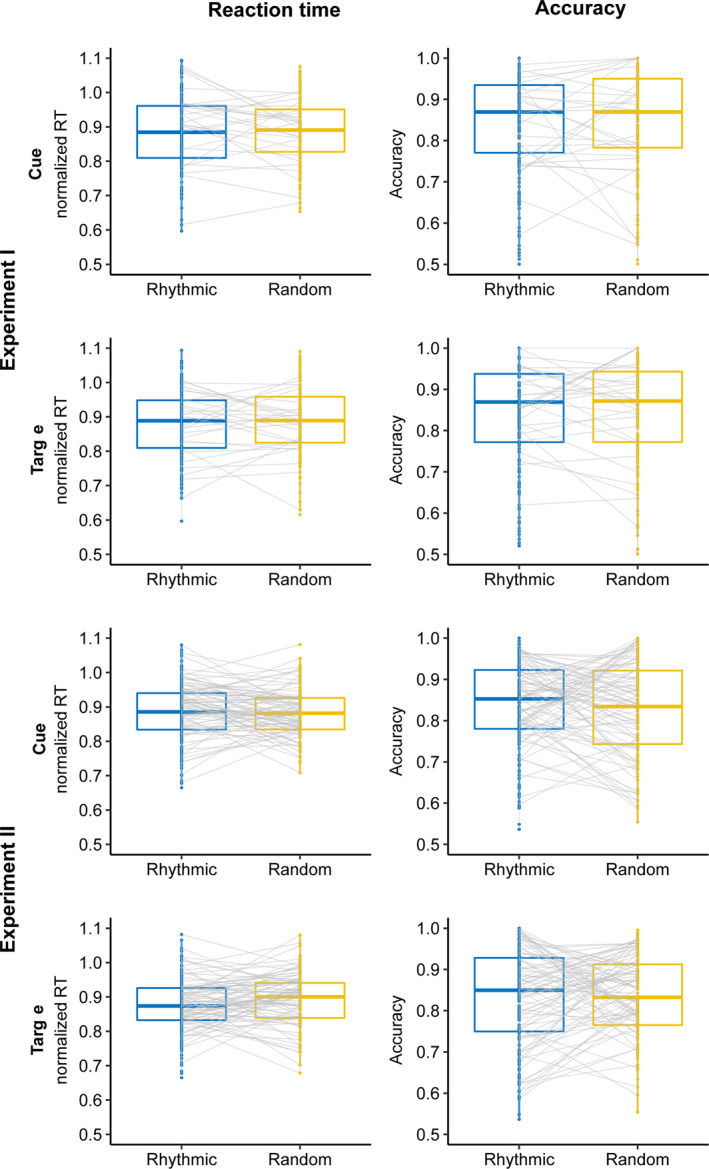
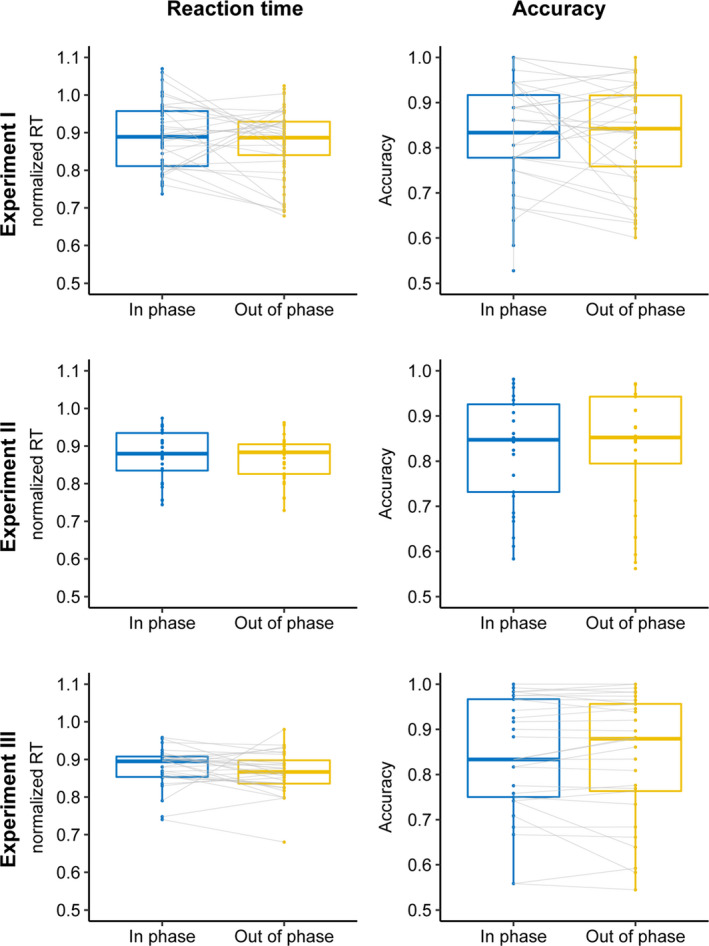
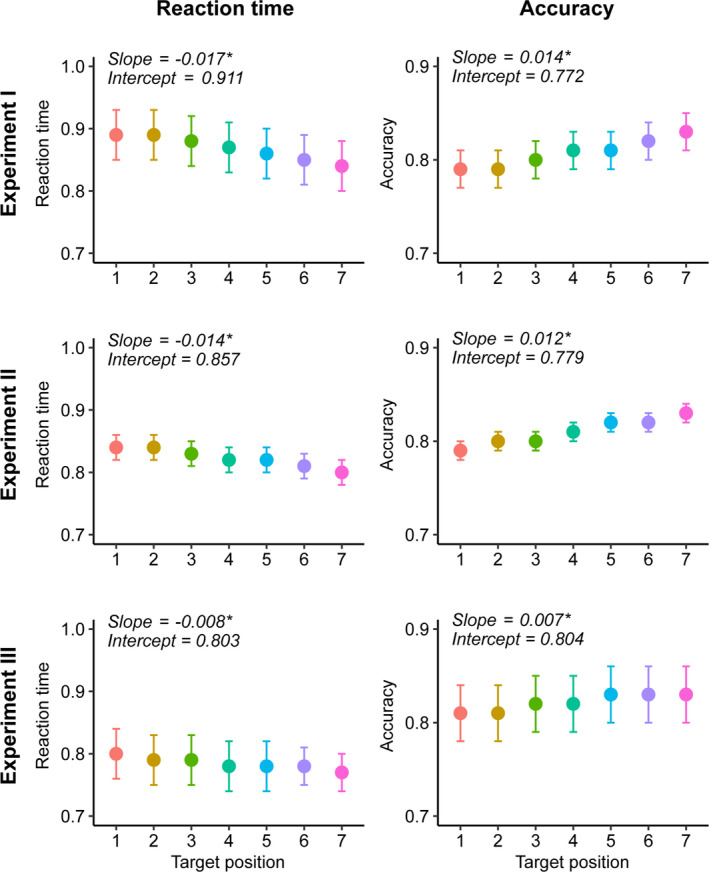
It has been hypothesized that internal oscillations can synchronize (i.e., entrain) to external environmental rhythms, thereby facilitating perception and behaviour. To date, evidence for the link between the phase of neural oscillations and behaviour has been scarce and contradictory; moreover, it remains an open question whether the brain can use this tentative mechanism for active temporal prediction. In our present study, we conducted a series of auditory pitch discrimination tasks with 181 healthy participants in an effort to shed light on the proposed behavioural benefits of rhythmic cueing and entrainment. In the three versions of our task, we observed no perceptual benefit of purported entrainment: targets occurring in-phase with a rhythmic cue provided no perceptual benefits in terms of discrimination accuracy or reaction time when compared with targets occurring out-of-phase or targets occurring randomly, nor did we find performance differences for targets preceded by rhythmic versus random cues. However, we found a surprising effect of cueing frequency on reaction time, in which participants showed faster responses to cue rhythms presented at higher frequencies. We therefore provide no evidence of entrainment, but instead a tentative effect of covert active sensing in which a faster external rhythm leads to a faster communication rate between motor and sensory cortices, allowing for sensory inputs to be sampled earlier in time.
有人假设内部振荡可以与外部环境节律同步(即,跟随),从而促进感知和行为。迄今为止,关于神经振荡相位与行为之间联系的证据还很少且相互矛盾;此外,大脑是否可以利用这种试探性的机制进行主动时间预测仍然是一个悬而未决的问题。在我们目前的研究中,我们对 181 名健康参与者进行了一系列听觉音高辨别任务,以努力阐明有节奏的提示和跟随所提出的行为益处。在我们任务的三个版本中,我们没有观察到所谓的跟随的感知益处:与目标在相位上同步的目标与目标在异相或随机出现时相比,在辨别准确性或反应时间方面没有提供任何感知益处,也没有发现目标在有节奏的 cue 之前的表现差异与随机 cue 相比。然而,我们发现 cue 频率对反应时间有一个惊人的影响,其中参与者对呈现的较高频率的 cue 节奏表现出更快的反应。因此,我们没有提供跟随的证据,而是提供了一种隐蔽主动感知的试探性效应的证据,其中更快的外部节奏导致运动和感觉皮层之间更快的通信速度,从而允许更早地对感觉输入进行采样。