O'Donnell Kyle L, Marzi Andrea
Laboratory of Virology, Division of Intramural Research, National Institute of Allergy and Infectious Diseases, National Institutes of Health, Hamilton, MT, USA.
Biologics. 2021 Mar 18;15:79-86. doi: 10.2147/BTT.S259069. eCollection 2021.
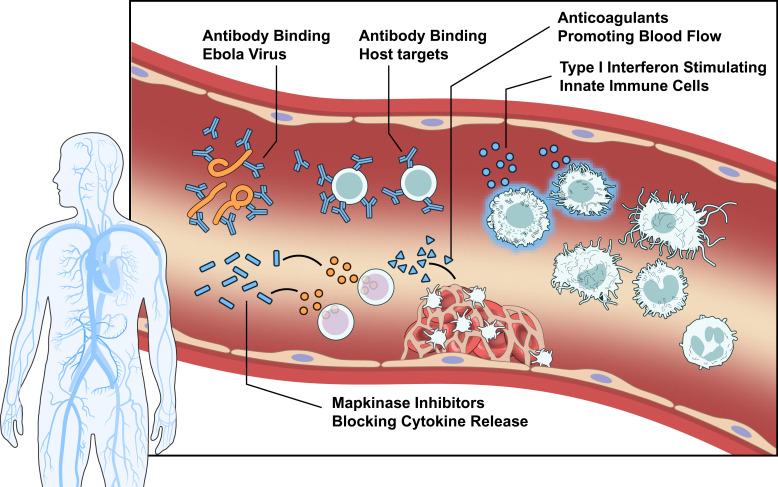
Ebola virus disease (EVD) remains among the biggest public health threats in Africa, even though recently a vaccine was approved for human use. However, in outbreak situations treatment strategies are needed in combination with vaccination campaigns to impact and stop the spread of the disease. Here, we discuss the development of the immunotherapeutics against EDV both targeting the virus itself and bolstering the immunological environment of the host at both the pre-clinical and clinical level. The early development of antibody therapy in preclinical settings and the early pitfalls in the implementation of this therapeutic strategy are discussed. We also consider the advancement of the production, modulation, and specificity of the antibody treatment that garnered increased success in preclinical studies to the point that it was warranted to test them in a clinical setting. Initial clinical trials in an outbreak scenario proved difficult to definitively confirm the efficacy of the implemented treatment. Upon further modification and with the experiences from the challenging outbreak conditions in mind, the PALM clinical trial demonstrated efficacy of an antibody cocktail which recently received approval for human use.
埃博拉病毒病(EVD)仍然是非洲最大的公共卫生威胁之一,尽管最近一种疫苗已被批准用于人类。然而,在疫情爆发情况下,需要结合疫苗接种运动采取治疗策略,以影响并阻止疾病传播。在此,我们讨论针对埃博拉病毒的免疫疗法的发展,这些疗法在临床前和临床水平上既针对病毒本身,也增强宿主的免疫环境。讨论了临床前环境中抗体疗法的早期发展以及该治疗策略实施过程中的早期陷阱。我们还考虑了抗体治疗在生产、调节和特异性方面的进展,这些进展在临床前研究中取得了更大成功,以至于有必要在临床环境中对其进行测试。在疫情爆发情况下进行的初步临床试验难以明确证实所实施治疗的疗效。在进一步改进并考虑到具有挑战性的疫情爆发情况所积累的经验后,PALM临床试验证明了一种抗体鸡尾酒疗法的疗效,该疗法最近已获得用于人类的批准。