Huet Antoine Tarquin, Dombrowski Tobias, Rankovic Vladan, Thirumalai Anupriya, Moser Tobias
Institute for Auditory Neuroscience and InnerEarLab, University Medical Center Göttingen, Göttingen, Germany.
Auditory Neuroscience and Optogenetics Laboratory, German Primate Center, Göttingen, Germany.
Front Mol Neurosci. 2021 Mar 11;14:635897. doi: 10.3389/fnmol.2021.635897. eCollection 2021.
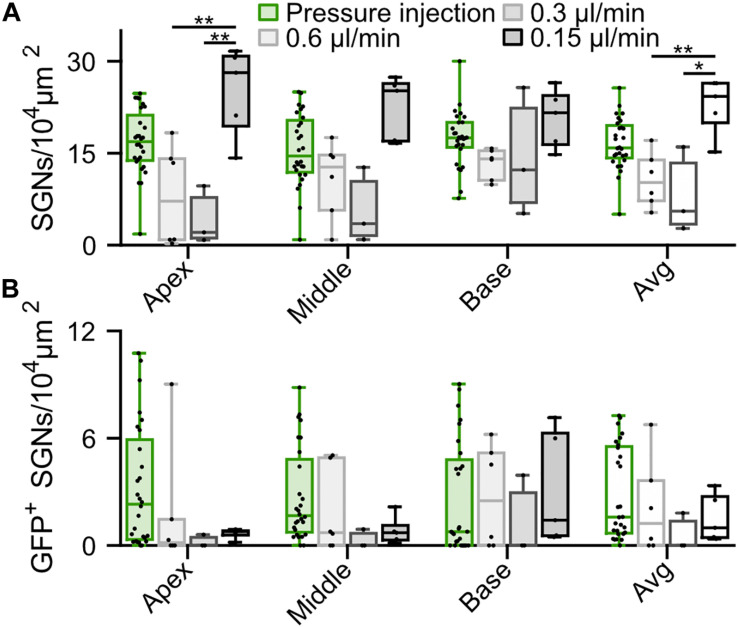
Optogenetic stimulation of type I spiral ganglion neurons (SGNs) promises an alternative to the electrical stimulation by current cochlear implants (CIs) for improved hearing restoration by future optical CIs (oCIs). Most of the efforts in using optogenetic stimulation in the cochlea so far used early postnatal injection of viral vectors carrying blue-light activated channelrhodopsins (ChRs) into the cochlea of mice. However, preparing clinical translation of the oCI requires () reliable and safe transduction of mature SGNs of further species and () use of long-wavelength light to avoid phototoxicity. Here, we employed a fast variant of the red-light activated channelrhodopsin Chrimson (f-Chrimson) and different AAV variants to implement optogenetic SGN stimulation in Mongolian gerbils. We compared early postnatal (p8) and adult (>8 weeks) AAV administration, employing different protocols for injection of AAV-PHP.B and AAV2/6 into the adult cochlea. Success of the optogenetic manipulation was analyzed by optically evoked auditory brainstem response (oABR) and immunohistochemistry of mid-modiolar cryosections of the cochlea. In order to most efficiently evaluate the immunohistochemical results a semi-automatic procedure to identify transduced cells in confocal images was developed. Our results indicate that the rate of SGN transduction is significantly lower for AAV administration into the adult cochlea compared to early postnatal injection. SGN transduction upon AAV administration into the adult cochlea was largely independent of the chosen viral vector and injection approach. The higher the rate of SGN transduction, the lower were oABR thresholds and the larger were oABR amplitudes. Our results highlight the need to optimize viral vectors and virus administration for efficient optogenetic manipulation of SGNs in the adult cochlea for successful clinical translation of SGN-targeting gene therapy and of the oCI.
对I型螺旋神经节神经元(SGNs)进行光遗传学刺激有望成为当前人工耳蜗(CIs)电刺激的替代方法,以便未来的光学人工耳蜗(oCIs)能更好地恢复听力。迄今为止,大多数在耳蜗中使用光遗传学刺激的研究都采用在出生后早期将携带蓝光激活的通道视紫红质(ChRs)的病毒载体注射到小鼠耳蜗中。然而,要将oCIs应用于临床,需要(1)对更多物种的成熟SGNs进行可靠且安全的转导,以及(2)使用长波长光以避免光毒性。在此,我们采用了红光激活的通道视紫红质Chrimson的快速变体(f-Chrimson)和不同的腺相关病毒(AAV)变体,在蒙古沙鼠中实现对SGNs的光遗传学刺激。我们比较了出生后早期(p8)和成年(>8周)时AAV的给药情况,采用不同方案将AAV-PHP.B和AAV2/6注射到成年沙鼠的耳蜗中。通过光学诱发听觉脑干反应(oABR)和耳蜗中膜蜗管冰冻切片的免疫组织化学分析光遗传学操作的成功与否。为了最有效地评估免疫组织化学结果,我们开发了一种半自动程序来识别共聚焦图像中的转导细胞。我们的结果表明,与出生后早期注射相比,将AAV注射到成年耳蜗中时,SGNs的转导率显著降低。将AAV注射到成年耳蜗后,SGNs的转导在很大程度上与所选的病毒载体和注射方法无关。SGNs的转导率越高,oABR阈值越低,oABR振幅越大。我们的结果凸显了优化病毒载体和病毒给药方式的必要性,以便在成年耳蜗中对SGNs进行有效的光遗传学操作,从而成功实现针对SGNs的基因治疗和oCIs的临床应用。