Department of Gastroenterology, Institute of Liver and Gastrointestinal Diseases, Hubei Key Laboratory of Hepato-Pancreato-Biliary Diseases, Tongji Hospital of Tongji Medical College, Huazhong University of Science and Technology, Wuhan, China.
Front Endocrinol (Lausanne). 2021 Mar 11;12:620566. doi: 10.3389/fendo.2021.620566. eCollection 2021.
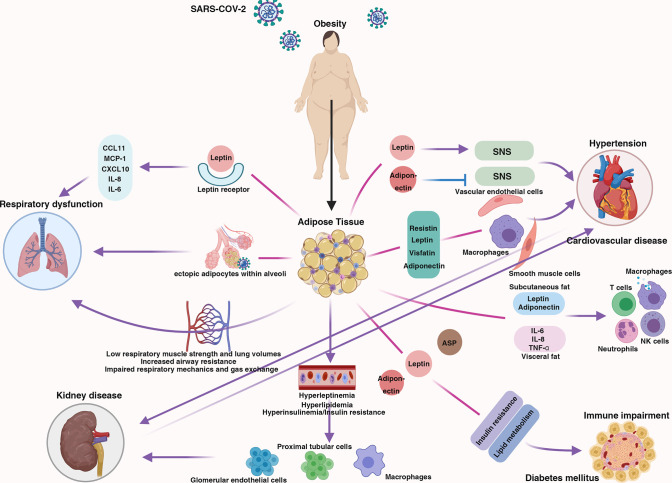
The ongoing coronavirus disease 2019 (COVID-19) pandemic caused by the novel severe acute respiratory syndrome coronavirus 2 (SARS-CoV-2) has become a global public health challenge. Most patients do not experience severe complications, but approximately 25% of patients progress to acute respiratory distress syndrome (ARDS), and the mortality rate is approximately 5-7%. Clinical findings have determined several risk factors for severe complications and mortality in COVID-19 patients, such as advanced age, smoking, obesity, and chronic diseases. Obesity is a common and serious health problem worldwide that initiates a cascade of disorders, including hypertension, cardiovascular disease (CVD), diabetes mellitus, and chronic kidney disease (CKD). The presence of these disorders is linked to a more severe course of COVID-19. Given the "epidemic" of obesity worldwide and the importance of obesity in the progression of COVID-19, we investigated the mechanisms through which obesity increases the susceptibility to and severity of COVID-19 to support the selection of more appropriate therapies for individuals with obesity.
由新型严重急性呼吸综合征冠状病毒 2 (SARS-CoV-2) 引起的持续的 2019 年冠状病毒病 (COVID-19) 大流行已成为全球公共卫生挑战。大多数患者不会出现严重并发症,但约 25%的患者进展为急性呼吸窘迫综合征 (ARDS),死亡率约为 5-7%。临床研究确定了 COVID-19 患者发生严重并发症和死亡的几个危险因素,如年龄较大、吸烟、肥胖和慢性疾病。肥胖是全球范围内常见且严重的健康问题,会引发一系列疾病,包括高血压、心血管疾病 (CVD)、糖尿病和慢性肾脏病 (CKD)。这些疾病的存在与 COVID-19 更严重的病程有关。鉴于全球肥胖“流行”以及肥胖在 COVID-19 进展中的重要性,我们研究了肥胖增加 COVID-19 易感性和严重程度的机制,以支持为肥胖个体选择更合适的治疗方法。