Rangani Gulab, Noguera Matheus, Salas-Perez Reiofeli, Benedetti Lariza, Roma-Burgos Nilda
Department of Crop, Soil and Environmental Sciences, University of Arkansas, Fayetteville, AR, United States.
Crop Protection Graduate Program (Programa de Pós-Graduação em Fitossanidade), Federal University of Pelotas (Universidade Federal de Pelotas), Pelotas, Brazil.
Front Plant Sci. 2021 Mar 12;12:652581. doi: 10.3389/fpls.2021.652581. eCollection 2021.
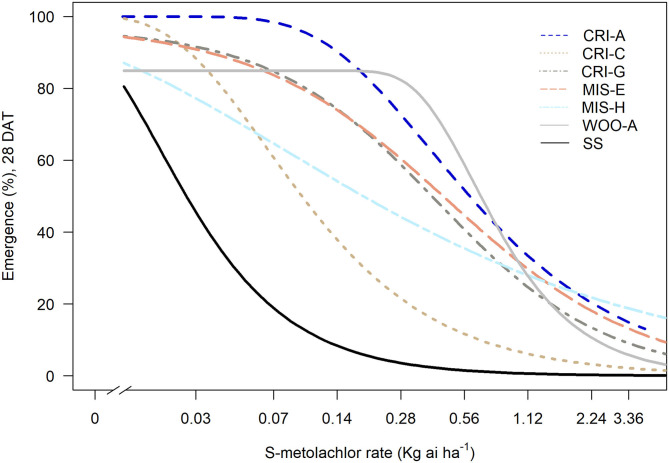
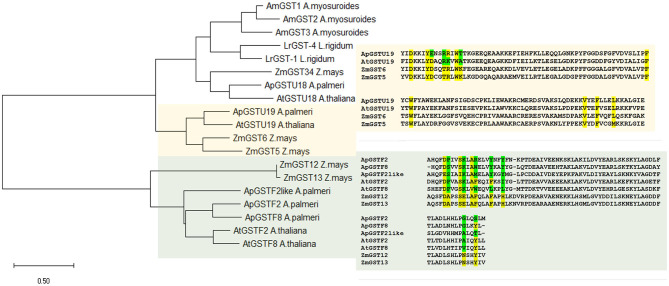
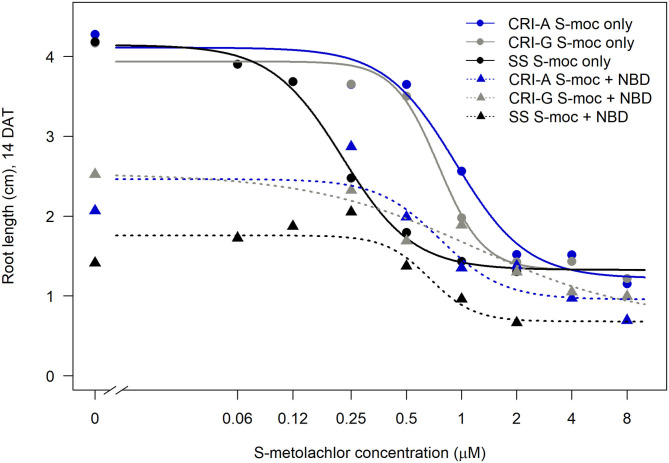
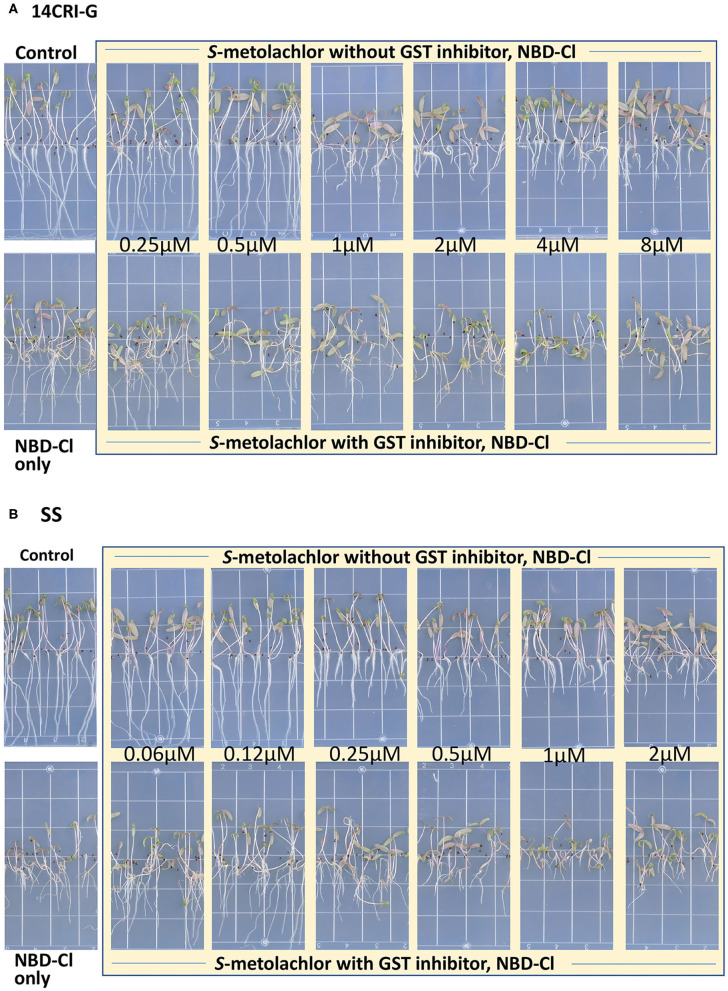
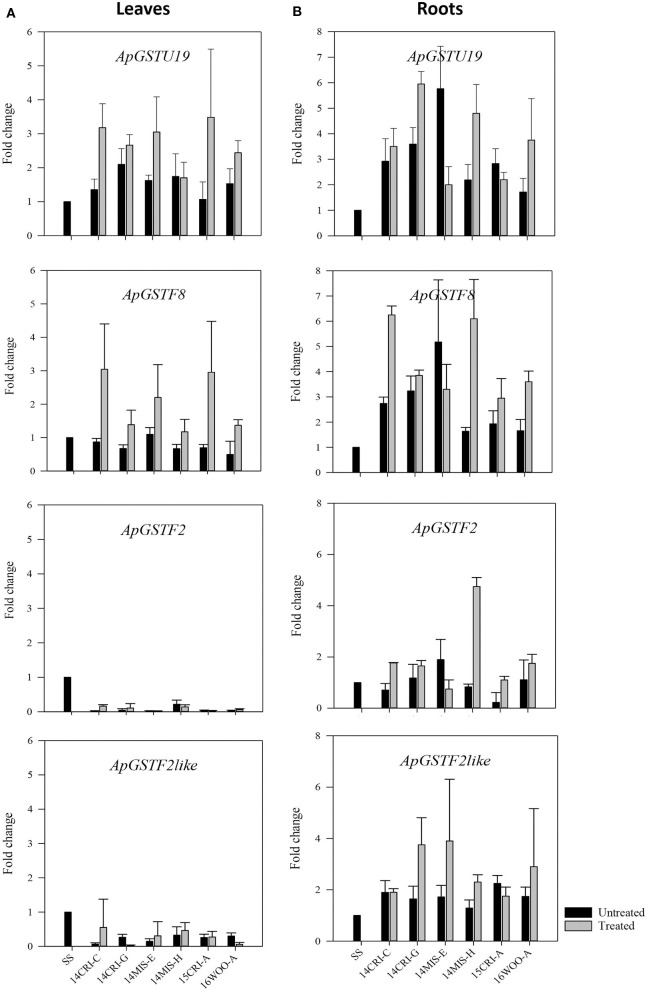
Herbicides are major tools for effective weed management. The evolution of resistance to herbicides in weedy species, especially contributed by non-target-site-based resistance (NTSR) is a worrisome issue in crop production globally. Glyphosate-resistant Palmer amaranth () is one of the extremely difficult weeds in southern US crop production. In this study, we present the level and molecular basis of resistance to the chloroacetamide herbicide, -metolachlor, in six field-evolved populations that had survivors at the recommended field-dose (1.1 kg ai ha). These samples were collected in 2014 and 2015. The level of resistance was determined in dose-response assays. The effective dose for 50% control (ED) of the susceptible population was 27 g ai ha, whereas the ED of the resistant populations ranged from 88 to 785 g ai ha. Therefore, resistance to -metolachlor evolved in Arkansas as early as 2014. Metabolic-inhibitor and molecular assays indicated NTSR in these populations, mainly driven by GSTs. To understand the mechanism of resistance, selected candidate genes were analyzed in leaves and roots of survivors (with 1 × -metolachlor). Expression analysis of the candidate genes showed that the primary site of -metolachlor detoxification in is in the roots. Two genes, and were constitutively highly expressed in roots of all plants across all resistant populations tested. The expression of both s increased further in survivors after treatment with -metolachlor. The induction level of and by -metolachlor differed among resistant populations. Overall, higher expression of , and , which would lead to higher GST activity in roots, was strongly associated with the resistant phenotype. Phylogenetic relationship and analysis of substrate binding site of candidate genes suggested functional similarities with known metolachlor-detoxifying GSTs, effecting metabolic resistance to -metolachlor in . Resistance is achieved by elevated baseline expression of these genes and further induction by -metolachlor in resistant plants.
除草剂是有效进行杂草治理的主要工具。杂草物种对除草剂产生抗性的进化,尤其是由非靶标位点抗性(NTSR)导致的抗性进化,是全球作物生产中一个令人担忧的问题。抗草甘膦的糙果苋是美国南部作物生产中极难防治的杂草之一。在本研究中,我们展示了6个田间进化的糙果苋种群对氯乙酰胺类除草剂异丙甲草胺的抗性水平及分子基础,这些种群在推荐田间剂量(1.1千克有效成分/公顷)下仍有存活植株。这些样本于2014年和2015年采集。通过剂量反应试验确定抗性水平。敏感种群的50%控制有效剂量(ED50)为27克有效成分/公顷,而抗性种群的ED50范围为88至785克有效成分/公顷。因此,早在2014年阿肯色州就出现了对异丙甲草胺的抗性。代谢抑制剂和分子试验表明这些种群存在NTSR,主要由谷胱甘肽S-转移酶(GSTs)驱动。为了解抗性机制,对存活植株(用1×异丙甲草胺处理)的叶片和根系中的候选基因进行了分析。候选基因的表达分析表明,糙果苋中异丙甲草胺解毒的主要部位在根部。两个GST基因GSTU19和GSTU24在所有测试抗性种群的所有植株根部均组成性高表达。用异丙甲草胺处理后,存活植株中这两个基因的表达进一步增加。异丙甲草胺对GSTU19和GSTU24的诱导水平在不同抗性种群中有所不同。总体而言,GSTU19、GSTU24和GSTU25的较高表达会导致根部GST活性更高,这与抗性表型密切相关。候选基因的系统发育关系和底物结合位点分析表明,它们与已知的异丙甲草胺解毒GSTs功能相似,导致糙果苋对异丙甲草胺产生代谢抗性。抗性是通过这些基因的基础表达升高以及抗性植株中异丙甲草胺的进一步诱导实现的。