Gao Guangliang, Gao Dengfeng, Zhao Xianzhi, Xu Songsong, Zhang Keshan, Wu Rui, Yin Chunhui, Li Jing, Xie Youhui, Hu Silu, Wang Qigui
Institute of Poultry Science, Chongqing Academy of Animal Science, Chongqing, China.
Institute of Animal Genetics and Breeding, College of Animal Science and Technology, Sichuan Agricultural University, Chengdu, China.
Front Genet. 2021 Mar 12;12:602583. doi: 10.3389/fgene.2021.602583. eCollection 2021.
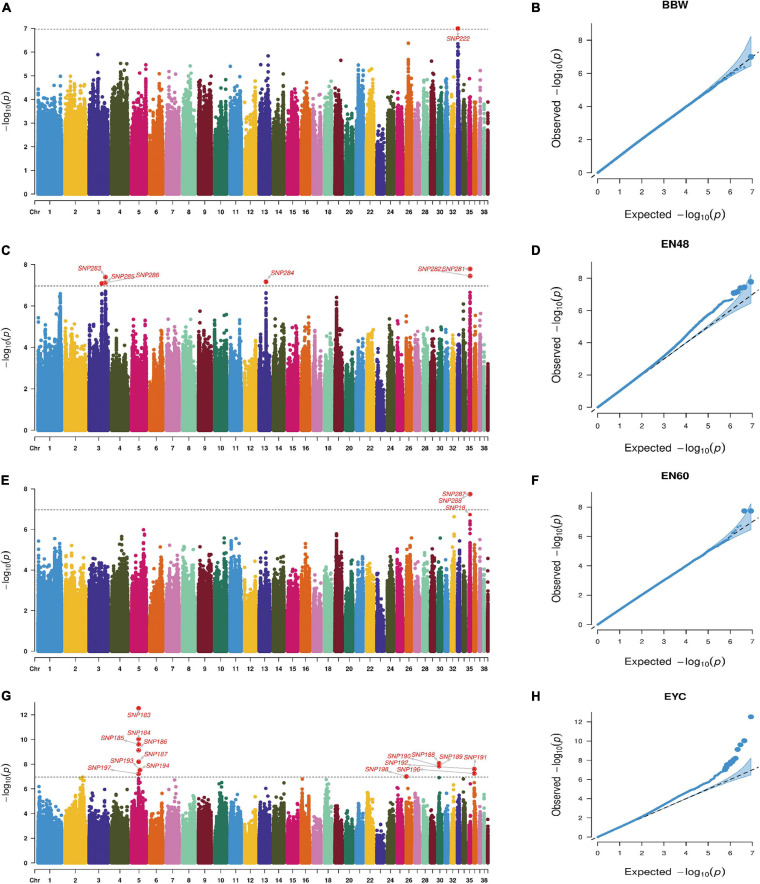
Geese are one of the most economically important waterfowl. However, the low reproductive performance and egg quality of geese hinder the development of the goose industry. The identification and application of genetic markers may improve the accuracy of beneficial trait selection. To identify the genetic markers associated with goose reproductive performance and egg quality traits, we performed a genome-wide association study (GWAS) for body weight at birth (BBW), the number of eggs at 48 weeks of age (EN48), the number of eggs at 60 weeks of age (EN60) and egg yolk color (EYC). The GWAS acquired 2.896 Tb of raw sequencing data with an average depth of 12.44× and identified 9,279,339 SNPs. The results of GWAS showed that 26 SNPs were significantly associated with BBW, EN48, EN60, and EYC. Moreover, five of these SNPs significantly associated with EN48 and EN60 were in a haplotype block on chromosome 35 from 4,512,855 to 4,541,709 bp, oriented to and another five SNPs significantly correlated to EYC were constructed in haplotype block on chromosome 5 from 21,069,009 to 21,363,580, which annotated by , , , and . Those genes were enriched in epidermal growth factor-activated receptor activity, regulation of epidermal growth factor receptor signaling pathway. The SNPs, haplotype markers, and candidate genes identified in this study can be used to improve the accuracy of marker-assisted selection for the reproductive performance and egg quality traits of geese. In addition, the candidate genes significantly associated with these traits may provide a foundation for better understanding the mechanisms underlying reproduction and egg quality in geese.
鹅是经济价值最重要的水禽之一。然而,鹅的低繁殖性能和蛋品质阻碍了鹅产业的发展。遗传标记的鉴定和应用可能会提高有益性状选择的准确性。为了鉴定与鹅繁殖性能和蛋品质性状相关的遗传标记,我们针对出生体重(BBW)、48周龄产蛋数(EN48)、60周龄产蛋数(EN60)和蛋黄颜色(EYC)进行了全基因组关联研究(GWAS)。该GWAS获得了2.896Tb的原始测序数据,平均深度为12.44×,并鉴定出9,279,339个单核苷酸多态性(SNP)。GWAS结果显示,26个SNP与BBW、EN48、EN60和EYC显著相关。此外,其中5个与EN48和EN60显著相关的SNP位于35号染色体上4,512,855至4,541,709bp的单倍型块中,方向为 ,另外5个与EYC显著相关的SNP在5号染色体上21,069,009至21,363,580的单倍型块中构建,由 、 、 和 注释。这些基因富集于表皮生长因子激活受体活性、表皮生长因子受体信号通路的调控。本研究中鉴定出的SNP、单倍型标记和候选基因可用于提高鹅繁殖性能和蛋品质性状的标记辅助选择准确性。此外,与这些性状显著相关的候选基因可能为更好地理解鹅繁殖和蛋品质的潜在机制提供基础。