Sandu Raluca-Maria, Paolucci Iwan, Ruiter Simeon J S, Sznitman Raphael, de Jong Koert P, Freedman Jacob, Weber Stefan, Tinguely Pascale
ARTORG Center for Biomedical Engineering Research, University of Bern, Bern, Switzerland.
Department of Hepato-Pancreato-Biliary Surgery and Liver Transplantation, University Medical Center Groningen, Groningen, Netherlands.
Front Oncol. 2021 Mar 10;11:623098. doi: 10.3389/fonc.2021.623098. eCollection 2021.
In thermal ablation of liver tumors, complete coverage of the tumor volume by the ablation volume with a sufficient ablation margin is the most important factor for treatment success. Evaluation of ablation completeness is commonly performed by visual inspection in 2D and is prone to inter-reader variability. This work aimed to introduce a standardized approach for evaluation of ablation completeness after CT-guided thermal ablation of liver tumors, using volumetric quantitative ablation margins (QAM).
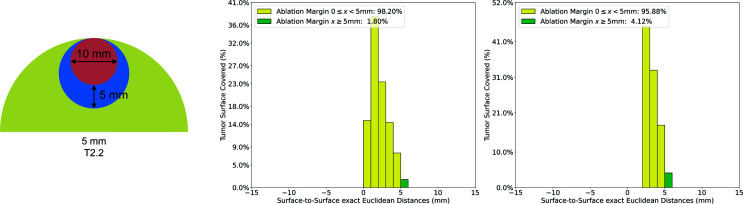
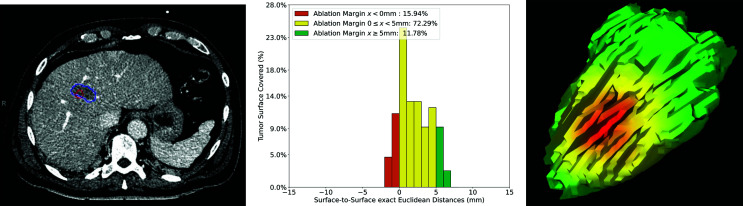
A QAM computation metric based on volumetric segmentations of tumor and ablation areas and signed Euclidean surface distance maps was developed, including a novel algorithm to address QAM computation in subcapsular tumors. The code for QAM computation was verified in artificial examples of tumor and ablation spheres simulating varying scenarios of ablation margins. The applicability of the QAM metric was investigated in representative cases extracted from a prospective database of colorectal liver metastases (CRLM) treated with stereotactic microwave ablation (SMWA).
Applicability of the proposed QAM metric was confirmed in artificial and clinical example cases. Numerical and visual options of data presentation displaying substrata of QAM distributions were proposed. For subcapsular tumors, the underestimation of tumor coverage by the ablation volume when applying an unadjusted QAM method was confirmed, supporting the benefits of using the proposed algorithm for QAM computation in these cases. The computational code for developed QAM was made publicly available, encouraging the use of a standard and objective metric in reporting ablation completeness and margins.
The proposed volumetric approach for QAM computation including a novel algorithm to address subcapsular liver tumors enables precision and reproducibility in the assessment of ablation margins. The quantitative feedback on ablation completeness opens possibilities for intra-operative decision making and for refined analyses on predictability and consistency of local tumor control after thermal ablation of liver tumors.
在肝脏肿瘤的热消融中,消融体积完全覆盖肿瘤体积并具有足够的消融边缘是治疗成功的最重要因素。消融完整性的评估通常通过二维视觉检查进行,容易出现不同阅片者之间的差异。本研究旨在引入一种标准化方法,使用体积定量消融边缘(QAM)来评估CT引导下肝脏肿瘤热消融后的消融完整性。
开发了一种基于肿瘤和消融区域的体积分割以及带符号欧几里得表面距离图的QAM计算指标,包括一种解决包膜下肿瘤QAM计算的新算法。QAM计算代码在模拟不同消融边缘情况的肿瘤和消融球体人工示例中得到验证。在从接受立体定向微波消融(SMWA)治疗的结直肠癌肝转移(CRLM)前瞻性数据库中提取的代表性病例中研究了QAM指标的适用性。
所提出的QAM指标在人工和临床示例病例中的适用性得到证实。提出了显示QAM分布底层的数据呈现的数值和视觉选项。对于包膜下肿瘤,证实了应用未调整的QAM方法时消融体积对肿瘤覆盖的低估,支持在这些情况下使用所提出的算法进行QAM计算的益处。所开发的QAM的计算代码已公开可用,鼓励在报告消融完整性和边缘时使用标准和客观的指标。
所提出的用于QAM计算的体积方法,包括一种解决包膜下肝脏肿瘤的新算法,能够在评估消融边缘时实现精确性和可重复性。关于消融完整性的定量反馈为术中决策以及对肝脏肿瘤热消融后局部肿瘤控制的可预测性和一致性进行精细分析开辟了可能性。